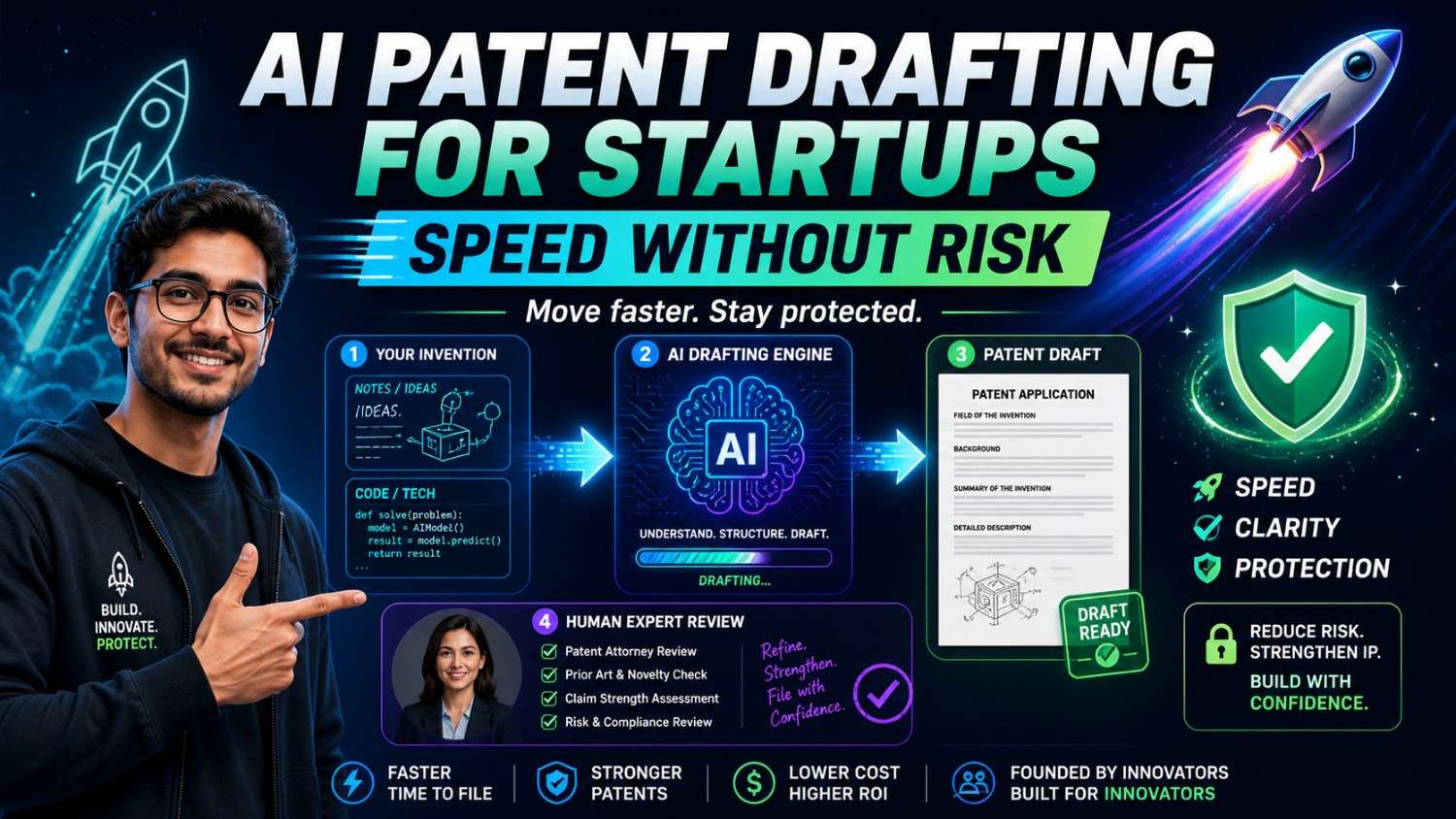
AI can help startups move faster with patents. But speed only helps when the draft is clear, correct, and safe to file.
This guide shows how founders can use AI for patent drafting without losing control, adding mistakes, or weakening the invention they worked so hard to build.
PowerPatent helps startups turn code, models, and technical ideas into stronger patent filings with smart software and real patent attorney oversight. You can see how it works here: https://powerpatent.com/how-it-works
Why startups are turning to AI for patent drafting
Startups move fast.
You build. You test. You ship. You raise money. You talk to customers. You change the product again.
Patents often feel too slow for that pace.
Traditional patent work can feel like a long chain of calls, notes, drafts, edits, and delays. For a founder, that can be painful. You may know your invention matters, but you may not have weeks to explain it again and again. You may also not want to spend a huge amount before you know how the product or market will grow.
AI changes the feel of the process.
It can help collect ideas. It can turn rough notes into a first draft. It can pull structure out of messy invention details. It can help compare versions. It can help find gaps. It can help make a long patent draft easier to review.
That is a big deal.
But AI does not remove risk by itself.
A fast draft can still be a weak draft. A clean-looking draft can still miss the real invention. A polished paragraph can still say something false. A claim can sound broad but fail to match the spec. A figure can show the wrong flow. A model description can include details your system does not use.
So the question is not, “Can AI draft patents?”
The better question is, “How can startups use AI to draft faster without creating hidden risk?”
That is where process matters.
AI should not replace judgment. It should support it.
AI should not guess your invention. It should help express it.
AI should not file on autopilot. It should work inside a system where founders, engineers, and patent attorneys each play the right role.
That is the safe path.
Speed is valuable only when the patent still protects the right thing
Speed matters for startups because timing matters.
You may need to file before a launch. You may need to file before a pitch. You may need to file before a demo day, partner meeting, paper, open-source release, or customer rollout.
When timing is tight, slow patent work can put you in a bad spot.
You may delay public work. You may rush a filing. You may skip patent protection. You may publish before you are ready. You may leave a core invention exposed.
AI can reduce that stress.
It can help you move from raw invention notes to a draft much faster. It can help your team see the invention in writing sooner. It can help attorneys review a better starting point instead of beginning from a blank page.
But speed must serve protection.
A patent draft should protect the thing that gives your startup an edge. That may be a model pipeline, a control method, a data structure, a robotics system, a chip design, a sensor process, a biotech workflow, a manufacturing method, or a software platform.
If AI drafts around the wrong thing, speed becomes a problem.
For example, say your startup built a new way to compress AI model updates on edge devices. If the AI draft spends most of its time describing a generic cloud dashboard, the draft may look full but miss the moat.
Or say your startup built a robot that chooses safer paths using a special risk score. If the AI draft turns that into “a robot with a camera and a map,” the heart of the invention may fade.
That is not safe.
A useful patent process starts with this question:
What is the real invention?
Not the product name.
Not the UI.
Not the marketing pitch.
The invention.
Once that is clear, AI can help move faster. Without that clarity, AI may produce volume instead of value.
PowerPatent is built to help founders move quickly while still focusing on what matters. The platform combines smart software with attorney oversight so the draft can move fast without drifting away from the real invention. See how it works here: https://powerpatent.com/how-it-works
The first risk: AI may invent details
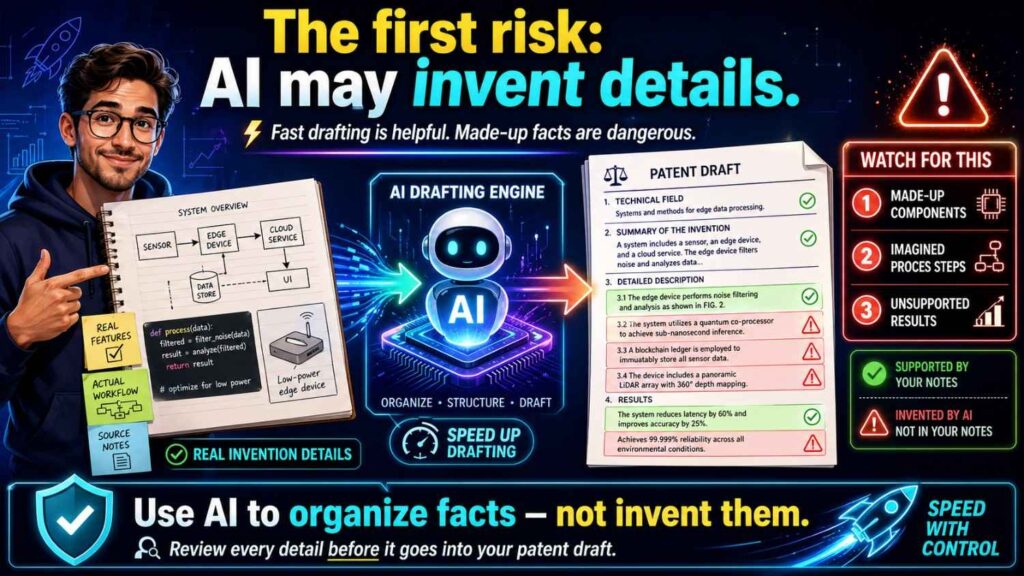
AI is very good at filling gaps.
That is useful when writing.
It is risky when drafting patents.
If your prompt says, “We use AI to detect machine failure,” the AI may add a cloud server, mobile app, admin dashboard, training database, feedback loop, user profile, alert engine, and payment system.
Some of those details may be harmless.
Some may be wrong.
Some may narrow your patent.
Some may create contradictions.
Some may make the draft describe a system you did not build.
This happens because AI tries to create a complete document. When your input is thin, it fills the empty space with common patterns.
But patents should not be built on guesses.
A patent draft should describe the invention you actually made, plus the right future versions you want to protect. It should not include random features just because they appear in many software products.
For startups, this is especially important because your product may have a sharp technical edge. Generic AI language can hide that edge.
Maybe your system does not use the cloud. Maybe that is the point.
Maybe your model does not need labeled data. Maybe that is the breakthrough.
Maybe your device works with one low-cost sensor instead of five expensive ones. Maybe that is what makes it scalable.
Maybe your platform avoids personal data. Maybe that is a key trust feature.
If AI adds standard parts that your invention avoids, the draft can lose the value of what you built.
The fix is simple, but it requires discipline.
Do not ask AI to draft from a vague idea.
Give it guardrails.
Tell it what is required. Tell it what is optional. Tell it what should not be included. Tell it where the model runs. Tell it what data is used. Tell it what data is not used. Tell it what actions the system takes. Tell it what parts are examples only.
Most important, ask AI to show its assumptions before drafting.
A safe prompt might say:
“Before drafting, list any assumptions you are making. Do not add assumed features unless they are approved.”
That one instruction can prevent many problems.
When you see the assumptions, you can reject the wrong ones early.
You may say, “No cloud server.” Or, “The dashboard is optional.” Or, “Do not say diagnosis.” Or, “Do not require GPS.” Or, “The model runs on device in the main version.”
AI can help once it knows the boundaries.
But you must set them.
The second risk: AI may make the patent too narrow
A patent can be too narrow when it protects only one tiny version of the invention.
This is a common startup problem.
Founders often describe what they built today. AI then turns that current build into the entire invention.
That can be a mistake.
Your product today may use a mobile app. Tomorrow it may use an API. Your current version may run on AWS. Later it may run on edge hardware. Your first model may be a transformer. Later you may switch to another model. Your first sensor may be a camera. Later you may add radar, lidar, vibration, temperature, or audio.
If the patent draft locks the invention to today’s exact product, it may fail to protect tomorrow’s business.
AI can make this worse because it may treat examples as fixed requirements.
It may write:
“The invention includes a mobile app that displays the score.”
But maybe the score could also be sent through an API, shown on a desktop screen, used by a controller, or passed to another system.
A safer version would say:
“In some examples, the score is displayed through a mobile app.”
That keeps the mobile app as one version, not the whole invention.
Small words matter.
“Is” can narrow.
“Must” can narrow.
“Always” can narrow.
“Only” can narrow.
“May” can preserve options when used correctly.
This does not mean every sentence should be vague. A strong draft should be clear. But it should also separate the core invention from one example.
Here is a useful founder question:
“What can change without losing the invention?”
If the answer is “the user interface,” then the draft should not make the interface required.
If the answer is “the sensor type,” then the draft should not require one sensor unless needed.
If the answer is “the model type,” then the draft should not lock to one model unless that model is the point.
If the answer is “the cloud setup,” then the draft should support local, edge, and server versions if those are real possibilities.
A good AI patent workflow protects the key idea while leaving room around it.
That is how you get speed without giving up future value.
The third risk: AI may make the patent too broad in a weak way
Founders want broad patents.
That makes sense.
But broad is not the same as strong.
A claim can sound broad while the spec fails to support it. A draft can say “any data,” “any device,” “any model,” and “any output,” but if it never explains how the invention works in a real way, the language may be weak.
AI can create this problem because it often writes broad general statements.
For example:
“The system may be used in any industry with any type of data to improve any outcome.”
That sounds big.
But it is not useful if the invention is really about a specific technical process.
Strong breadth comes from a clear core idea plus well-chosen examples.
Say your invention improves model updates for edge devices.
A strong draft may explain the core method, then show examples for phones, robots, factory sensors, vehicles, or medical devices if those are true and useful.
That is better than saying “any device” over and over without detail.
Good patent drafting is not about throwing wide words at the page.
It is about building support.
The claims should be broad enough to protect the business, but the spec should give enough detail to make that breadth feel real.
AI can help draft examples. It can help organize variations. It can help find places where support is thin.
But a person must decide what breadth makes sense.
That is where attorney review matters.
A patent attorney can look at the invention and ask whether the claims are too narrow, too broad, unsupported, or aimed at the wrong value point.
PowerPatent brings this kind of review into a faster workflow. Founders get the benefit of AI speed without relying on AI alone. You can see the process here: https://powerpatent.com/how-it-works
The fourth risk: AI may create contradictions
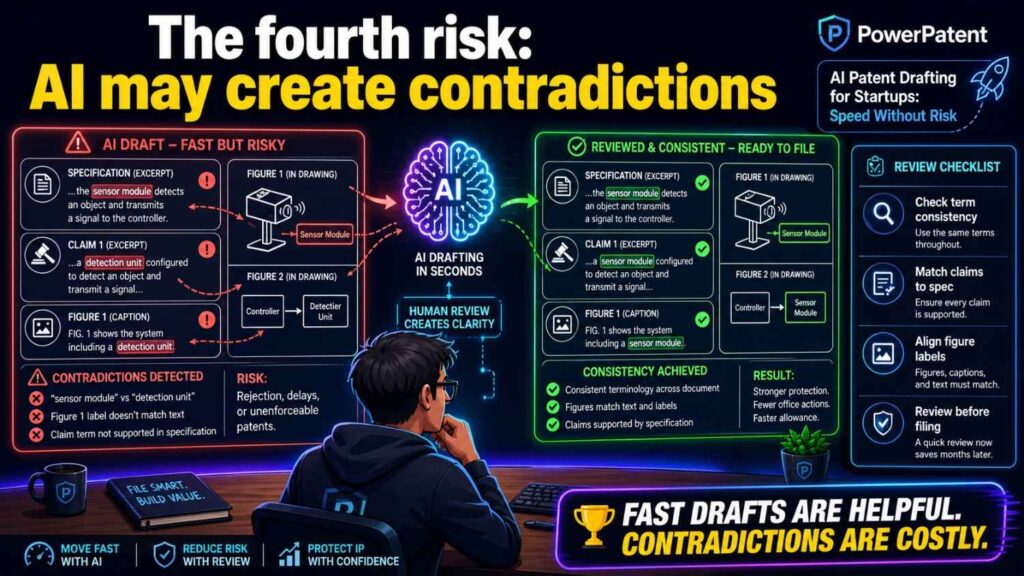
Contradictions are one of the biggest risks in AI patent drafting.
A draft may say the system runs locally in one section and in the cloud in another.
It may say the model is trained before use, then say it trains during every use.
It may say a sensor is optional, then require that sensor in the claims.
It may say the score means high risk when the number is high, then later treat a high score as safe.
It may show five steps in a figure and describe six steps in the text.
These conflicts can happen because AI often drafts in pieces.
It may write the claims in one style, the spec in another, and the figures in another. It may use different names for the same thing. It may pull from old notes and new notes at the same time.
Contradictions are dangerous because they create doubt.
A patent draft should make the invention easier to understand. It should not make a reader ask which version is true.
To reduce this risk, use consistency checks.
Start with the claims. Every key term in the claims should have support in the spec. Every major part should be explained. Every important step should match the detailed description. Figures should use the same names and show the same flow.
Then check the spec. Make sure examples are clearly marked as examples. Make sure optional parts do not become required later. Make sure strong words like “always” and “must” are truly correct.
Then check the figures. Make sure labels match the text. Make sure reference numbers are right. Make sure arrows show the correct data flow. Make sure the method steps match the claims.
This review does not have to be complex.
It just has to be done.
AI can help search for mismatches, but humans should make the final call.
For startups, this is one of the best ways to keep drafting fast without making the filing messy.
The fifth risk: AI may miss the business moat
A patent is not just a technical document.
It is also a business asset.
It should protect what makes your startup hard to copy.
AI may not know what that is unless you explain it.
For example, your product may have many features. But the real moat may be a special data pipeline, a low-power inference method, a model update process, a sensor fusion method, or a way to control hardware based on predictions.
If your AI prompt includes everything, the draft may spread attention across everything.
That can bury the important part.
Before drafting, name the moat.
Ask:
What would hurt most if a competitor copied it?
What did we spend the most time figuring out?
What gives us speed, accuracy, cost savings, safety, privacy, or scale?
What did others fail to do?
What part of the product would be hardest to rebuild?
What technical choice makes the product better?
These answers should guide the patent.
If the moat is the model pipeline, the claims should not focus only on the dashboard.
If the moat is the edge control method, the spec should not focus only on cloud storage.
If the moat is the way training data is generated, the draft should not treat training data as a minor side note.
AI can write what you tell it to write.
But founders and attorneys must decide what matters.
PowerPatent is designed for this founder reality. The goal is not to file something that looks like a patent. The goal is to protect what gives the company an edge. Learn more here: https://powerpatent.com/how-it-works
Start with an invention brief before asking AI to draft
The best way to reduce risk is to prepare a simple invention brief.
This does not need to be formal.
It should be clear.
Write the invention in plain words. Write the problem. Write the solution. Write the main parts. Write the data flow. Write what is new. Write what can change. Write what must not be added.
A good invention brief gives AI better inputs.
It also gives your team a source of truth.
Without it, everyone may be working from memory. One engineer may think the invention is the model. Another may think it is the data pipeline. Another may think it is the control loop. The patent draft may then become a mix of all three without a clear center.
A brief helps avoid that.
For example, a brief for an AI robotics invention may say:
The problem is that robots react too late to unsafe zones.
The solution is to predict risk for route segments before the robot reaches them.
The system uses sensor data, map data, and a trained risk model.
The output is a route risk score.
The action is changing the planned path or speed.
The model may run on the robot or an edge server.
The invention does not require GPS.
The dashboard is optional.
The key idea is risk-based route adjustment before the robot enters the unsafe zone.
That is enough to guide a stronger draft.
It gives AI the base story. It gives the reviewer a way to check the output. It gives the attorney a way to see the invention faster.
This is how you get speed without losing control.
Use a “must, may, and avoid” framework
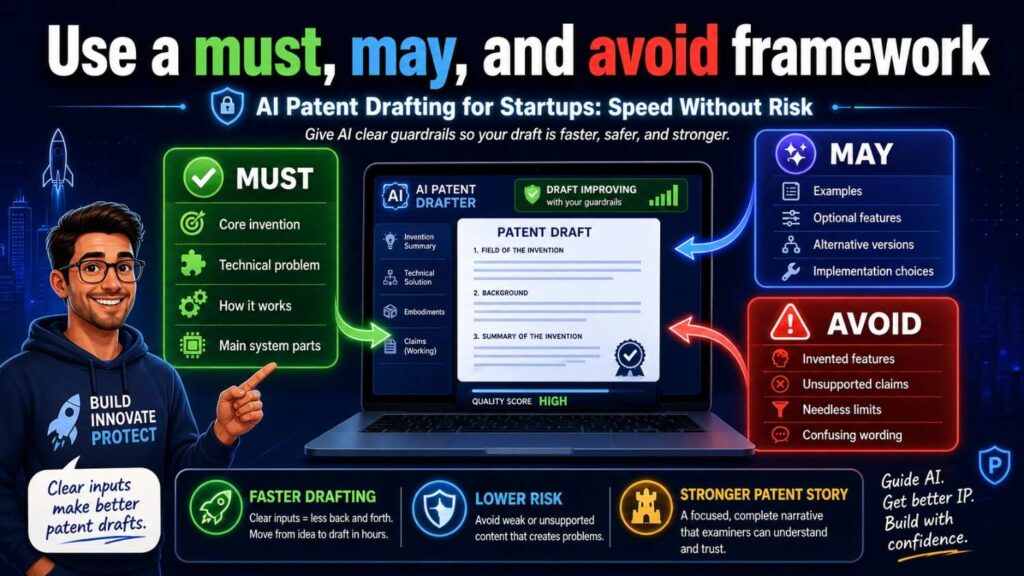
A simple framework can prevent many drafting problems.
Write what the invention must include.
Write what the invention may include.
Write what the draft should avoid.
The “must” section should be short. These are the core parts or steps that make the invention work.
The “may” section can include useful versions, options, and examples.
The “avoid” section protects you from wrong or risky language.
For an AI health monitoring startup, the framework may look like this in plain words:
The system must receive user health data, detect a change pattern, and send an alert.
The system may use wearable data, phone data, home sensor data, or record data.
The draft should avoid saying the system diagnoses disease, replaces a doctor, or requires one brand of wearable.
For an AI infrastructure startup:
The system must detect a model update need, compress update data, and send a smaller update package to an edge device.
The system may use different compression methods, device types, or update schedules.
The draft should avoid saying all updates require a cloud server if local update sharing is supported.
This framework is simple enough for founders and engineers.
It is also powerful enough to guide patent drafting.
When the AI draft comes back, compare it to the framework.
If the draft says an optional feature is required, fix it.
If it adds something from the avoid section, remove it.
If it misses a must-have feature, add support.
This process saves time because it catches mistakes early.
Keep the founder in control of the invention story
AI should not decide what your invention is.
The founder or inventor should.
That does not mean you need to know patent law. It means you need to know your technology.
You know what you built.
You know what was hard.
You know why customers care.
You know what changed after testing.
You know what competitors are missing.
You know what future versions matter.
AI can help you express those ideas, but it cannot replace that knowledge.
One of the best ways to stay in control is to write a one-sentence invention story.
For example:
“Our invention predicts a machine failure risk from live sensor data and changes a maintenance plan before failure occurs.”
Or:
“Our invention reduces edge AI update size by selecting and sending only the model changes needed by each device.”
Or:
“Our invention helps a robot change its route based on a predicted safety risk before entering a risky area.”
This sentence becomes your anchor.
Every claim, figure, and example should connect back to it.
If the draft drifts away, the sentence helps you notice.
Founders often feel patents are hard because the language is formal. But the core invention story should be simple.
If it is not simple yet, the draft may not be ready.
Let AI help with structure, not strategy
AI is useful for structure.
It can turn notes into sections. It can draft a summary. It can create example language. It can help write figure descriptions. It can create first-pass claims. It can suggest alternatives. It can find repeated terms.
But strategy is different.
Strategy means deciding what to protect, how broad to go, what to leave as a trade secret, when to file, whether to file one application or several, and how the patent fits the company’s future.
AI can support those discussions, but it should not own them.
For example, AI may suggest claiming every feature in the product. That may not be smart. Some features may not be new. Some may not be valuable. Some may be better kept out. Some may distract from the real invention.
AI may also suggest broad claims that sound exciting but do not match the spec.
A patent attorney can help shape the strategy.
A founder can help explain the business.
An engineer can help confirm technical truth.
AI can help move the work faster.
That is the right mix.
PowerPatent combines these pieces into a modern patent workflow for startups. Smart software helps with speed and structure, while real patent attorneys help with judgment and filing quality. See how it works here: https://powerpatent.com/how-it-works
Use AI to interview the invention
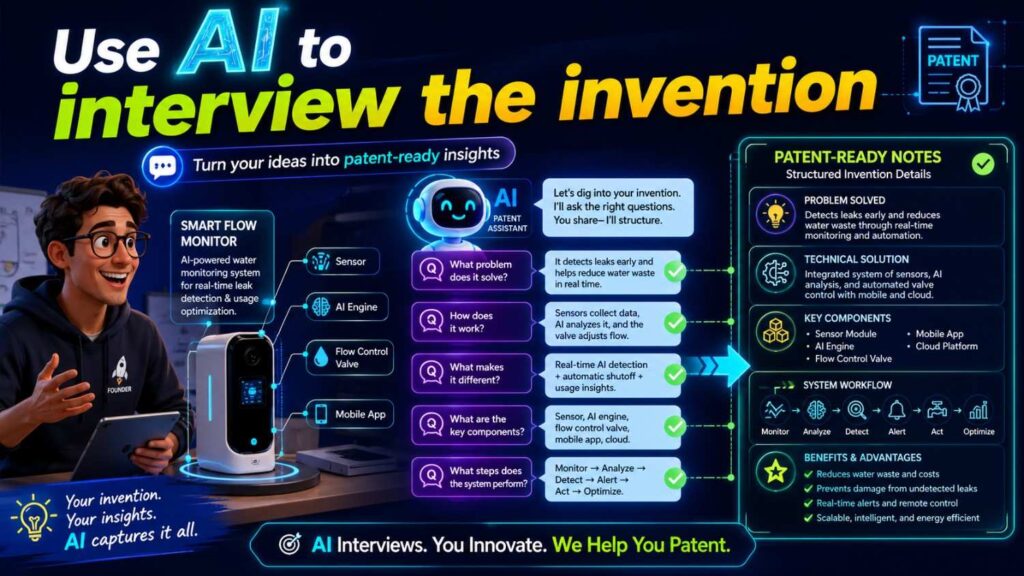
One of the best uses of AI is not drafting first.
It is asking better questions.
AI can help interview the founder or engineer.
It can ask:
What problem does the invention solve?
What happens before the invention is used?
What data goes in?
What output comes out?
What action happens next?
What part is new?
What part can change?
What part should not be required?
What would a competitor copy?
What are different versions of the invention?
These questions can surface details that a normal intake form may miss.
For startups, this is useful because founders may not know what patent details matter. Engineers may assume some details are obvious. AI can prompt them to explain the invention more clearly.
But the answers should come from humans.
AI can ask. You answer.
Then the answers can be used to create a better draft.
This is much safer than asking AI to invent missing details.
Give AI real technical inputs
AI patent drafting works better when it has real material.
Use architecture notes. Use design docs. Use product specs. Use diagrams. Use model cards. Use API flows. Use engineering comments. Use test notes. Use user stories only when they reflect technical flow.
The more real the input, the less the AI needs to guess.
For software and AI startups, useful inputs may include model inputs and outputs, training flow, inference flow, data schemas, deployment setup, edge or cloud roles, update process, error handling, and system actions.
For hardware startups, useful inputs may include parts, connections, materials, movement, sensor placement, control logic, manufacturing steps, and operating modes.
For biotech or life science startups, useful inputs may include sample handling steps, measurement methods, analysis flow, device structure, assay conditions, and result interpretation.
Do not throw everything in without order.
Organize the material.
Tell AI what each piece is.
For example:
“This is the current product architecture.”
“This is the invention we want to protect.”
“This is an optional future version.”
“This is outdated and should not be used.”
“This is private business data and should not appear in the draft.”
That kind of labeling reduces risk.
A pile of mixed notes can create a mixed draft.
A structured set of inputs creates a cleaner one.
Watch out for outdated product details
Startups change fast.
A patent draft may start based on one version of the product. Two weeks later, the product may change. A month later, the roadmap may change again.
AI can accidentally blend old and new details.
That creates risk.
For example, your old system may have used a cloud server. Your new system may run on device. If both notes are fed to AI without context, the draft may include both in a confusing way.
Or your old system may have used manual approval. Your new one may be automatic. The draft may not know which version is real.
This is why version control matters.
Before using AI, mark old material.
Say:
“This old design is no longer used.”
“This design is still possible but optional.”
“This is the current main version.”
“This is a future version we want to support.”
Without those labels, AI may treat all details as equally true.
A strong patent draft can include old, current, and future versions if they are all part of the invention strategy. But it must explain them clearly.
Do not let time create contradictions.
Use AI to create alternatives, then review them
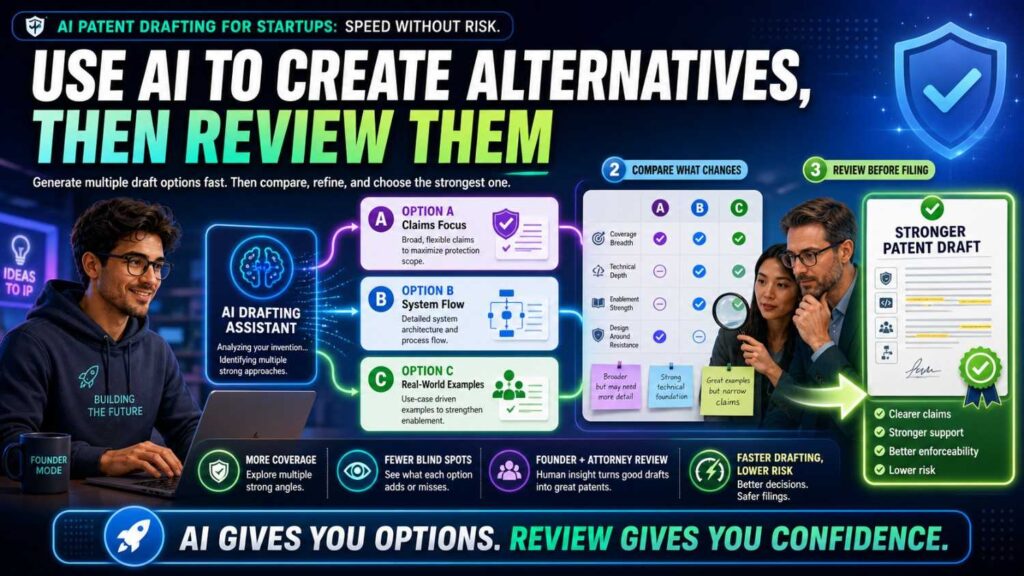
One of the best things AI can do is help you think of variations.
A good patent draft often describes more than one version of an invention.
AI can help suggest different sensors, devices, data types, deployment locations, model types, control actions, user interfaces, and system flows.
This can be useful.
It may help you avoid filing a patent that is too narrow.
But suggested alternatives must be reviewed.
Do not include an alternative just because AI suggested it.
Ask whether it is technically possible, useful, and aligned with the invention.
For example, if AI suggests that your robot uses GPS, but your robot works indoors where GPS is weak, that may not fit.
If AI suggests that your privacy tool stores raw user data in the cloud, that may conflict with your design.
If AI suggests a medical diagnosis feature, but your product only sends wellness alerts, that may be too far.
AI can widen your thinking.
Humans must filter.
The best patent drafts include alternatives that are real, useful, and tied to the core invention.
Use AI to find missing support
AI can help compare claims against the spec.
You can ask it:
“List each claim element and show where the spec supports it.”
This can reveal gaps.
Maybe a claim mentions a “confidence score,” but the spec only explains a “risk score.”
Maybe the claim requires “updating the model,” but the spec never explains updates.
Maybe the claim says “edge device,” but the spec only describes a cloud server.
This kind of check can save time.
You can also ask AI to flag terms that appear in claims but not in the spec.
Or figure labels that do not appear in the text.
Or acronyms that are not explained.
Or optional features that later appear as required.
These checks are helpful because patent drafts are long.
But the output should be reviewed by a person.
AI may miss a subtle issue. It may also flag a non-issue. It can assist, but it is not the final judge.
Use AI to simplify the draft for founder review
Patent drafts can be hard to read.
Founders and engineers may avoid reviewing them because the language feels dense.
AI can help by creating a plain-language summary of the draft.
For example:
“Explain this claim in simple words.”
“Summarize what this patent appears to protect.”
“List the required parts of claim 1.”
“List what seems optional.”
“Describe the data flow shown in the figures.”
This helps founders review the draft faster.
It also helps catch problems.
If the plain-language summary says the invention is a cloud dashboard, but your invention is really an edge model update method, you know something is wrong.
This is a powerful use of AI.
It turns formal patent text back into simple language so the team can check whether it matches the real invention.
PowerPatent helps make the patent process easier for technical founders by using software to improve speed and clarity while keeping attorney review in the loop. Explore the process here: https://powerpatent.com/how-it-works
Keep attorney review in the process
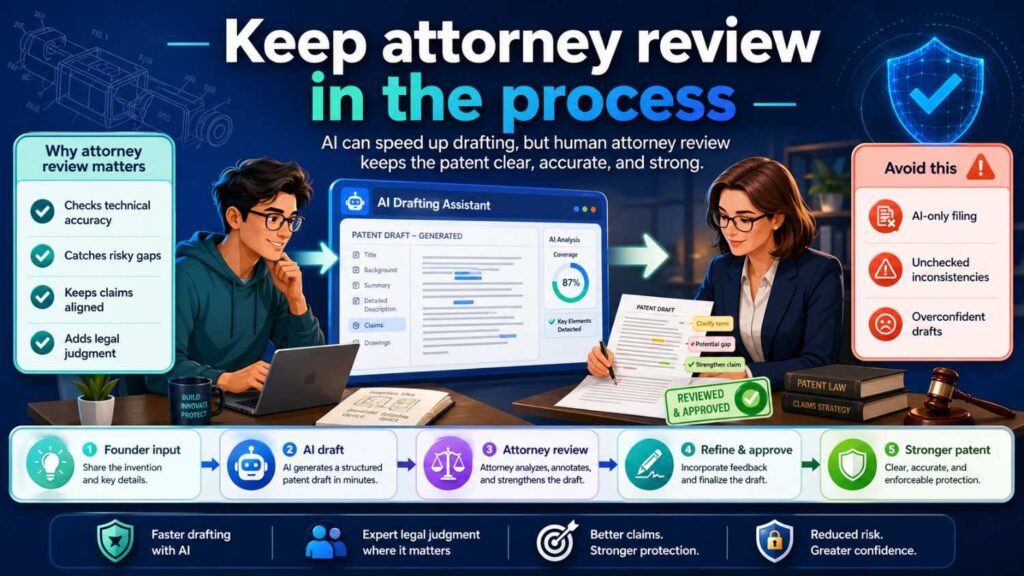
AI can draft.
AI can summarize.
AI can check terms.
AI can suggest examples.
But patent filing still needs expert review.
A patent attorney can help with questions AI cannot safely own.
Are the claims aimed at the right invention?
Is the draft broad enough?
Is the draft too broad for the support?
Are the figures useful?
Are the examples framed correctly?
Does the wording create unwanted limits?
Should this be a provisional or non-provisional filing?
Should there be more than one application?
What should be filed before public disclosure?
What should stay as trade secret?
These are judgment calls.
For startups, the goal should not be to remove attorneys. The goal should be to use attorney time better.
Instead of paying for endless back-and-forth from a blank page, use AI and structured software to gather and organize the invention. Then let attorneys focus on the work that truly needs judgment.
That is faster.
It is also safer.
Do not confuse a provisional filing with a rough draft
Many startups use provisional patent applications because they can be faster and more flexible.
But “provisional” does not mean “sloppy.”
A weak provisional can create problems later if it does not describe the invention well enough.
AI makes it easy to create a quick provisional draft. That can be helpful when timing is tight. But the draft still needs to support the invention.
If the provisional misses the core technical idea, later claims may not get the benefit you expected.
If the provisional includes contradictions, it may create confusion.
If the provisional only describes the current product and not the broader invention, it may be too narrow.
So even for provisional filings, use a careful process.
Describe the invention clearly.
Include key variations.
Add useful figures.
Explain the main technical flow.
Keep terms consistent.
Avoid false limits.
Have a patent professional review it.
Fast is good.
Careless is not.
PowerPatent helps startups move quickly while still keeping quality in view. That is the kind of balance founders need when filing under real startup pressure. Learn more here: https://powerpatent.com/how-it-works
Protect before you disclose
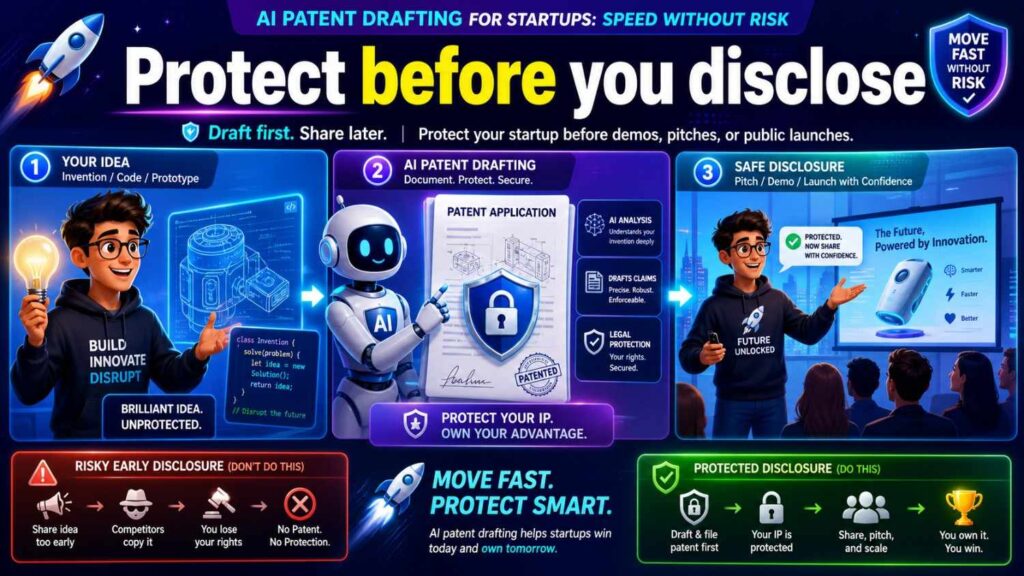
Startups love to share.
You may pitch investors, launch a beta, post on Product Hunt, publish a paper, demo at a conference, release code, or talk to partners.
Public disclosure can affect patent options.
That is why timing matters.
If you are close to sharing a new technical feature, it is smart to think about patent filing before the disclosure.
AI can help speed up the preparation process, but do not wait until the night before a launch if you can avoid it.
Build patent review into your product rhythm.
When the team creates something new, capture it.
When the architecture changes, note why.
When a model improves, record what changed.
When a customer problem leads to a technical fix, write it down.
These notes make future AI-assisted drafting much easier.
They also help your attorney understand the invention quickly.
A patent process should not be a panic event.
It should be part of how your startup protects what it builds.
Create an invention capture habit
The best patent drafts start before drafting.
They start with invention capture.
That means your team has a simple way to record new ideas as they happen.
This can be lightweight.
When an engineer solves a hard problem, capture the problem, the solution, why it was not obvious, what changed in the system, and what other versions may work.
Do not wait six months.
By then, details fade.
The team may forget why a design choice mattered. A key engineer may leave. The code may change. The product may move on.
AI can help organize invention notes later, but it cannot recover facts your team never saved.
For startups, a simple invention capture habit can become a major advantage.
It helps you file faster.
It helps you avoid weak drafts.
It helps you build a stronger patent portfolio over time.
PowerPatent is designed for technical teams that want this kind of modern workflow: fast, structured, founder-friendly, and backed by real patent professionals. See how it works here: https://powerpatent.com/how-it-works
What to capture from engineers
Engineers often know the invention, but they may not describe it like a patent.
That is fine.
You do not need them to write patent language.
You need them to explain the technical truth.
Ask them what was hard.
Ask what failed before the final design.
Ask what tradeoff the invention solves.
Ask what inputs the system uses.
Ask what outputs it creates.
Ask what happens automatically.
Ask what can be changed.
Ask what should not be required.
Ask what a competitor would likely copy.
For AI systems, ask about training data, input features, model output, deployment location, update flow, evaluation, fallback behavior, and human review.
For hardware systems, ask about part placement, signals, control logic, materials, movement, assembly, and modes.
For software platforms, ask about data flow, rules, models, APIs, user actions, system actions, and storage.
The goal is not to make engineers do legal work.
The goal is to collect the raw invention.
AI can then help shape it. Attorneys can then protect it.
What founders should review in an AI-generated draft
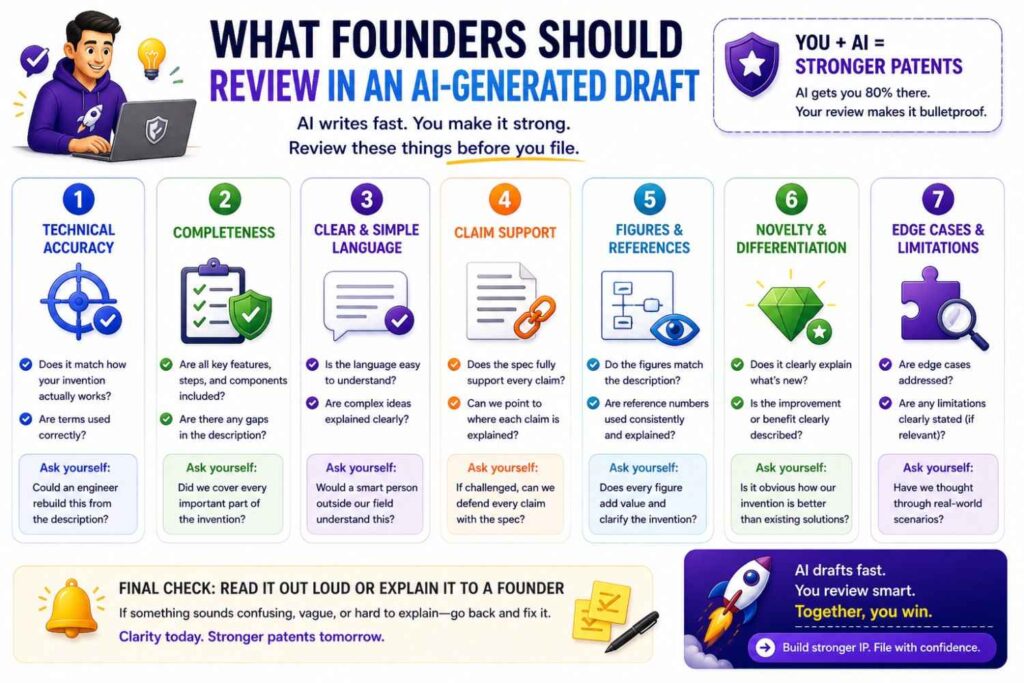
Founders do not need to review every comma.
They should review the invention story.
Read the title. Does it sound like the right invention?
Read the abstract. Does it describe what matters?
Read the first claim in plain language. Does it protect the key idea?
Read the main figure. Does it show the right flow?
Read the examples. Do they match the product and future versions?
Search for risky words like “always,” “only,” “must,” and “required.”
Search for wrong architecture terms like “cloud server” if your invention is local.
Search for wrong data terms like “user profile” if your system does not use user profiles.
Search for medical, financial, or safety claims that your product does not make.
Search for names of old features.
Search for optional features that appear as required.
This founder review is not a substitute for attorney review.
It is a truth check.
No one knows the startup’s invention better than the team building it.
What attorneys should review in an AI-generated draft
Attorneys should review the draft for patent strength.
They should look at claim scope, support, clarity, fallback positions, figure support, term consistency, and filing strategy.
They should check whether the claims are too narrow or too broad.
They should check whether examples support the desired scope.
They should check whether the draft creates unwanted limits.
They should check whether the figures help.
They should check whether the invention is framed in a way that can support later prosecution.
They should also help decide what should be filed now and what may need a later filing.
AI can prepare a strong starting point, but attorney review turns that starting point into a safer filing.
For startups, this is the best use of legal help.
Do not use attorneys only to clean up chaotic text. Use them to guide protection.
The best AI patent workflow for startups
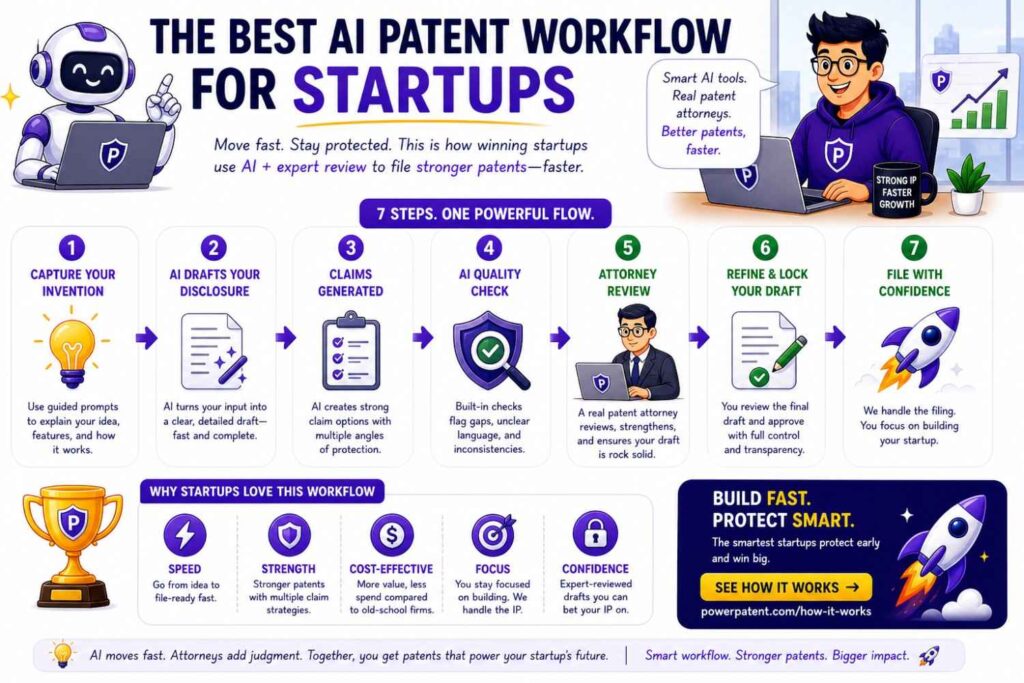
A safe AI patent workflow has a clear order.
First, capture the invention in plain language.
Then organize the technical details.
Then mark what is required, optional, and not allowed.
Then use AI to create a structured draft.
Then use AI to check for gaps and inconsistencies.
Then have the founder or engineer review technical truth.
Then have a patent attorney review scope and filing quality.
Then revise before filing.
This workflow is fast because it avoids wasted effort.
It is safe because it does not rely on AI alone.
It is founder-friendly because it keeps the team focused on what they know best.
It is attorney-friendly because the draft and notes are organized.
That is the future of patent work.
Not old-school delay.
Not blind AI filing.
A smarter middle path.
Use AI to speed up claim brainstorming
Claims are hard.
They define what you want to protect.
AI can help brainstorm claim ideas based on the invention brief.
It can suggest different claim angles.
For example, it may suggest claims focused on the system, the method, the model update process, the data flow, the device, or the control action.
This can be helpful because a startup may have more than one protectable idea inside a product.
But claim brainstorming is not the same as final claim drafting.
AI may suggest claims that are too broad, too narrow, unsupported, or not useful.
Use the suggestions as raw material.
Then work with a patent attorney to decide the best claim strategy.
A good claim strategy should match the business.
If your moat is the data pipeline, claim the data pipeline.
If your moat is the control method, claim the control method.
If your moat is the training process, claim the training process.
If your moat is how pieces work together, claim the system flow.
Do not let AI pick the center of gravity alone.
Use AI to test whether claims are understandable
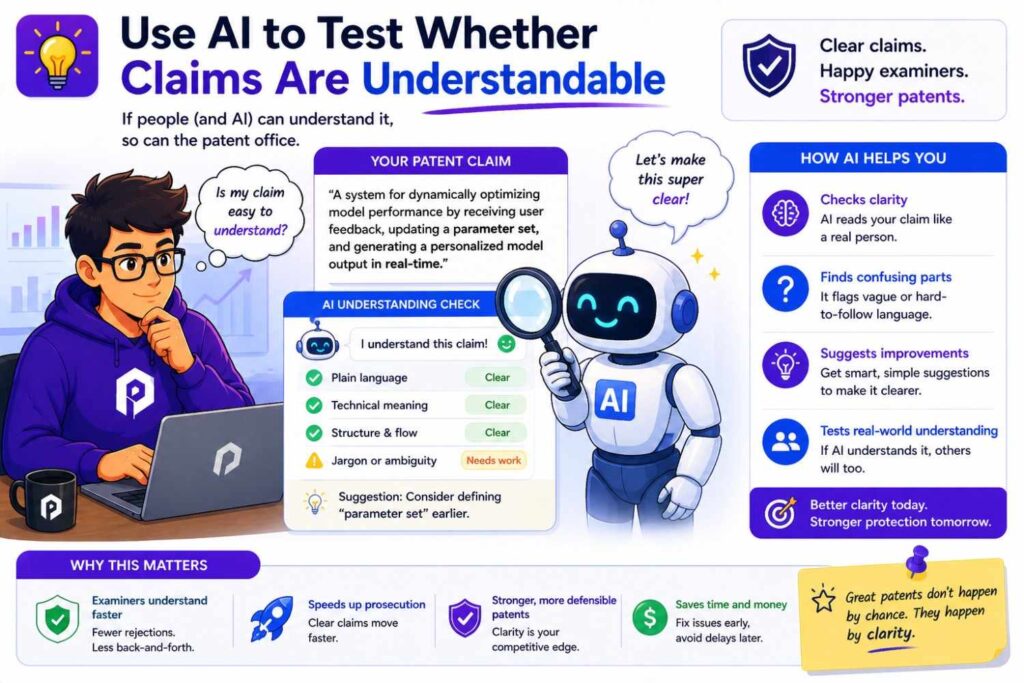
A claim can be technically correct but hard to understand.
AI can help translate claims into plain language for review.
Ask:
“What does claim 1 require in simple words?”
“What would a competitor need to do to practice this claim?”
“What parts seem required?”
“What parts seem optional?”
“What product feature does this claim appear to cover?”
This can help founders spot issues.
If the answer does not match your intent, the claim may need work.
For example, you may think the claim covers edge processing, but the plain summary may reveal that edge processing is not actually required.
Or you may think the claim covers a broad model update process, but the summary may show that it is limited to one type of device.
This is not final legal analysis, but it is a useful sanity check.
It makes the claim easier for the startup team to review.
Use AI to find term drift
Term drift happens when the same thing gets different names.
“Prediction engine.”
“Risk model.”
“AI module.”
“Scoring unit.”
“Classifier.”
If these all mean the same part, the draft may be confusing.
AI can help find this.
Ask it to list all terms that appear to refer to the same component.
Then decide which term should stay.
A clean draft uses one name for one thing.
If two names are needed, explain the difference.
For example, a “risk model” may create a risk score. A “route planner” may use that score to choose a path. Those should not be mixed.
Term drift is easy to fix when caught early.
It is harder to fix after the claims, spec, and figures all use different names.
Use AI to create figure descriptions, then verify them
Figures are important.
They help show the invention.
AI can help draft figure descriptions from a diagram or outline. It can explain a flow. It can write text for system blocks. It can describe method steps.
But figure descriptions must match the actual drawings.
If the figure shows data moving from a device to a server, the text should not say the data stays local.
If the figure shows step 204 before step 206, the text should not reverse the order unless the order can vary.
If the figure labels a block “controller,” the spec should not call the same block “database.”
Review figures carefully.
For technical founders, figures are often easier to check than dense patent text.
Use them.
Look at each figure and ask:
Is this our invention?
Does this show the right parts?
Does this show the right flow?
Does anything look old, fake, or too narrow?
Does this support the claims?
A good figure can make the whole patent stronger.
A bad figure can create confusion.
Do not let AI overstate results
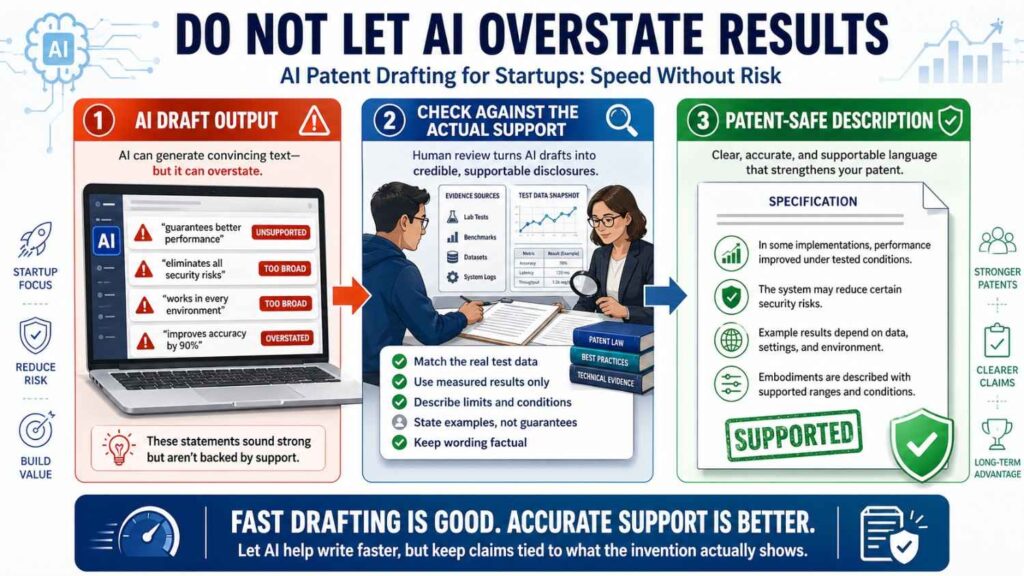
Startups want to show value.
AI may overstate it.
It may write that the invention guarantees accuracy, prevents all failures, eliminates risk, or always improves performance.
Be careful.
Patent drafts should be credible.
Most technical systems improve something under certain conditions. They rarely guarantee perfect results.
Use measured language.
Say “may improve,” “may reduce,” “may help,” or “may increase,” when that is accurate.
Tie the benefit to the mechanism.
For example:
“By processing data on the device, the system may reduce delay caused by network transmission.”
That is better than:
“The system provides instant results.”
Or:
“By selecting model updates based on device state, the system may reduce update size.”
That is better than:
“The system eliminates bandwidth costs.”
This is not about sounding weak.
It is about sounding true.
A true, clear patent draft is stronger than a flashy one.
Do not let AI add legal-sounding filler
AI often writes patent-style filler.
Some of it may be fine.
Some of it may add noise.
A patent draft should be detailed, but not bloated with useless text.
For example, AI may add long lists of generic computing devices, networks, databases, processors, storage media, and interfaces. Some of that may be needed. But too much generic text can bury the invention.
It may also add phrases that sound formal but do not help.
The goal is not to make the draft look legal.
The goal is to make the invention well supported.
When reviewing an AI draft, ask whether each section helps.
Does it explain the invention?
Does it support the claims?
Does it show a useful version?
Does it clarify a term?
Does it help with figures?
If not, it may be filler.
Patent attorneys can decide what boilerplate is useful and what should be trimmed or revised.
Keep trade secrets in mind
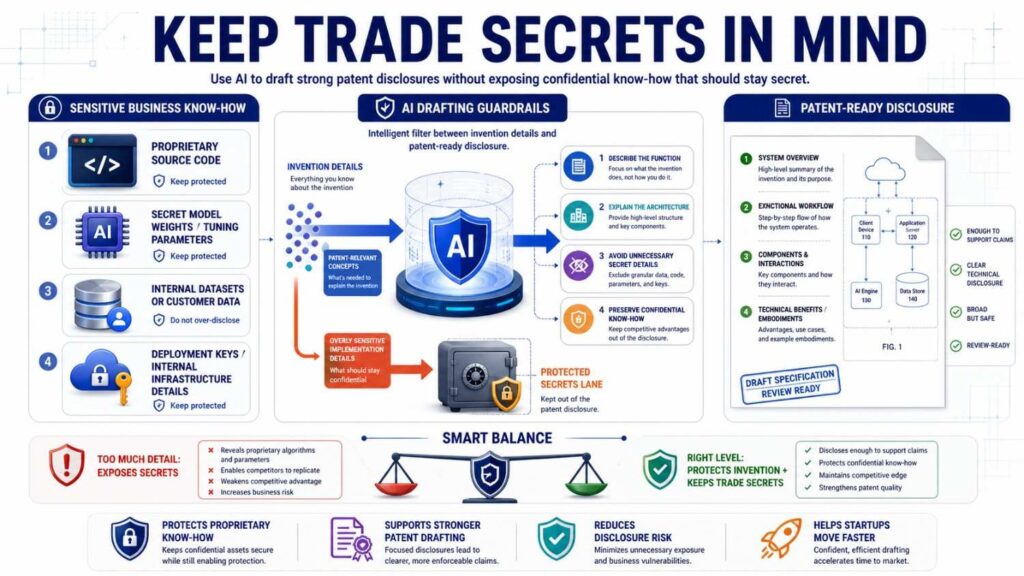
Not every technical detail belongs in a patent.
A patent is published.
That means some details may become public.
Startups need to think carefully about what to disclose and what to keep secret.
AI can make this harder because it may pull in detailed notes and include them in the draft.
Before using AI for patent drafting, decide what should not appear.
Maybe exact model weights should not be included.
Maybe customer data details should not be included.
Maybe private performance numbers should not be included.
Maybe a secret tuning method should be discussed only at a higher level, depending on the strategy.
This is a legal and business decision.
A patent must describe the invention well enough. But it should not casually reveal every secret if not needed.
Work with a patent attorney on this balance.
PowerPatent helps founders build a more thoughtful process around patent drafting, so sensitive technical work can be turned into patent filings with more care and control. See how it works here: https://powerpatent.com/how-it-works
Be careful with code
Many startups want to protect software.
They may wonder if they should paste code into AI.
Be careful.
Code can help explain what the system does. But a patent draft usually does not need raw code. It often needs the technical method, system flow, data handling, and inventive structure behind the code.
Instead of pasting large code blocks, it may be better to summarize the key logic.
What data is received?
What decision is made?
What rule or model is applied?
What output is created?
What action follows?
What is different from common approaches?
AI can help convert code comments or structured notes into patent-style explanations. But raw code may include private details, dependencies, customer names, internal paths, or secrets that should not appear.
Use judgment.
Better yet, use a platform designed for this kind of controlled invention capture.
Be careful with model details
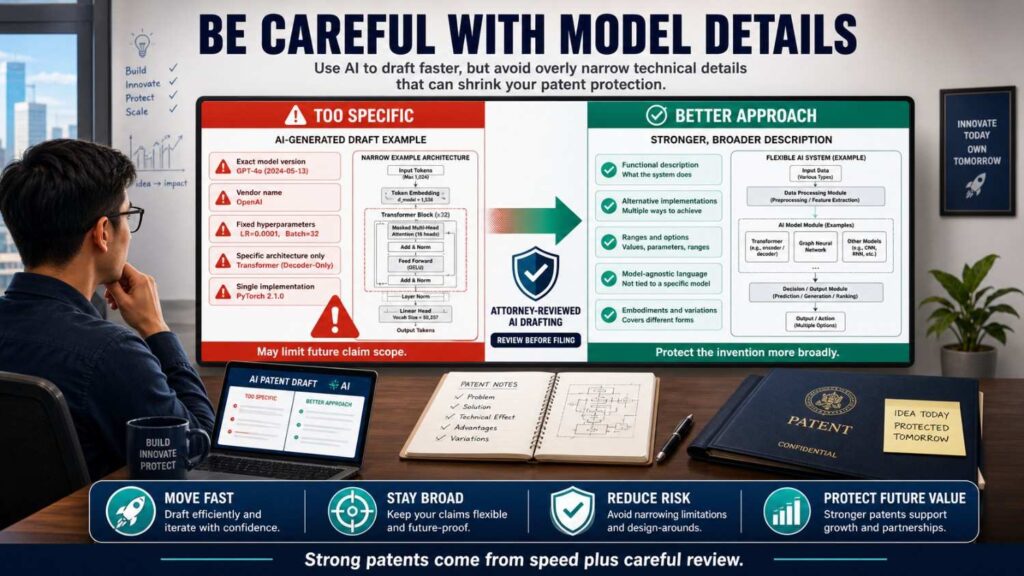
AI startups often have complex model details.
A model may use a certain architecture, training method, feature set, loss function, data selection method, prompt chain, evaluation loop, retrieval step, or fine-tuning process.
Some details may be central to the invention.
Others may be implementation choices.
Do not include model details blindly.
Ask what matters.
If the invention is about selecting training samples, the model architecture may be optional.
If the invention is about a specific model structure, the architecture may be central.
If the invention is about deployment on low-power devices, the compression or scheduling method may matter more than the base model.
AI may not know which detail is the real invention.
Your team and attorney should decide.
The draft should explain enough to support the claims, but it should not drown the invention in unrelated model language.
Be careful with open-source and third-party tools
Startups often build with open-source libraries, APIs, cloud services, and third-party models.
AI may include these in the patent draft if they appear in your notes.
That may or may not be helpful.
If a third-party tool is just an implementation choice, you may not want the patent to require it.
For example, if your system can use many vector databases, do not limit the draft to one named database unless there is a reason.
If your model can run on many cloud platforms, do not tie the invention to one vendor.
If your system uses an open-source library today, but the invention is the data flow around it, keep the focus on the data flow.
The patent should protect your inventive contribution, not accidentally narrow itself to a vendor or tool.
Use general names where appropriate.
Use specific names only when needed.
Use AI for prior art preparation, but be careful
Prior art means earlier public technology that may be relevant to the invention.
AI can help organize what you know about existing systems. It can help summarize competitor approaches. It can help create comparison tables. It can help identify what seems different.
But prior art analysis is a careful legal task.
Do not rely on AI alone to decide whether your invention is patentable.
AI may miss key references. It may misunderstand a paper. It may overstate differences. It may create false confidence.
Use AI as a helper.
Use patent professionals for real analysis.
For drafting, it is still useful to know what makes your invention different.
A simple statement like this can guide the draft:
“Existing systems detect failure after sensor values cross a fixed threshold. Our system predicts future failure risk using a learned pattern and changes the maintenance schedule before the threshold is crossed.”
That kind of contrast helps focus the patent.
But be careful with strong claims about what all existing systems do unless reviewed.
Build fallback positions into the draft
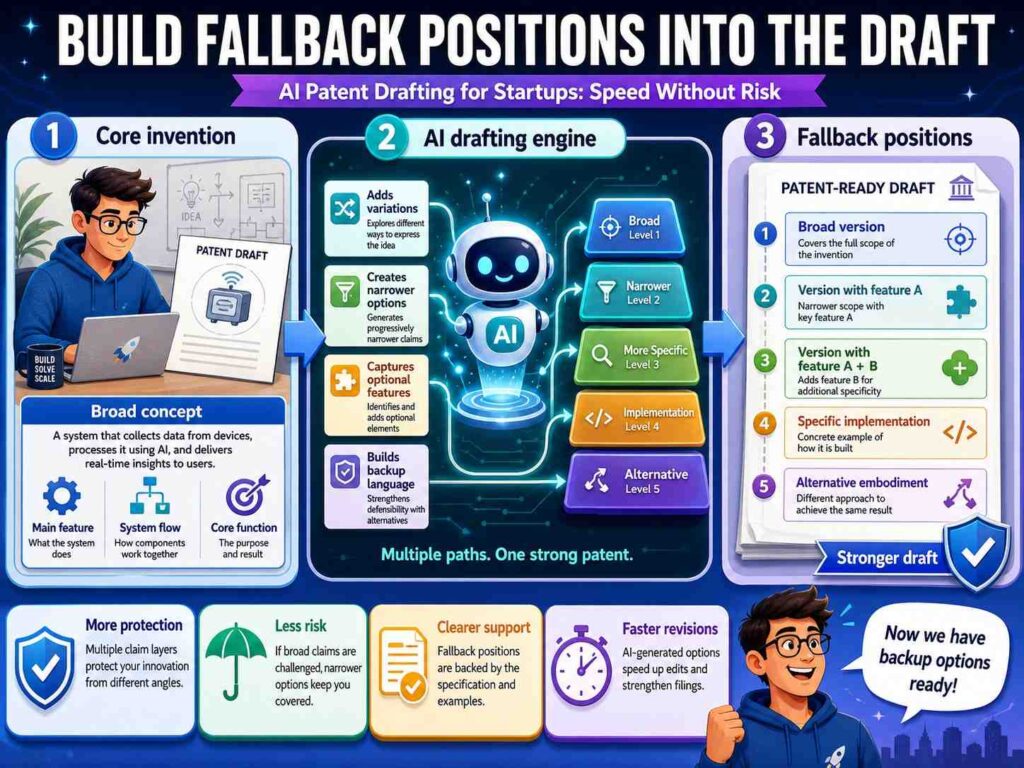
A strong patent draft gives you options.
The broadest claim may not always survive as written. That is normal.
Fallback positions are more specific versions that still have value.
AI can help identify fallback features.
For example, if your broad invention is a risk scoring system, fallback positions may include specific data types, model steps, deployment locations, update methods, control actions, or user review modes.
The spec should describe these versions.
The claims may include some of them.
This gives the patent attorney more room to work later.
Without fallback support, you may be stuck if a broad claim faces problems.
Startups should care about this because patents are long-term assets. The draft you file now may be examined years later. You want the filing to give you room.
AI can help list possible fallback versions, but the team should choose the ones that are real and valuable.
Avoid “one magic model” drafting
AI inventions often get described as if the model is magic.
“The model processes the data and creates the output.”
That is usually too thin.
A patent draft should explain what goes into the model, what comes out, and how the output is used.
It may also explain how data is prepared, how the model is trained or updated, how confidence is handled, how outputs are filtered, or how actions are selected.
The goal is not to reveal every secret.
The goal is to avoid a black box description that fails to support the invention.
For example, instead of saying:
“The AI model analyzes sensor data.”
A better draft may say:
“The risk model receives vibration data and recent operating state data, creates a failure risk score for a future time window, and provides the score to a maintenance scheduler that changes a planned service time.”
That is much stronger.
It tells a clear story.
It shows input, output, and action.
This is the kind of clarity that makes AI patent drafting safer.
Make data flow clear
For many startups, the data flow is the invention.
Data comes from a device, user action, sensor, machine, model, database, or external system. It is cleaned, transformed, scored, ranked, stored, routed, compressed, or used to control something.
AI drafts can blur this flow.
Do not let that happen.
Write the data flow in plain words before drafting.
For example:
Sensor data is collected from the machine.
The data is filtered on the device.
A feature set is created.
The feature set is sent to a risk model.
The model creates a failure score.
The score is sent to a scheduler.
The scheduler changes the next service time.
Now compare the draft to that flow.
Does the claim follow it?
Does the spec explain it?
Do the figures show it?
Does any section add a step that is not real?
Does any section skip the key step?
Data flow checks are one of the fastest ways to catch AI drafting risk.
Make control flow clear
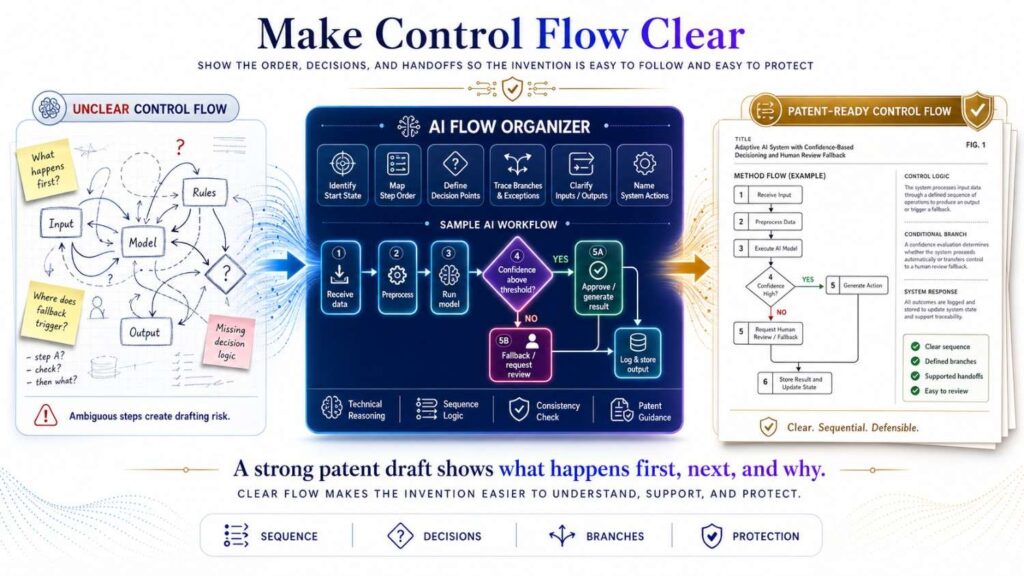
If the invention controls a device, robot, machine, network, or software process, control flow matters.
Who decides?
What signal is sent?
What changes?
When does it change?
Is there human approval?
Is the action automatic?
Is there a safety fallback?
AI may describe actions vaguely.
“The system responds.”
“The device adjusts.”
“The controller takes action.”
That may not be enough.
A stronger draft says what action happens.
For example:
“The controller reduces motor speed when the route risk score exceeds a threshold.”
Or:
“The scheduler moves a maintenance task earlier when the failure risk score meets a risk condition.”
Or:
“The edge device delays a model update when the battery level is below a set level.”
Clear control flow helps the patent feel real.
It also helps avoid contradictions between claims, spec, and figures.
Make model training and model use clear
AI startups should be very careful with training and use.
Training creates or updates a model.
Use applies the model to new input.
Those are not the same.
AI-generated drafts often mix them.
A draft may say the model is trained on live input, when the real system only uses a pre-trained model. Or it may say the model is fixed, when the invention includes updates.
Before drafting, decide what the patent covers.
Is the invention about training?
Is it about use?
Is it about updating?
Is it about deployment?
Is it about data selection?
Is it about feedback?
The draft can cover more than one of these, but it should be clear.
Use headings or labels if needed.
“Training phase.”
“Use phase.”
“Update phase.”
This makes the patent easier to understand.
It also helps avoid mistakes in claims and figures.
Keep human review clear
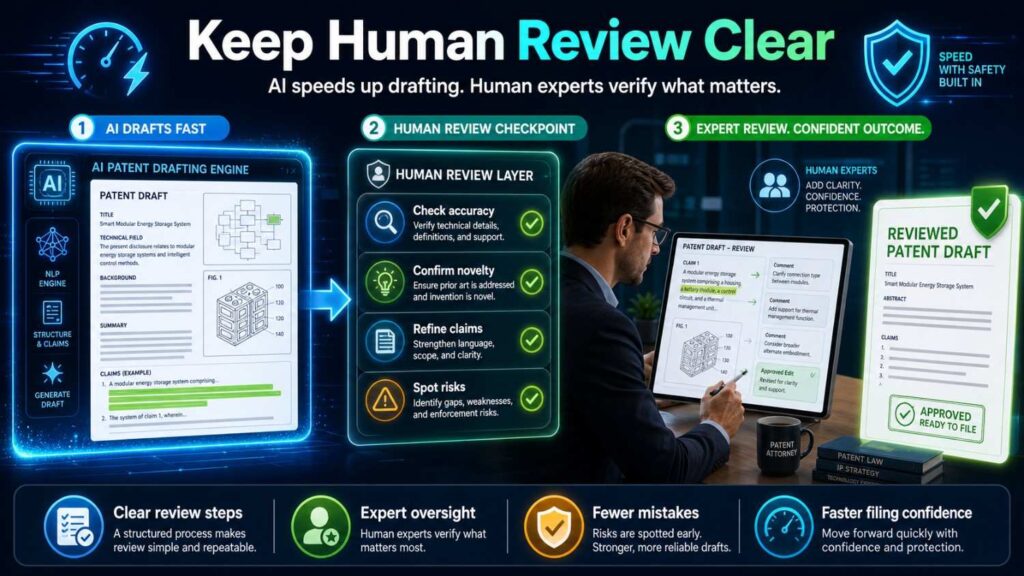
Some AI systems recommend actions to humans.
Some take action automatically.
Some do both in different modes.
This must be clear.
A system that recommends a treatment is different from a system that performs an action. A system that alerts a technician is different from a system that changes a machine setting. A system that suggests a route is different from a robot that changes route automatically.
If the draft blurs this, the claims may not match the product.
Use mode language.
“In one mode, the system presents a recommendation to a user.”
“In another mode, the system sends a control signal without user approval.”
Only include both if both are real or planned.
Human-in-the-loop language matters for safety, trust, and scope.
Make privacy choices clear
Many AI startups care about privacy.
Some process data locally. Some send only summaries. Some remove identifiers. Some use encrypted storage. Some avoid personal data altogether.
AI may add generic privacy language that sounds good but does not match the design.
Be careful.
If privacy is part of the invention, explain the technical mechanism.
Does the system keep raw data on device?
Does it send only derived features?
Does it anonymize data?
Does it encrypt data before sending?
Does it use federated learning?
Does it avoid user identity?
Each of these is different.
Do not say “privacy is protected” without explaining how.
Also avoid absolute statements unless true.
“No data leaves the device” is strong. Use it only if true.
“Raw sensor data may remain on the device while a summary value is sent” may be more accurate.
A patent draft should build trust through precision.
Make deployment choices clear
Where does the invention run?
On a phone?
On a robot?
On a sensor?
On a vehicle?
On a server?
On an edge gateway?
Across many devices?
AI may default to cloud language. But many deep tech inventions depend on where processing happens.
If the invention reduces delay by running locally, say that.
If the invention improves scale by using cloud coordination, say that.
If the invention supports both, explain the versions.
Deployment can affect claim scope.
It can also affect the business story.
A system that works offline may be valuable for factories, vehicles, defense, medical devices, or remote locations. A patent draft should not erase that by adding cloud-only wording.
Make the figures work hard
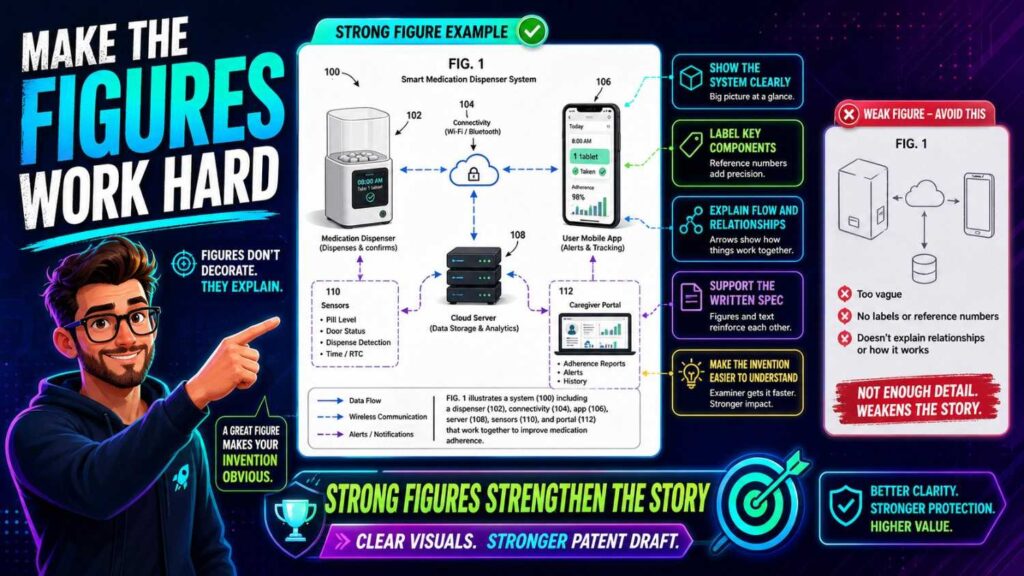
Figures are not decoration.
They should help the reader understand the invention.
For startups using AI drafting, figures can also expose risk.
If the figure does not match the invention, the text may not either.
A good figure may show the system architecture, data flow, method steps, model pipeline, device structure, user interaction, control loop, or training process.
The figure should match the claims.
If the claim says the system creates a risk score and changes an action, the figure should show that path.
If the claim says a model update package is sent to an edge device, the figure should show the update flow.
If the claim says a sensor signal controls an actuator, the figure should show the connection.
Review every label.
Review every arrow.
Review every step.
AI can help draft figure text, but the team should confirm that the picture tells the right story.
Do not skip consistency checks
Consistency checks are one of the best ways to reduce AI drafting risk.
Check claims against the spec.
Check the spec against the figures.
Check figures against the claims.
Check terms.
Check actors.
Check inputs.
Check outputs.
Check optional features.
Check strong words.
Check old product details.
Check examples.
Check the abstract.
This may sound like a lot, but it is much easier than fixing a bad filing later.
AI can help run these checks, but people must review the results.
A consistent patent draft feels like one clear story.
An inconsistent draft feels like several drafts pasted together.
You want one story.
Avoid filing a draft that nobody on the team understands
This is a simple rule.
Before filing, at least one founder and one technical person should understand what the patent is trying to protect.
They do not need to understand every legal detail.
But they should know the core claim idea.
They should know what the figures show.
They should know what the main examples cover.
They should know what the filing is meant to protect.
If the team cannot explain it, something is wrong.
AI can produce language that sounds official, but official language is not enough.
A patent is part of your startup’s strategy. The team should know what it says.
Use AI to create a simple summary. Review that summary with the team. Then ask whether it matches the real invention.
This step can catch major problems before filing.
The role of PowerPatent in AI patent drafting
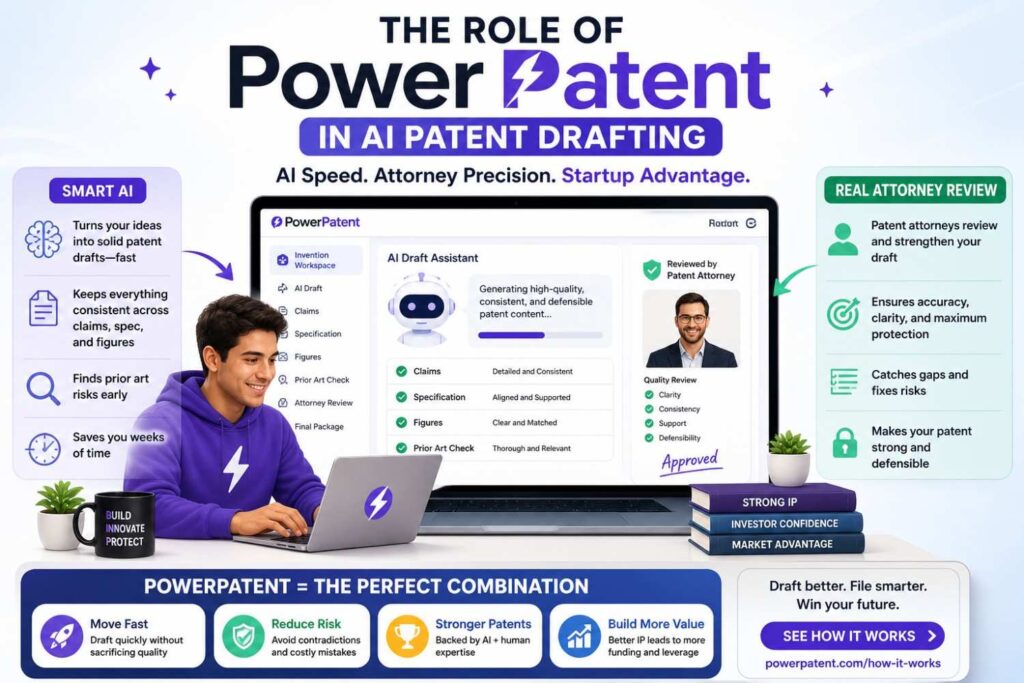
PowerPatent helps founders use AI in a safer, smarter way.
The goal is not to make founders do legal work alone.
The goal is to make the patent process faster, clearer, and more connected to the real invention.
PowerPatent helps turn technical inputs like code, models, diagrams, and invention notes into structured patent work. It gives founders more control and visibility. It helps reduce the back-and-forth that often slows down old-school patent work. And it brings in real patent attorney oversight so the final work is not just AI text.
That matters.
AI alone can be fast but risky.
Traditional patent work can be careful but slow and hard to manage.
PowerPatent gives startups a better path: software speed plus professional review.
You can see how it works here: https://powerpatent.com/how-it-works
How to know when your startup should file
You do not need to file a patent for every idea.
But you should consider filing when the invention gives your startup a real edge.
That may be before a public launch.
Before a conference talk.
Before publishing a paper.
Before sharing details with partners.
Before open-sourcing key code.
Before fundraising if the invention is central to the pitch.
Before a competitor can see and copy the feature.
You should also consider filing when your team solves a hard technical problem that others in the market face.
Ask whether the solution is tied to the company’s value.
If yes, it may be worth protecting.
AI can help prepare faster, but timing should still be thoughtful.
A rushed filing is better than no filing in some cases, but a planned filing is better than a rushed one.
Build IP review into your startup rhythm.
How to avoid over-filing
Speed can create another risk: filing too much without strategy.
If AI makes drafts easier, a startup may be tempted to file on every small feature.
That can waste money and attention.
The goal is not to file the most patents.
The goal is to file the right patents.
A good patent portfolio supports the business.
It protects core technology, key product advantages, future platform directions, and areas competitors may copy.
Before filing, ask:
Does this invention support our moat?
Could it matter in fundraising, partnerships, licensing, or exit?
Would a competitor want to copy this?
Is this a technical solution, not just a business idea?
Can we describe it well?
Is now the right time?
AI can make filing easier, but strategy should still guide what gets filed.
A patent attorney can help prioritize.
How to avoid under-filing
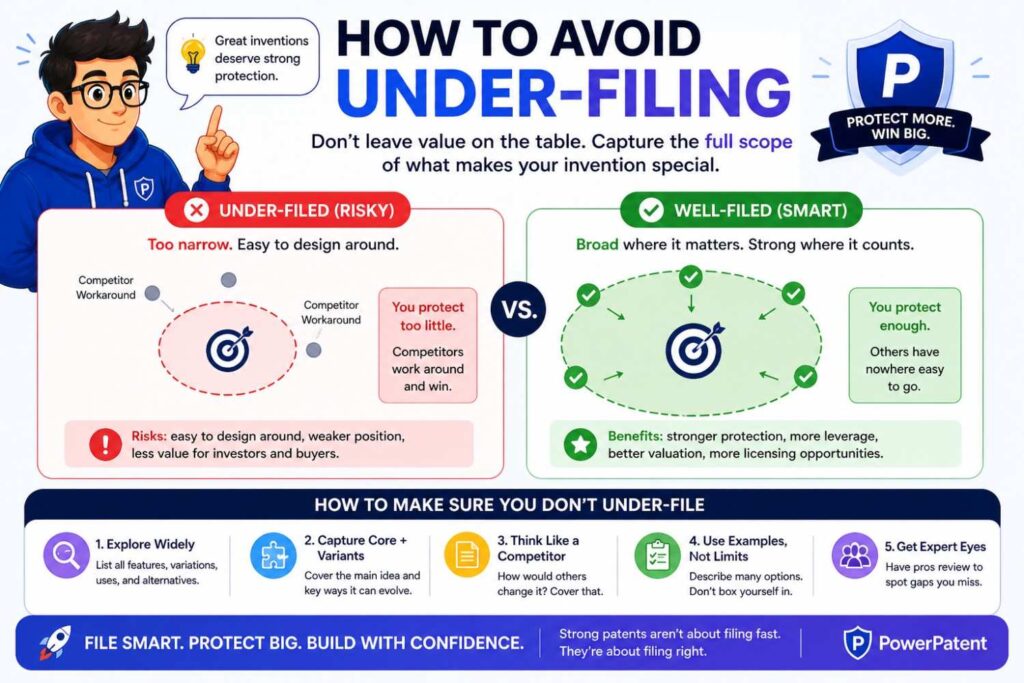
Some startups wait too long.
They think patents are only for big companies.
They assume software cannot be protected.
They believe they are too early.
They plan to file later, then disclose too much.
This can be risky.
If your startup is building deep tech, AI systems, robotics, hardware, biotech tools, infrastructure, or technical software, you may be creating protectable inventions sooner than you think.
The key is not to wait until the product is perfect.
Patents can protect technical ideas while the product is still evolving.
A well-prepared provisional filing can help secure an early date while you keep building.
AI can help make that process faster and more affordable, especially when paired with attorney review.
The main point is to be intentional.
Do not file everything.
Do not file nothing.
File the inventions that matter.
AI patent drafting for fundraising
Investors care about defensibility.
They want to know whether your startup has something hard to copy.
Patents can help tell that story.
A strong patent filing can show that the company is serious about protecting its technology. It can also help explain the technical moat in a concrete way.
But a weak AI-generated patent draft can do the opposite.
If the filing is vague, inconsistent, or aimed at the wrong feature, it may not support the story well.
For fundraising, the patent should align with the pitch.
If you tell investors your edge is low-latency edge AI, your patent should not focus only on a cloud dashboard.
If you tell investors your edge is a novel robotics control loop, your patent should not read like a generic sensor system.
If you tell investors your edge is a new model training pipeline, your patent should not only describe the app interface.
The patent story and business story should match.
PowerPatent helps founders build that bridge between technical work and IP strategy. See how the platform supports startups here: https://powerpatent.com/how-it-works
AI patent drafting for product launches
Product launches create pressure.
You want to share what you built.
But you also want to protect the invention first.
AI can help accelerate patent drafting before launch, especially if your invention notes are already organized.
The best move is to start patent capture before launch week.
As soon as the feature is mostly clear, capture the invention.
Describe the technical flow.
Mark what is new.
Include drawings or diagrams.
Explain what will be disclosed publicly.
Then work with a patent process that can move fast.
If you wait until the day before launch, your options may be limited. But AI-assisted drafting with attorney oversight can still help in time-sensitive cases.
The key is to avoid filing a weak draft just to check a box.
The filing should still protect the real feature.
AI patent drafting for open-source startups
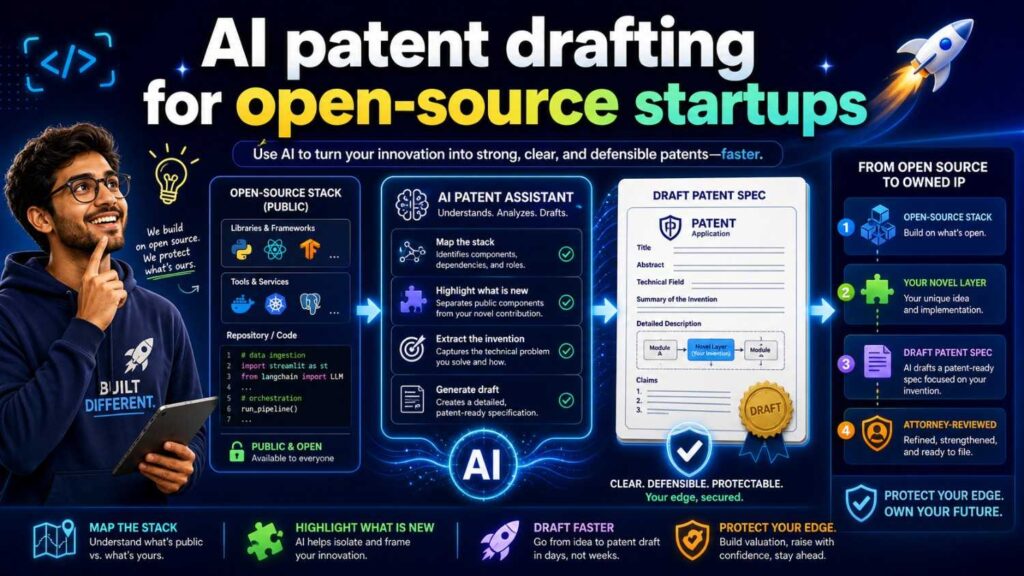
Open-source startups face a special challenge.
They may publish code early.
That can create patent timing issues.
If your company plans to open-source important code, consider patent review before release.
AI can help identify inventions inside the codebase and turn them into plain-language invention notes.
But be careful not to paste sensitive code into random tools without a plan.
Think about what the invention is at a higher level.
Is it a data flow?
A model optimization?
A developer tool workflow?
A distributed system method?
A runtime process?
A security control?
Open-source and patents can fit together, but they need strategy.
A patent filing before public release may help protect the company while still supporting an open-source motion.
This is a good area for attorney guidance.
AI patent drafting for AI model companies
AI model companies often have many possible inventions.
Training methods.
Data cleaning.
Synthetic data generation.
Evaluation.
Fine-tuning.
Prompt routing.
Retrieval methods.
Agent workflows.
Safety filters.
Deployment methods.
Monitoring.
Feedback loops.
The hard part is choosing what to protect.
AI drafting can help document these inventions, but strategy matters.
Some details may be better as trade secrets. Some may be patentable. Some may be too tied to fast-changing model choices. Some may become core platform IP.
The patent draft should not just say “we use AI.”
It should explain the technical method that makes the system better.
For example, “using a model to answer questions” is generic.
But “selecting a retrieval path based on a user intent score and a document freshness score before generating an answer” is more concrete.
Strong AI patents often focus on specific technical flows, not broad claims that AI is involved.
AI patent drafting for robotics startups
Robotics patents often involve sensors, models, control loops, movement, safety, and real-world constraints.
AI can help draft these systems, but it may miss physical details.
For robotics, figures matter a lot.
Where are the sensors?
What does the robot measure?
Where does processing happen?
What command changes movement?
What safety condition triggers a fallback?
Does the robot act on its own or wait for a user?
Does it work indoors, outdoors, or both?
AI may write a generic robot system. Your patent should protect the actual control or sensing advance.
The draft should connect data to action.
For example:
The robot receives sensor data.
The system creates a risk score.
The controller changes speed or path.
The robot avoids the unsafe zone.
That flow is much stronger than saying the robot “uses AI for navigation.”
AI patent drafting for hardware startups
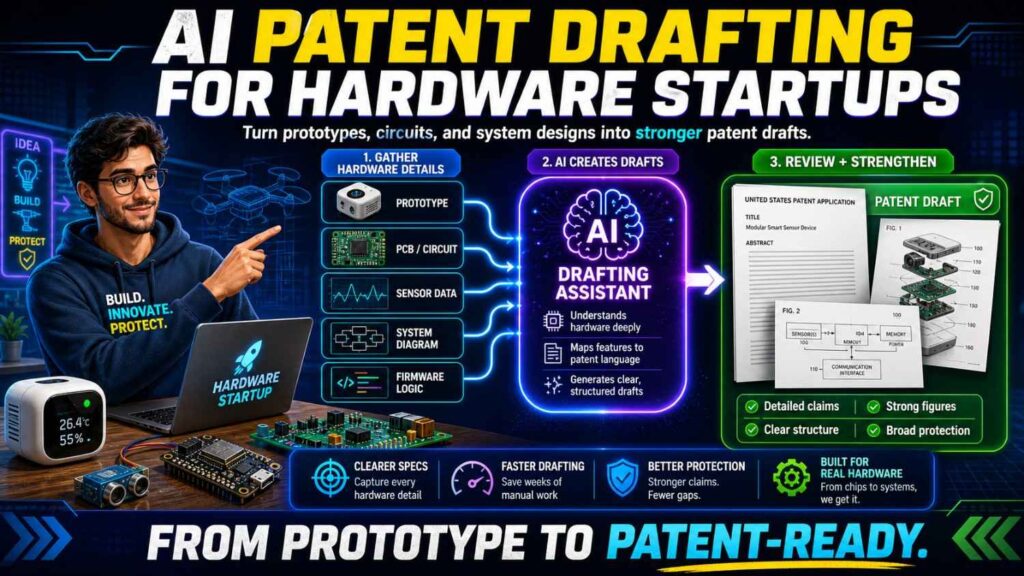
Hardware patents need clear structure.
AI can help describe parts, but it may not understand how parts fit unless you provide diagrams and details.
For hardware, capture the physical arrangement.
What parts are connected?
What moves?
What is fixed?
What signal travels where?
What material matters?
What shape matters?
What can vary?
What is the key improvement?
A small physical detail can be central.
For example, a sensor placement may reduce noise. A heat path may improve cooling. A housing shape may improve alignment. A control circuit may reduce power draw.
Do not let AI turn hardware into generic blocks.
Give it real structure.
Then have a technical person review every figure and part label.
AI patent drafting for climate and energy startups
Climate and energy startups often build systems with sensors, control, materials, power flow, storage, forecasting, optimization, or grid interaction.
AI drafting can help organize these complex systems.
But be careful with performance claims.
Do not say the invention “eliminates energy waste” unless that is truly supported.
Describe the technical mechanism.
Maybe the system shifts load based on predicted demand.
Maybe it changes battery charging based on degradation risk.
Maybe it controls HVAC based on occupancy and weather forecasts.
Maybe it improves solar output by adjusting panel orientation.
Maybe it reduces cooling load through better workload placement.
Tie the benefit to the method.
That makes the patent stronger and more credible.
AI patent drafting for biotech and health startups
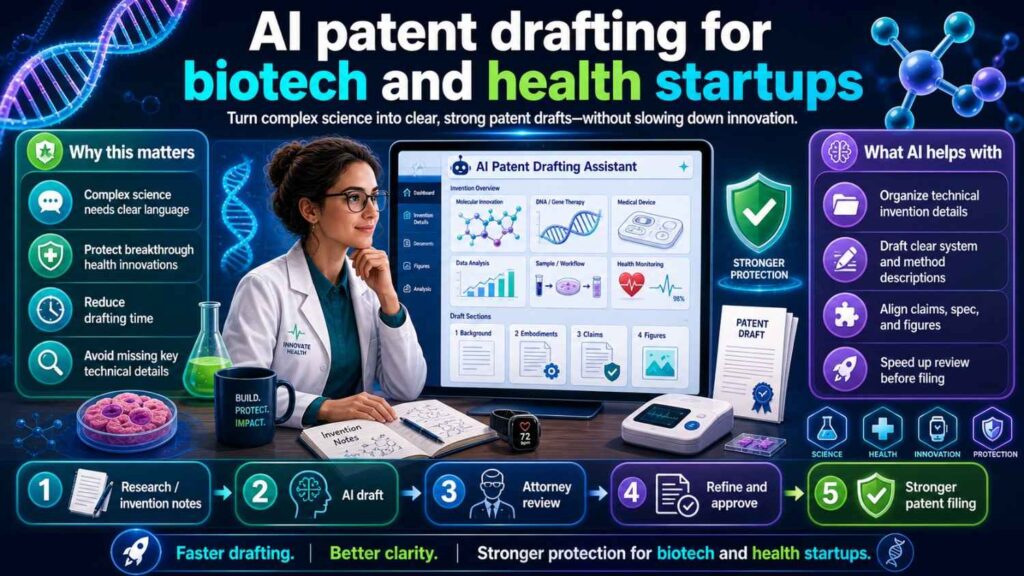
Biotech and health inventions need careful language.
AI can help draft, but it may add terms that carry more meaning than intended.
For example, it may say “diagnose” when the invention only flags a risk. It may say “treat” when the system only recommends review. It may say “patient” when the product is a wellness tool. It may say “clinical decision” when the product is not meant for that.
Be precise.
If the invention detects a pattern, say that.
If it sends an alert, say that.
If it supports a clinician, say that.
Do not overstate.
Also make sure data sources, sample steps, model outputs, and user actions are clear.
Health-related patent drafts need extra care because technical wording and product claims can matter a lot.
Attorney oversight is especially important here.
Build a patent review culture
The best startups do not treat patents as a one-time chore.
They build a simple culture around invention capture and review.
When a major technical problem is solved, the team records it.
When a new model pipeline is created, the team notes what changed.
When a new hardware design works, the team captures why.
When a new architecture improves speed or cost, the team writes down the flow.
This does not need to slow the team down.
It can be lightweight.
The point is to avoid losing inventions in the rush of building.
AI can help turn these notes into drafts later. But the notes must exist first.
A strong patent culture helps startups protect value without stopping product speed.
Common mistakes startups make with AI patent drafting
One common mistake is starting with a vague prompt.
Another is trusting the first draft because it sounds professional.
Another is letting AI add fake parts.
Another is failing to separate required features from optional ones.
Another is skipping founder review.
Another is skipping attorney review.
Another is filing a draft that protects the current UI but not the real technical moat.
Another is waiting until after public disclosure.
Another is using old product notes without marking them as old.
Another is making claims broad without enough spec support.
These mistakes are avoidable.
The solution is not complicated.
Use AI with structure.
Review the draft with care.
Bring in patent judgment before filing.
A safer prompt structure for AI patent drafting
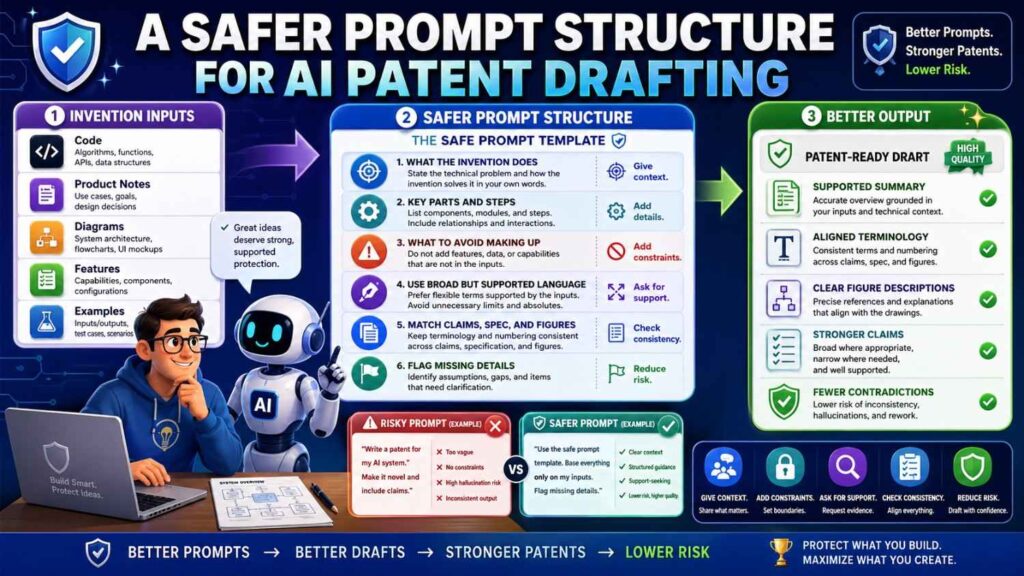
A good prompt should not just say, “Draft a patent.”
It should provide context and rules.
Start with the invention story.
Then give the problem.
Then explain the solution.
Then list required features.
Then list optional features.
Then list things to avoid.
Then provide technical flow.
Then ask AI to list assumptions before drafting.
Then ask it to draft using consistent terms.
Then ask it to mark uncertain details.
This kind of prompt creates a better first draft.
For example:
“Draft a patent-style description for a system that predicts machine failure risk from sensor data and changes a maintenance schedule. Required features are sensor data, a risk model, a failure risk score, and a schedule change. Optional features include a dashboard, technician alert, cloud storage, and model updates. Do not say the system diagnoses human health. Do not require GPS. Before drafting, list assumptions and mark uncertain details.”
That prompt is much safer than:
“Write a patent for AI predictive maintenance.”
Better inputs create better outputs.
Review AI output like an engineer
Engineers are good at systems thinking.
Use that skill.
When you review the draft, do not just read the words. Trace the system.
Follow the data.
Follow the signal.
Follow the user action.
Follow the model output.
Follow the control command.
Ask whether each step makes sense.
Ask whether the output exists before it is used.
Ask whether the actor has the data it needs.
Ask whether the figure shows the same path as the text.
Ask whether the claim requires the right pieces.
This kind of review catches many problems that grammar checks miss.
A patent draft is a technical system on paper.
Treat it like one.
Review AI output like a competitor
After the technical review, read the draft like a competitor.
Ask how you would design around it.
Could you avoid one required feature?
Could you move processing from cloud to edge?
Could you use another sensor?
Could you replace the model type?
Could you send a recommendation instead of a command?
Could you use a different data source?
Could you copy the core value while avoiding the claim?
This exercise helps reveal whether the patent is too narrow.
It also helps find whether the draft protects the real moat.
A patent attorney can help with this kind of review, but founders should think this way too.
You know how competitors might copy you.
Use that knowledge.
Review AI output like an investor
Investors want a clear moat.
Read the patent story through that lens.
Can you explain what the patent protects in one sentence?
Does it match the company pitch?
Does it protect a core technical edge?
Does it show that the company has more than a simple app feature?
Does it support the long-term platform?
If not, the draft may need refocusing.
A patent is not only for patent offices. It is part of how your startup tells the market that what you are building is real and defensible.
Keep the language simple, but the invention strong
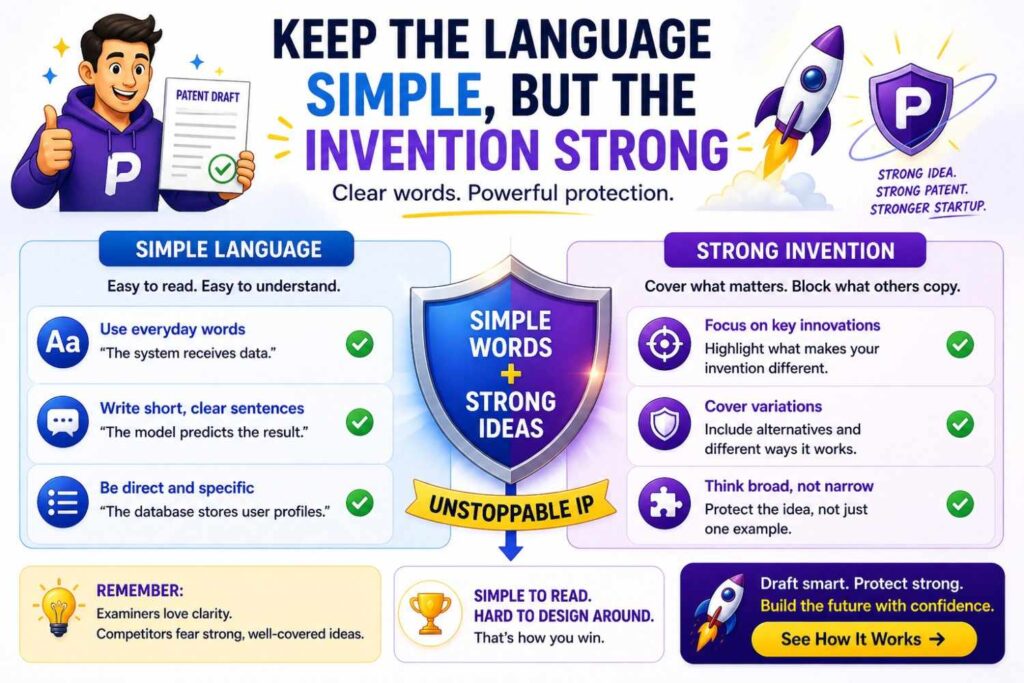
Patent drafts can be clear without being shallow.
Simple words help everyone.
They help founders review.
They help engineers catch mistakes.
They help attorneys focus on substance.
They help future readers understand the invention.
The goal is not to make the draft sound fancy.
The goal is to make it accurate and strong.
AI often writes in a formal style. That can be useful, but it can also hide weak thinking.
Push for clear language.
If a sentence is hard to understand, ask what it really means.
If the answer is unclear, the draft may need more work.
A strong invention does not need fog.
It needs clear support.
Why “speed without risk” does not mean “no risk”
No patent process removes all risk.
Patent law is complex. Markets change. Competitors adapt. Patent offices may reject claims. Technology may evolve.
The goal is not zero risk.
The goal is lower risk.
AI patent drafting can reduce delay, cost, and friction. But only if paired with structure and expert review.
Without that, AI may increase risk by making it easier to file weak drafts quickly.
Speed without risk really means speed without careless risk.
It means fast drafting, but not blind drafting.
It means AI help, but not AI-only filing.
It means founder control, engineer truth, and attorney judgment.
That is the balance startups need.
The future of startup patent work
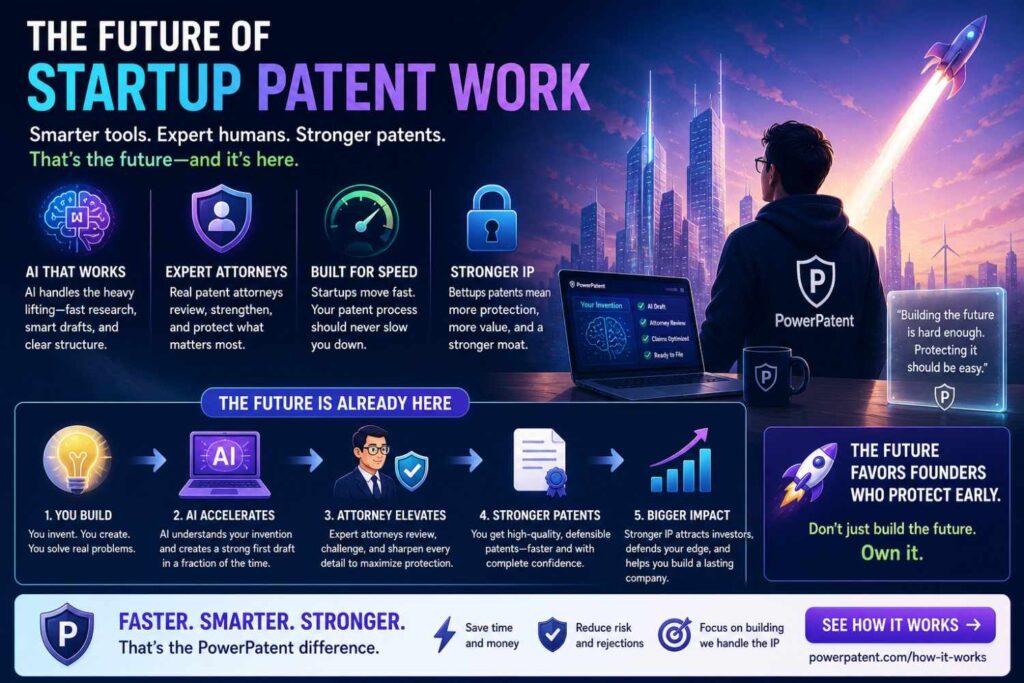
The old patent process was not built for modern startup speed.
Founders need a better way.
They need to capture inventions as they build. They need software that understands technical work. They need faster drafts. They need clearer review. They need attorney oversight without endless delay. They need patents that support the business, not documents that sit in a folder and confuse everyone.
AI is part of that future.
But AI is not the whole answer.
The real shift is a better workflow.
A workflow where startup teams can move fast, stay involved, and still file with confidence.
That is why PowerPatent exists.
PowerPatent helps founders turn inventions into patent filings through smart software and real attorney support. It is built for startups that want strong IP without the old-school headache. You can see how it works here: https://powerpatent.com/how-it-works
Final thoughts
AI can make patent drafting faster for startups.
That speed is valuable.
But speed must be handled with care.
A patent draft should not be a pile of AI-generated text. It should be a clear, accurate, well-supported story about the invention your startup is building.
To use AI safely, start with a strong invention brief. Separate required features from optional ones. Tell AI what to avoid. Use real technical inputs. Check for fake details. Review claims, spec, and figures for consistency. Make sure the draft protects the business moat. Involve engineers for technical truth. Involve patent attorneys for strategy and quality.
That is how startups get speed without unnecessary risk.
You do not need to choose between moving fast and protecting your invention well.
With the right process, you can do both.
PowerPatent helps startups draft, review, and file smarter patents with software speed and real attorney oversight. Learn how it works here: https://powerpatent.com/how-it-works
Leave a Reply