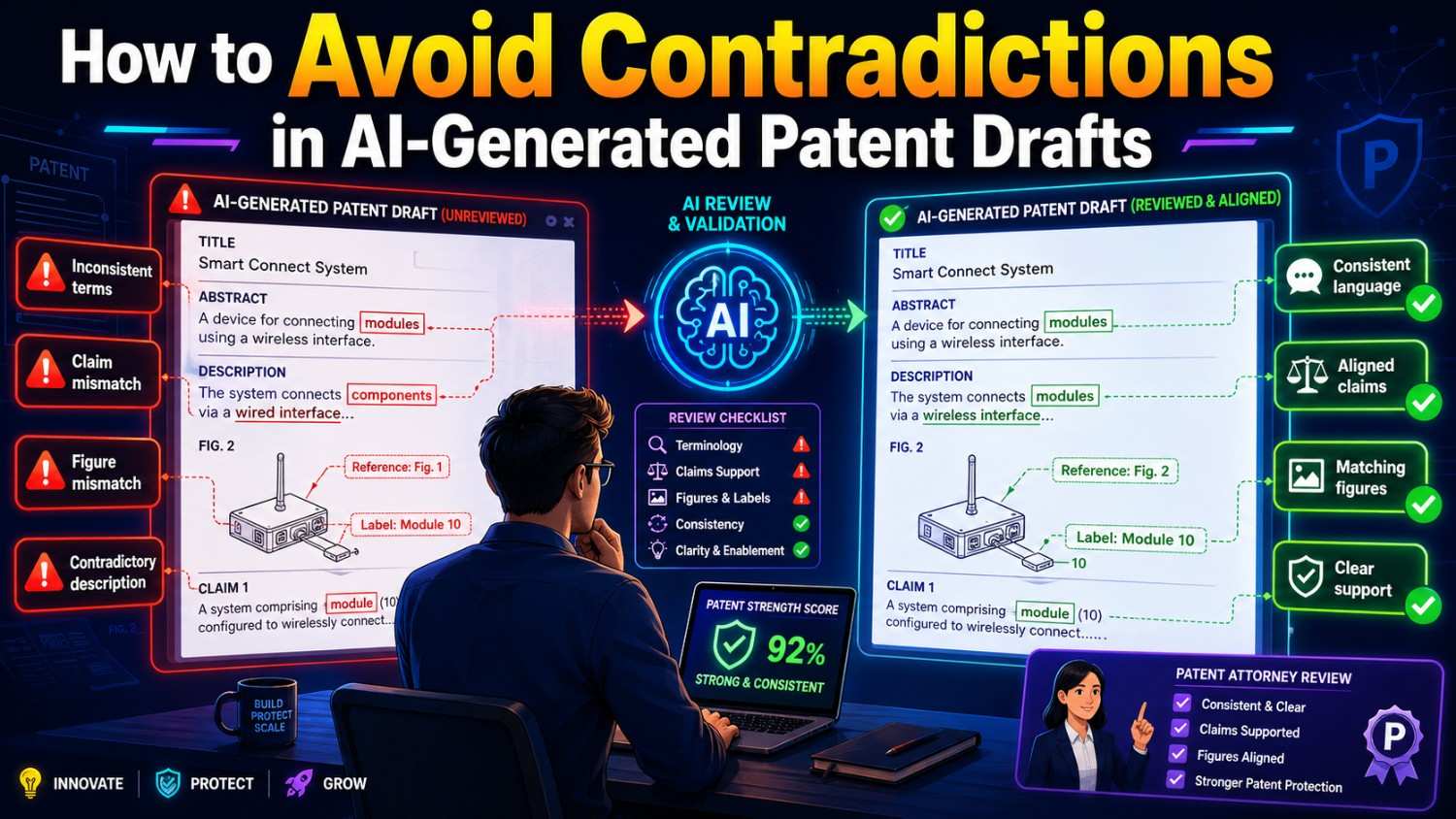
AI can help you write a patent draft faster. But speed can create a new problem: the draft may say one thing in one place and a different thing somewhere else.
That is risky.
A patent draft should tell one clear story. The words should match. The drawings should match. The claims should match the details. The examples should not fight each other. When they do, the draft becomes weaker, harder to fix, and easier to attack later.
This guide shows you how to avoid those problems before they cost you time, money, or patent strength.
And if you want a faster way to turn your invention into a clean, attorney-reviewed patent draft, you can see how PowerPatent works here: https://powerpatent.com/how-it-works
Why contradictions happen in AI patent drafts
AI is fast because it can produce a lot of text from a small amount of input.
That is also why contradictions happen.
A founder may give the AI a short note like:
“Our system uses a machine learning model to predict battery failure in electric vehicles.”
The AI then tries to fill in the gaps. It may add sensors. It may add a cloud server. It may add a mobile app. It may add training data. It may add a dashboard. Some of those details may be right. Some may be wrong. Some may conflict with what the invention really does.
That is the core issue.
AI does not truly know your invention unless you teach it. If the input is thin, the output may sound polished but still be wrong.
A draft can look clean on the surface while hiding small conflicts inside. One section may say the model runs on the vehicle. Another section may say the model runs in the cloud. One part may say the system needs three sensors. Another part may say one sensor is enough. One claim may require a step that the main example never uses.
These issues are easy to miss because patent drafts are long. They repeat ideas in many forms. They include summaries, drawings, examples, claim language, and technical details. A single mismatch can slip through.
That is why AI patent drafting needs a process.
Not just a prompt.
Not just a quick review.
A real process.
At PowerPatent, the goal is to help founders move fast without losing control of the invention story. Smart software can speed up the work, but real attorney oversight helps catch the issues that AI alone can miss. You can see that workflow here: https://powerpatent.com/how-it-works
A contradiction is not always obvious
Most people think a contradiction means two sentences directly disagree.
That can happen.
For example:
“The system does not use GPS.”
Then later:
“The GPS module sends location data to the server.”
That is a clear conflict.
But many patent contradictions are softer. They hide in small word choices.
A draft may say the system “always” does something in one section, then describe an example where it does not do that thing. A claim may say a part is “required,” while the description says it is “optional.” A drawing may show five modules, while the text names six. A summary may say the invention is for robots, while the claims only mention drones.
These are contradictions too.
They may not jump off the page. But they can still create doubt.
And doubt is not your friend when you are trying to protect a new idea.
A strong patent draft should make the invention feel clear, steady, and well thought out. Every section should support the same main idea. The draft should not make a reader wonder, “Which version is real?”
That reader may be a patent examiner. It may be an investor. It may be a buyer. It may be a future competitor looking for a way around your patent.
Your job is to remove confusion before anyone else sees it.
Start with one clean invention story
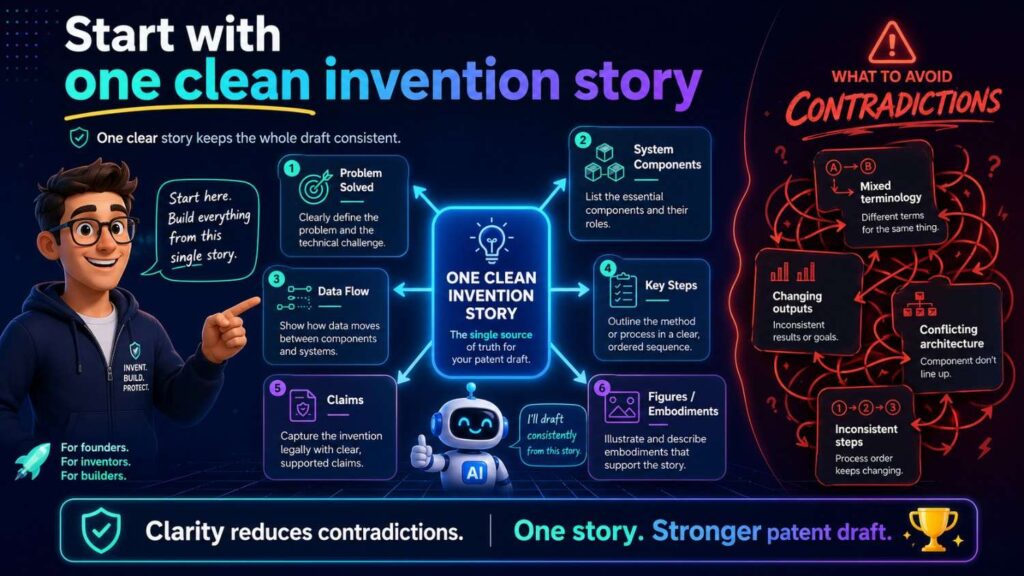
Before you draft anything, write the invention story in plain words.
Not legal words.
Not fancy words.
Plain words.
The story should answer a few simple questions.
What problem does the invention solve? What does the system do? What parts does it use? What is new about it? What can change from one version to another? What must always be there?
This simple story becomes the source of truth.
For example:
“Our invention helps a warehouse robot choose a safer path by using live camera data, stored map data, and a risk score from a trained model. The robot can make the decision on board, or it can receive help from a local server. The key idea is that the route is changed based on a risk score that predicts unsafe zones before the robot reaches them.”
That short story already prevents many mistakes.
It says the robot can work on board or with a local server. So the draft should not say the server is always required. It says the key idea is the risk score. So the claims and examples should keep that idea at the center. It says camera data and map data are used. So if the AI later invents lidar, radar, or GPS, you can check whether those are true or just extra guesses.
A clean invention story keeps the draft grounded.
Without it, AI may build a draft around assumptions.
With it, you can review the draft against a clear base.
This is one reason PowerPatent helps founders organize the invention before the drafting work goes too far. When your inputs are clearer, the output is stronger. Learn more here: https://powerpatent.com/how-it-works
Name things once, then keep the names steady
One of the most common AI drafting problems is name drift.
That means the same thing gets called by different names across the draft.
A “prediction engine” becomes an “AI module.” Then it becomes a “model server.” Then it becomes a “risk analyzer.” Then it becomes a “classification unit.”
Sometimes that is okay if each name means a different thing. But if they all refer to the same part, the draft may become confusing.
In a patent draft, steady names matter.
If the invention uses a “route planner,” call it a route planner each time. If the system has a “risk model,” do not switch to “safety model,” “hazard model,” and “accident model” unless you explain the difference.
This is not just about style. It is about control.
When names change, the reader may think there are multiple parts. Or they may think the draft is unclear. Or they may think a claim is missing support because the claim uses one name and the description uses another.
Before using AI, create a small name map.
For example:
The device is called “robot device.”
The model is called “risk model.”
The score is called “route risk score.”
The map is called “facility map.”
The server is called “edge server.”
Then tell the AI to use those names only.
After the draft is created, search the whole document for alternate names. Look for words that may refer to the same part. Fix them. Keep the draft steady.
This one habit removes a surprising amount of confusion.
Avoid “always” unless it is truly always
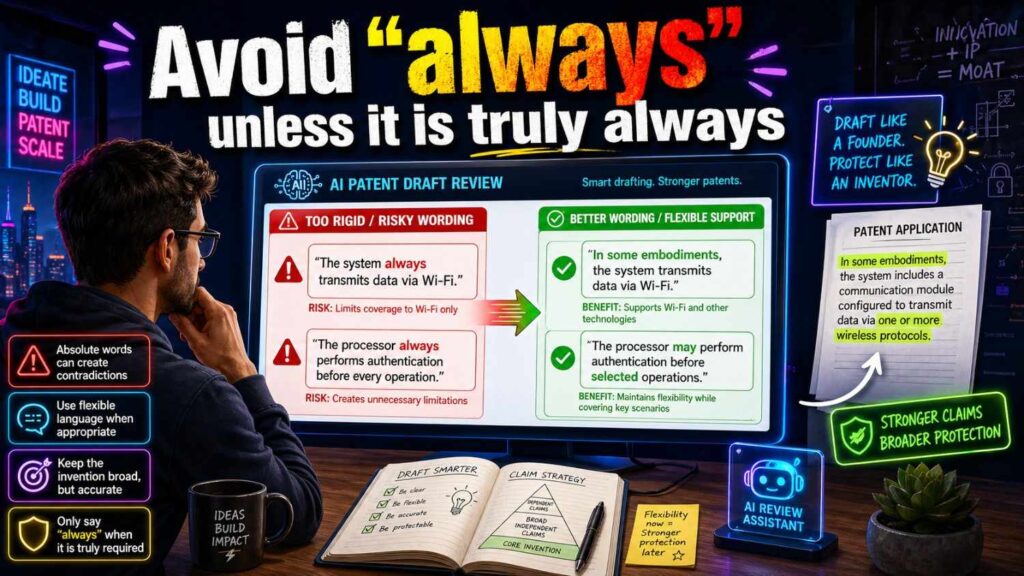
AI likes strong words.
It may write that a system “always” performs a step. It may say a sensor is “required.” It may say a model “must” be trained in a certain way. It may say a device “only” works through a cloud server.
These words can be dangerous.
They may make your patent narrower than it needs to be. They may also create contradictions when another section gives a broader example.
For example, one section may say:
“The system always sends sensor data to a cloud server.”
But another section may say:
“In some cases, the device processes sensor data locally.”
Those two ideas fight.
The fix is simple. Use careful words.
Instead of “always,” say “in some cases,” “in one example,” “in some versions,” or “the system may.”
That does not mean the draft should be vague. It means the draft should be honest about what is fixed and what can change.
Some features are core. Some are optional. Some are examples. Some are nice add-ons.
The draft must make those roles clear.
A good patent draft protects the big idea while still showing useful details. It does not lock the invention into one version unless that version is truly required.
This is where attorney review helps a lot. A strong patent attorney can spot language that quietly narrows your invention or creates conflict. PowerPatent combines AI tools with real attorney oversight so founders do not have to catch everything alone. See how that works here: https://powerpatent.com/how-it-works
Separate the core idea from the examples
Many contradictions happen because the draft mixes up the invention with one example of the invention.
The core idea is the broad thing you want to protect.
The example is one way to build it.
Those are not the same.
Suppose your invention is a system that reduces energy use in a data center by moving workloads based on predicted cooling load.
One example may use temperature sensors, GPU usage data, and a neural network.
But the invention may not need those exact sensors. It may not need that exact model type. It may not need GPUs. It may also work with CPU clusters, edge devices, or storage racks.
If the draft says the invention “is” the exact example, you may lose room.
The draft should say the invention may be used in that example.
That small shift matters.
Bad version:
“The invention is a GPU data center system that uses rack temperature sensors and a neural network.”
Better version:
“In some examples, the system is used in a GPU data center and uses rack temperature sensors and a neural network.”
The second version leaves more room.
It also avoids contradictions later when the draft describes other data centers, other sensors, or other models.
When you review an AI draft, ask this simple question again and again:
“Is this a must-have part of the invention, or just one way to build it?”
If it is just one way, do not let the draft treat it like the only way.
Build a “must, may, and never” table before drafting
A simple table can save your patent draft.
It does not need to be fancy.
You can write it in a doc before using AI.
There are three buckets.
First, write what the invention must have.
Second, write what the invention may have.
Third, write what the invention should not say.
For example, for an AI health monitoring tool, the table may look like this in plain words:
The system must receive user health data, compare the data to a learned pattern, and create an alert when the pattern shows risk.
The system may use wearable data, phone data, medical record data, or home sensor data.
The draft should not say the tool diagnoses disease. It should not say a doctor is not needed. It should not say the system is limited to one watch brand.
This kind of prep gives the AI guardrails.
It also gives your reviewer a clear way to check the draft.
When a sentence says the system must use a smartwatch, you can check the table and see that a smartwatch was only optional. When a section says the tool diagnoses disease, you can see that the draft has crossed a line you wanted to avoid.
This is simple. But it works.
Founders often skip this step because they want the draft fast. That is understandable. But skipping it can make the draft slower in the end because contradictions create cleanup work.
A little structure up front saves a lot of repair later.
Make the claims and the description tell the same story
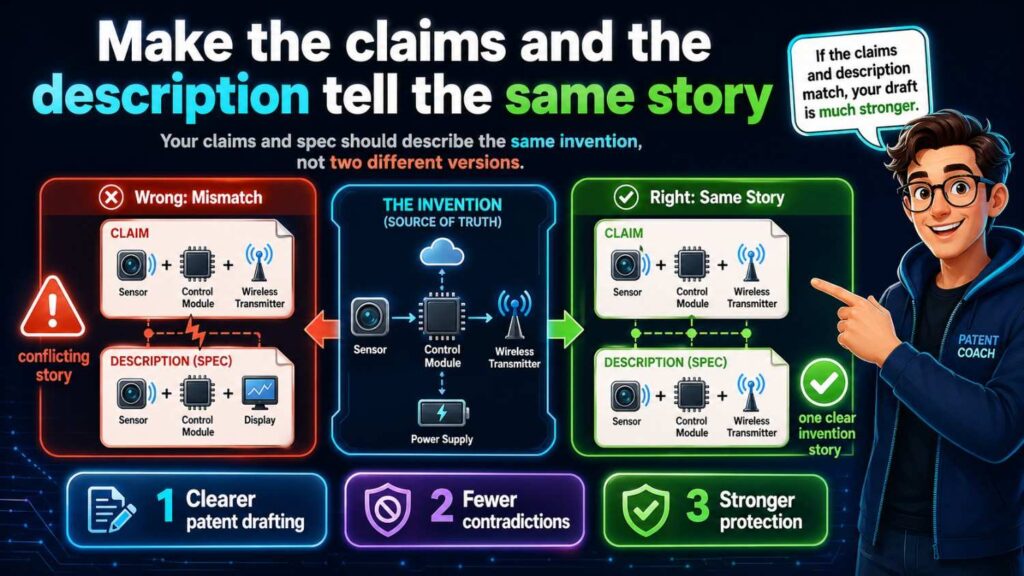
The claims are the part of the patent that defines what you are trying to protect.
The description explains the invention in more detail.
They must match.
A common AI problem is that the claims say one thing, while the description focuses on something else.
For example, the claim may say:
“A method for ranking software bugs based on predicted customer impact.”
But the description may spend most of its time on:
“Detecting software bugs using code scanning.”
Those are related, but they are not the same. One is about ranking bugs. The other is about finding bugs.
That mismatch weakens the draft.
The claims should be supported by the description. The description should explain each claimed part in clear terms. If the claim says there is a “customer impact score,” the description should explain where it comes from, what data it may use, and how it may affect the bug ranking.
Do not let AI create claims in a vacuum.
Review each claim line by line. Then find the matching support in the description.
Ask:
Where does the draft explain this part?
Does the same name appear?
Does the example show how it works?
Does any later section say something different?
If you cannot find support, the draft may need more detail. If the support uses different words, align the terms. If the description says the opposite, fix the conflict.
A patent draft is not just a pile of sections. It is one system. The claims and description should work together.
Watch for number conflicts
AI often creates number errors.
These can be easy to miss.
A draft may say the system has three sensors, then later list four. It may say a process has five steps, then the drawing shows six. It may say the model uses ten features, then the example includes twelve. It may say a threshold is 80%, then later use 85%.
Some number changes are fine if they are examples. But the draft must make that clear.
For example:
“In one example, the risk threshold is 80%.”
Then later:
“In another example, the risk threshold is 85%.”
That is not a contradiction if the draft explains that both are examples.
But this is a problem:
“The risk threshold is 80%.”
Then later:
“The system triggers an alert when the score passes 85%.”
Now the reader may wonder which number matters.
The fix is to avoid hard numbers unless you need them.
When numbers are only examples, label them as examples.
Use phrases like “for example,” “in one version,” or “such as.”
Also check all figure labels. If Figure 2 shows steps 202, 204, 206, and 208, make sure the text does not refer to step 210 unless step 210 exists.
Number conflicts are small, but they make the draft feel careless.
A clean draft builds trust.
Check every drawing against the words
Drawings are one of the best ways to find contradictions.
A figure gives you a fast view of the invention. It shows the parts and the flow. If the text says one thing and the drawing shows another, you have a problem.
For AI-generated patent drafts, this happens often because the text and drawings may be created at different times. The AI may name a module in the text that does not appear in the drawing. Or the drawing may show a server, while the text says the system is fully local. Or the method steps may be in a different order.
Do a drawing walk-through.
Start with Figure 1. Read the figure description. Then read the detailed text for that figure. Check each part.
Does every label exist?
Does every label have the same name?
Does the flow direction match the text?
Does the drawing show optional parts as if they are required?
Does the text mention parts not shown in the figure?
Then move to the next figure.
This review can feel slow, but it is one of the fastest ways to catch hidden conflicts.
For software and AI inventions, drawings often include system blocks, data flows, model pipelines, user devices, servers, and method steps. These must line up.
If the drawing shows training data going into a model, but the text says the model is pre-trained and never updated, you need to explain whether both versions are possible.
If the method flow says data is cleaned before being labeled, but the text says it is labeled before cleaning, you need to fix the order or explain that the order may change.
Drawings should make the invention easier to understand, not add new confusion.
Do not let AI invent fake parts
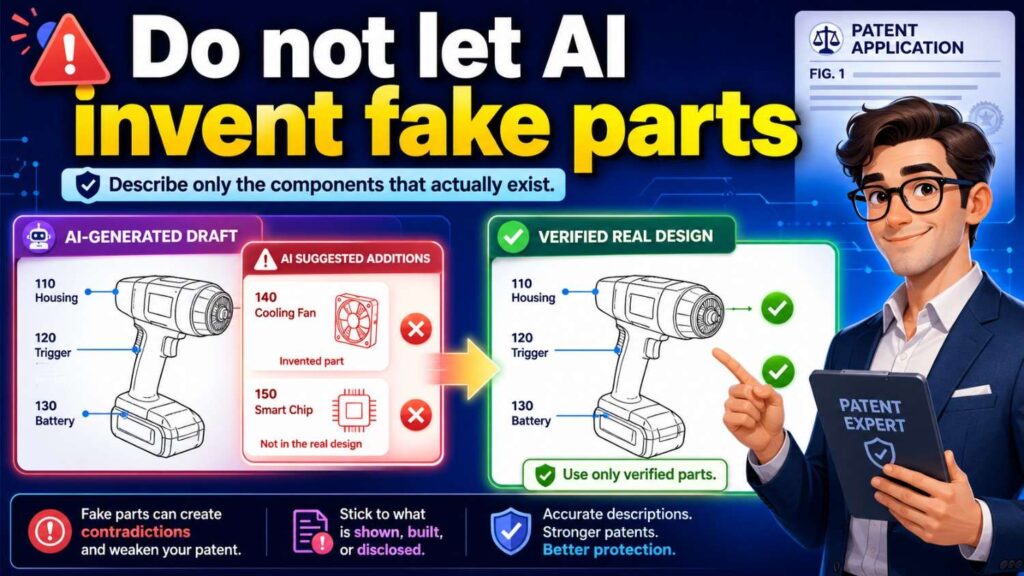
AI can be too helpful.
If you describe a machine learning system, it may add a training server, a data lake, a user profile store, a feedback loop, an app, an admin panel, an encryption module, and a payment system.
Some of those may be useful.
Some may be fake.
Fake parts create two problems.
First, they may be wrong. Your real system may not use them.
Second, they may create contradictions with the actual invention.
For example, your invention may be a lightweight model that runs on a tiny device without cloud access. But the AI may add a cloud server because many AI systems use one. Now the draft may suggest the cloud is part of the invention, even though your key value is that cloud access is not needed.
That is a big issue.
Do not assume a polished AI detail is true.
Mark each part as real, possible, or wrong.
Real means your invention uses it.
Possible means the invention could use it in some versions.
Wrong means it should be removed.
This review is especially important for deep tech startups. Your invention may have subtle design choices that generic AI text will not understand. Maybe the model runs on device for privacy. Maybe the sensor is passive to save power. Maybe the system avoids a step that competitors require. Those details matter.
Generic AI may smooth them out.
Your draft should not.
PowerPatent is built for technical founders who need to move fast but still protect the real invention, not a generic version of it. The platform helps turn code, models, and invention details into stronger patent work with attorney review built in. See the workflow here: https://powerpatent.com/how-it-works
Keep the time order clear
Many inventions involve steps.
Data is received. Data is cleaned. A model is used. A score is created. A choice is made. An action is taken.
AI may mix up this order.
That can create contradictions.
For example, a draft may say:
“The system trains the model based on the risk score.”
Then later:
“The system uses the trained model to create the risk score.”
That may be circular. It may not make sense unless the draft explains a feedback loop.
Time order matters in software, AI, robotics, biotech, hardware control, and data systems.
To catch order problems, create a plain step flow.
Write it as a simple story.
The device collects data.
The data is cleaned.
The model receives the cleaned data.
The model creates a score.
The controller changes a device setting based on the score.
Then compare the draft to that story.
Look for steps that happen too early or too late. Look for outputs that appear before inputs. Look for actions that depend on data the system does not have yet.
Also watch training and use.
In AI inventions, there is often a training phase and a use phase. The training phase builds or updates the model. The use phase applies the model to new data.
AI-generated drafts often mix those phases.
A sentence may say the model is trained during live use. Another section may say the model is already trained. Both can be true if the invention supports both. But the draft must explain that clearly.
For example:
“In some examples, the model is trained before use. In other examples, the model is updated during use based on new data.”
That clears up the conflict.
Without that explanation, the draft may look inconsistent.
Make optional features truly optional
Optional features are useful in a patent draft. They show different versions of the invention.
But optional features must stay optional.
AI may start by saying a feature is optional, then later write as if it is required.
For example:
“The system may include a voice interface.”
Then later:
“The user speaks a command into the voice interface to start the process.”
That second sentence may imply the voice interface is needed.
A better version is:
“In examples that include a voice interface, the user may speak a command to start the process.”
That keeps the option in its lane.
This matters because optional details can narrow the invention if they are not handled well.
When reviewing a draft, search for every “may include” feature. Then check whether the feature later becomes required by accident.
Common optional features that often drift into required status include mobile apps, cloud servers, dashboards, user accounts, specific sensors, specific model types, databases, feedback loops, manual approvals, alerts, and network connections.
These may be useful. But they may not be core.
Keep the draft honest.
Do not mix product features with invention features
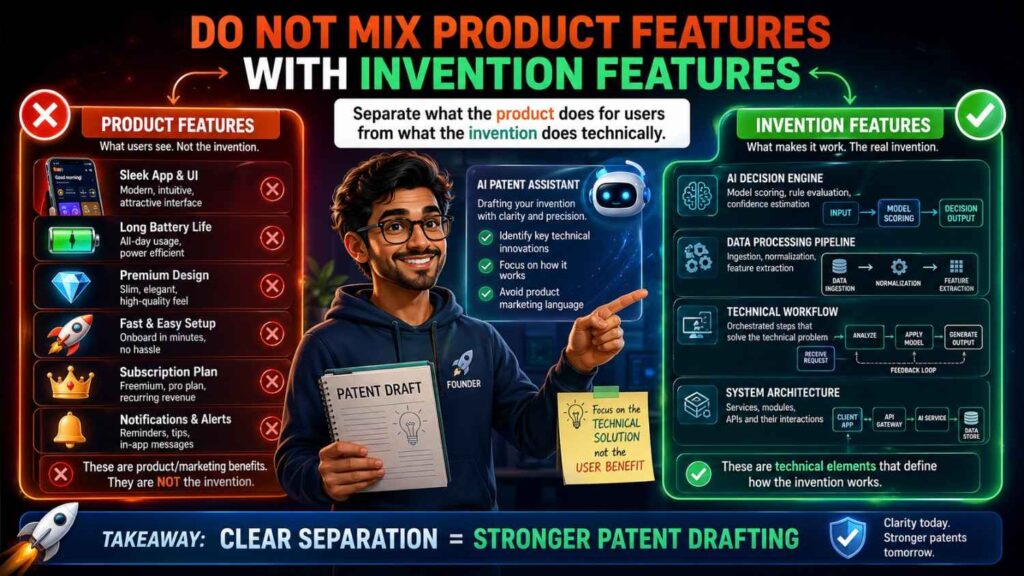
Founders often describe their product. That makes sense. They know the product best.
But a patent draft should protect the invention, not just the current product screen.
AI may turn product details into invention limits.
For example, your product may have a web dashboard with a blue risk meter and three tabs. The invention may be a better way to calculate risk from machine data.
If the AI focuses too much on the dashboard, the draft may imply that the invention requires that dashboard.
That is not what you want.
The product is one version. The invention is the deeper idea.
This is where many startup patent drafts go wrong. They describe what exists today but fail to protect what the company may build tomorrow.
A good draft should cover the product, but it should not be trapped by the product.
When reviewing an AI draft, ask:
Is this detail part of our current app, or part of the invention?
If the detail is just part of the app, label it as an example.
For example:
“In one example, the risk score is shown in a dashboard.”
That is better than:
“The risk score is shown in the dashboard.”
The second version sounds more fixed.
Small words create big effects.
Align the problem statement with the solution
A strong patent draft starts with a problem and then explains a solution.
But AI sometimes creates a problem that does not match the invention.
For example, the invention may reduce model delay on edge devices. But the background section may talk mostly about data privacy. Privacy may be related, but it may not be the core problem.
That creates a soft contradiction. The draft says the problem is one thing, while the invention solves another.
The reader may wonder why the invention matters.
To fix this, keep the problem narrow and true.
If the invention reduces delay, say that systems may respond too slowly when data must be sent away for processing.
If the invention reduces power use, say that devices may waste power when running large models all the time.
If the invention improves training data quality, say that noisy labels can lead to poor model results.
The problem should set up the solution.
Do not let AI write a broad, generic background that could fit any startup. Generic background often adds clutter and may conflict with your real point.
Your patent draft should make the reader think:
“Yes, that is the problem. And yes, this invention is a clear way to solve it.”
That is also better for business. Investors and partners do not just want legal text. They want to understand why your technology matters.
Watch for “black box” AI wording
AI-generated patent drafts often use vague phrases like:
“The AI system processes the data.”
“The model generates an output.”
“The engine analyzes the input.”
These phrases may be true, but they are often too thin.
They can also hide contradictions.
If the draft does not explain what the model receives, what it creates, and how the output is used, later sections may fill in different answers.
One section may say the model predicts failure. Another may say it classifies users. Another may say it ranks tasks. Those are different things.
To avoid this, define the model’s job clearly.
What goes in?
What comes out?
What happens next?
For example:
“The risk model receives sensor values and recent machine state data. The risk model creates a risk score that shows how likely the machine is to fail during a future time window. A controller changes a maintenance schedule based on the risk score.”
That is much clearer.
It gives the draft a stable center.
AI inventions do not need to reveal every private business secret in a careless way. But the draft should give enough clear detail to support the invention and avoid confusion.
A vague draft can sound broad, but vague is not the same as strong.
Strong means clear.
Use one meaning for each key word
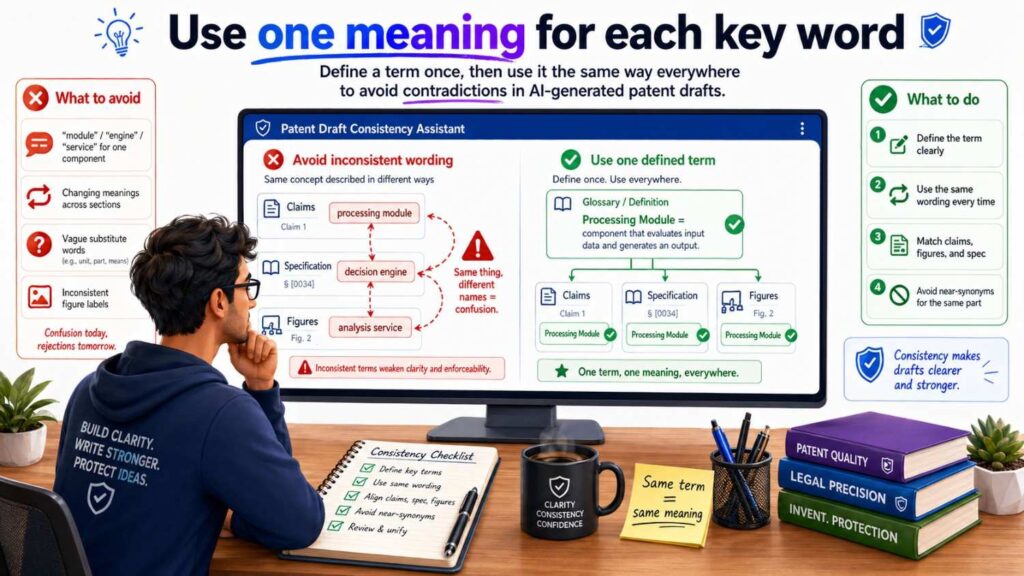
Some words can mean different things in different contexts.
Take the word “model.”
It may mean a machine learning model. It may mean a data model. It may mean a simulation model. It may mean a product model.
If a draft uses “model” in all these ways without care, confusion follows.
The same is true for words like profile, score, node, agent, token, event, state, session, layer, feature, and signal.
In technical drafts, these words matter.
Pick one meaning for each key word. If the draft needs more than one meaning, use different names.
For example:
Use “machine learning model” for the AI model.
Use “device profile” for stored device data.
Use “simulation model” for a physics model.
Do not call all of them “model.”
This may sound basic, but it prevents many contradictions.
AI often repeats common technical words without knowing the fine meaning your team uses. Your team should control the vocabulary.
One good way to do this is to give the AI a glossary.
A glossary is just a short list of terms and meanings.
The glossary can say:
“Risk score means a value that shows predicted risk for a route segment.”
“Route segment means a portion of a path between two points.”
“Edge server means a local server in or near the facility, not a remote cloud server.”
Then use those meanings across the draft.
Keep hardware, software, and data roles separate
Many modern inventions combine hardware, software, and data.
That is powerful.
It also creates room for contradictions.
A draft may say a sensor makes a decision. Later it may say a processor makes the decision. Another section may say the server makes it. The drawing may show the model in the cloud. The product may actually run it on device.
You need to know who does what.
For each key action, identify the actor.
Who receives the data?
Who cleans it?
Who runs the model?
Who stores the result?
Who triggers the action?
Who sends the alert?
Once you know that, check the draft.
For example:
If the robot runs the model, do not let another section say the cloud server runs the model unless that is also a supported version.
If the server only trains the model, do not let the draft say the server controls the robot in real time.
If the sensor only measures data, do not let the draft say the sensor “determines” the final action unless the sensor has processing logic.
These may seem like small wording issues. They are not.
In patent drafting, the actor matters because it shapes the invention.
A system where a server makes decisions is different from a system where an edge device makes decisions. A system where a user approves each action is different from one that acts on its own.
Be clear.
Do not let the summary overpromise
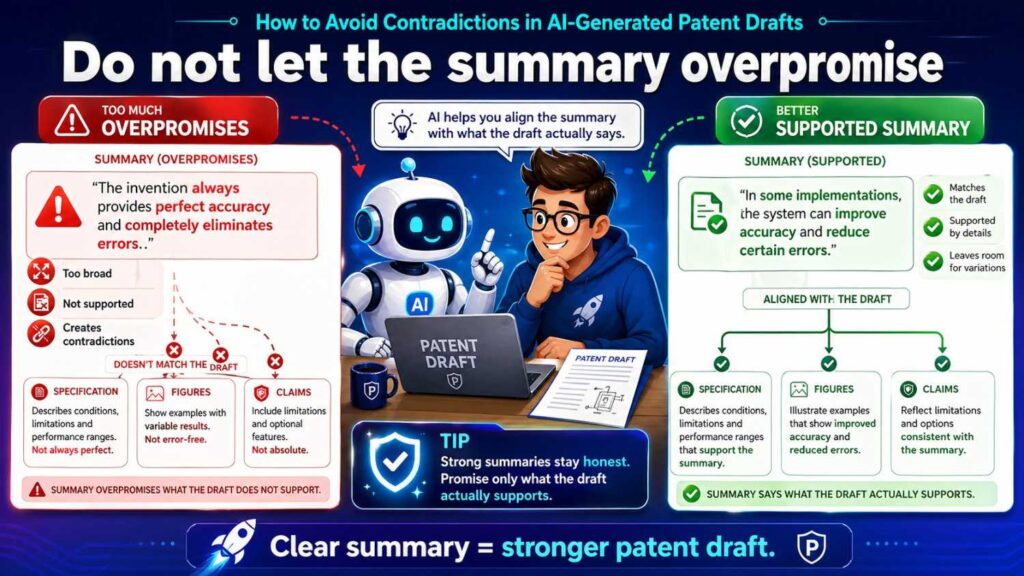
The summary section is often short, but it can cause trouble.
AI may write a broad summary that promises more than the draft supports.
For example, the summary may say:
“The invention prevents all unauthorized access.”
But the details only describe flagging risky login attempts.
That is a contradiction.
The system does not prevent all unauthorized access. It detects or reduces risk in a certain way.
Overpromising is risky because it makes the draft look less careful.
It can also create business risk. A patent draft should not make claims that sound like marketing hype when the technology does not support them.
Use measured language.
Instead of saying “prevents all failures,” say “may reduce a risk of failure.”
Instead of saying “guarantees accuracy,” say “may improve accuracy.”
Instead of saying “eliminates human review,” say “may reduce manual review.”
This does not weaken the invention. It makes the draft more credible.
Credible drafts are easier to trust.
Make sure the abstract does not create a new invention
The abstract is short. It should summarize the invention.
It should not introduce new features that are missing from the rest of the draft.
AI sometimes writes an abstract after reading the whole draft and adds a polished twist that sounds nice but is not supported.
For example, the draft may describe a system that ranks repair tasks. The abstract may say the system also orders replacement parts, sends invoices, and schedules technicians.
If those features are not in the draft, the abstract has invented more.
That creates mismatch.
Review the abstract last.
Make sure each key part in the abstract appears in the claims and description. Make sure the abstract does not use names that differ from the main draft. Make sure it does not narrow the invention by naming one example as if it were required.
The abstract should be clear, plain, and faithful.
Nothing more.
Watch claim terms like a hawk
Claims use short phrases that carry a lot of weight.
If the claim says “training data set,” the description should use the same phrase or clearly explain it.
If the claim says “control signal,” the description should show what creates it and what it does.
If the claim says “confidence score,” the examples should not only talk about a “risk score” unless those are the same thing and the draft says so.
Claim terms should not float alone.
Every important claim term needs a home in the description.
AI may draft claims with terms that sound smart but are not well supported. That can happen when the AI tries to make the claim sound more formal.
Do not accept that blindly.
For each claim term, ask:
Did we define this?
Did we use it the same way elsewhere?
Does it match the invention story?
Is it broader or narrower than intended?
Does it conflict with another term?
This is a careful task, but it pays off.
The claims are too important for loose wording.
PowerPatent helps founders move from raw invention notes to attorney-reviewed patent work without making them manage every tiny drafting detail alone. See how the platform helps here: https://powerpatent.com/how-it-works
Keep “training,” “tuning,” and “using” separate
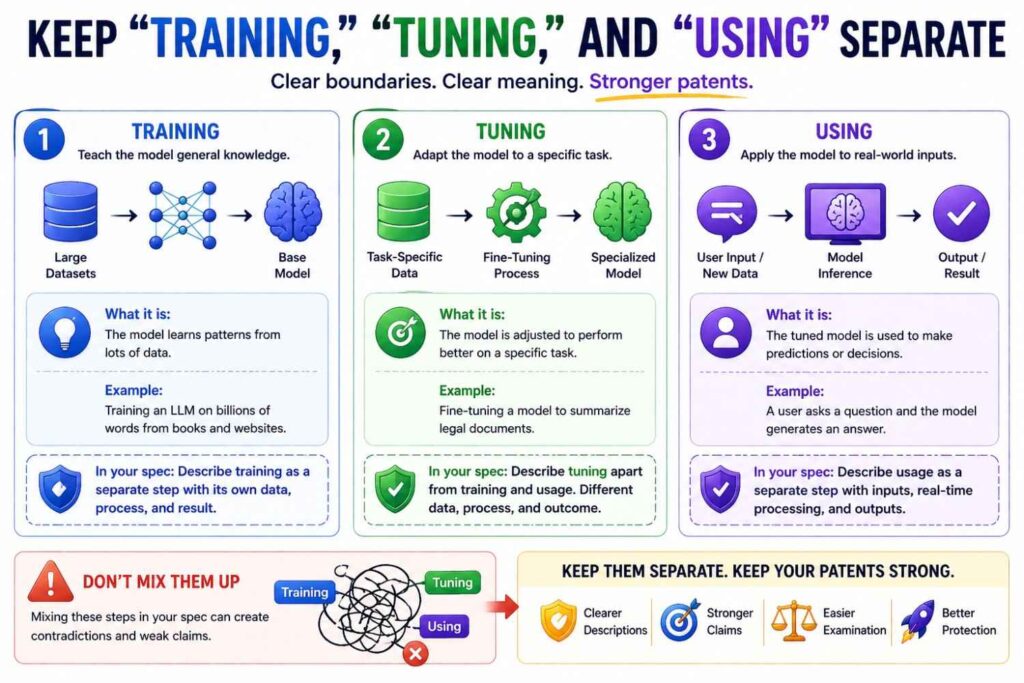
AI and machine learning patents often involve model training.
This is an area where contradictions appear fast.
Training means creating or updating the model using data.
Tuning may mean adjusting settings or improving performance.
Using means applying the model to new data to get an output.
A draft may confuse these steps.
It may say the model is trained on live input data. Then it may say live input data is scored by an already trained model. It may say the model is tuned based on user feedback. Then it may say no user feedback is used.
These can all be valid in different versions. But the draft needs to say so.
A clean draft might explain:
In one example, the model is trained before use using historical data.
In another example, the model is updated after use based on feedback.
In another example, the model is not updated on the user device.
That makes the options clear.
The key is to avoid mixing them without explanation.
This is especially important when your startup has privacy, safety, or speed reasons for not training on user data. If AI adds user-data training by default, it may misrepresent your design.
Review those sections with care.
Keep data sources consistent
AI drafts often list data sources.
Sensor data. User data. Log data. Image data. Audio data. Location data. Transaction data. Medical data. Machine state data.
The more sources you list, the more chances there are for conflict.
One section may say the system uses only non-personal data. Another may say it uses user identity data. One section may say the system does not use location. Another may include GPS. One section may say data is received from a single device. Another may say many devices send data.
Some of these differences may be okay. But they need to be framed as different examples.
Create a data source map.
For each data type, write whether it is required, optional, or not used.
Then check the draft.
If the invention can work without location data, do not let the draft say location data is required.
If personal data is not part of the invention, remove it unless there is a clear reason to include it.
If the system can use many data sources, say that it may use one or more of them.
Data is often the heart of an AI invention. Treat it carefully.
Make privacy and security statements match the design
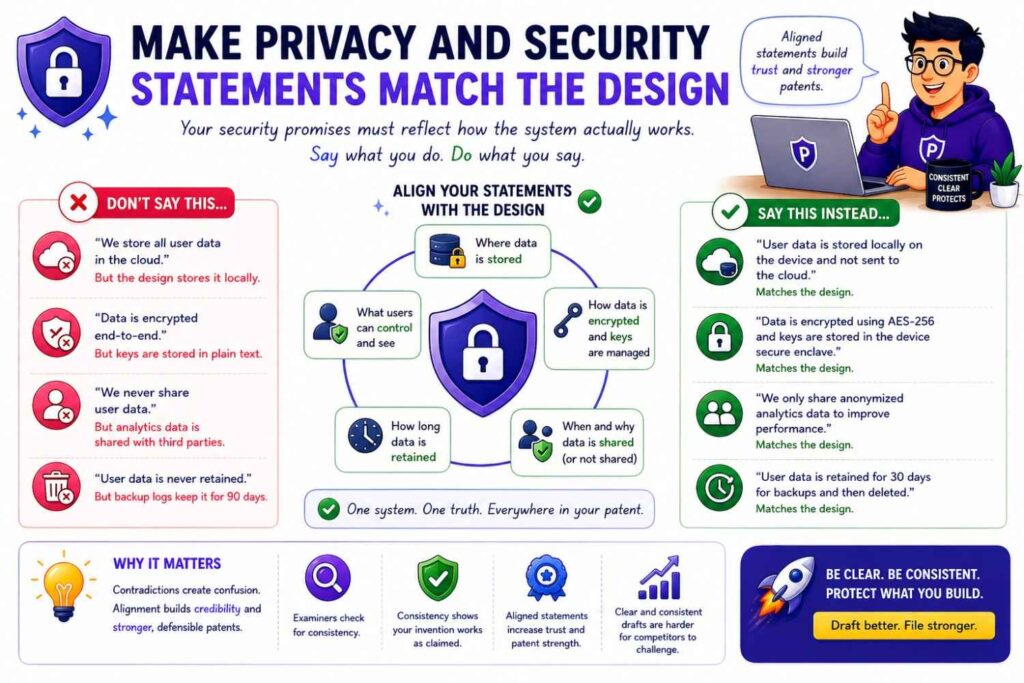
AI may add privacy and security language because it sounds good.
That can create contradictions.
For example, the draft may say all data stays on the device. Later it may say data is sent to a cloud server. Or it may say all data is encrypted, but the example sends plain data. Or it may say users are anonymous, but the system uses user profiles.
These are not just writing issues. They may affect trust.
Do not add privacy or security claims just because they sound nice.
Only include them if they match the invention.
If the invention supports both local and cloud versions, explain that.
For example:
“In some examples, data is processed on the device. In other examples, selected data is sent to a server.”
If only some data is sent, say that.
If data is changed before being sent, say that.
If privacy is part of the invention, give clear support.
Avoid absolute statements like “no data ever leaves the device” unless that is truly required.
A patent draft should not make promises your product does not keep.
Check units, ranges, and thresholds
Technical drafts often include units.
Milliseconds. Watts. Degrees. Percentages. Meters. Volts. Frames per second. Confidence values. Temperature ranges. Pressure ranges.
AI can make mistakes with these.
It may say latency is under 10 milliseconds in one section and under 100 milliseconds in another. It may mix Celsius and Fahrenheit. It may use a range that does not make sense for your device. It may say the sensor samples once per second in one place and 100 times per second in another.
These details can matter.
When numbers are central to the invention, confirm them with your engineering team.
When numbers are only examples, say so.
Do not add exact numbers just to make the draft sound technical. Wrong numbers are worse than no numbers.
A useful patent draft often includes ranges because they show possible versions. But the ranges should be realistic and consistent.
For example:
“In some examples, the time window may be between 1 second and 10 minutes.”
That may be fine if true.
But if another section says the window is always 24 hours, you need to fix it.
Numbers should support the invention, not create traps.
Make “real time” mean one thing
The phrase “real time” appears often in AI and software drafts.
It can mean different things.
It may mean instantly. It may mean near instantly. It may mean within a second. It may mean during operation rather than after the fact.
AI may use “real time” loosely.
That creates conflict.
For example, a draft may say a system responds in real time. Later it may describe batch processing at the end of each day. Those may conflict unless the invention supports both modes.
If real time matters, define it in simple terms.
For example:
“In some examples, real time means during operation of the device.”
Or:
“In some examples, real time means within a time period short enough to affect a current control decision.”
That keeps the draft from overpromising.
If the invention can also work in batch mode, say that separately.
Do not let one phrase blur two different designs.
Do not copy the same idea into every section without review
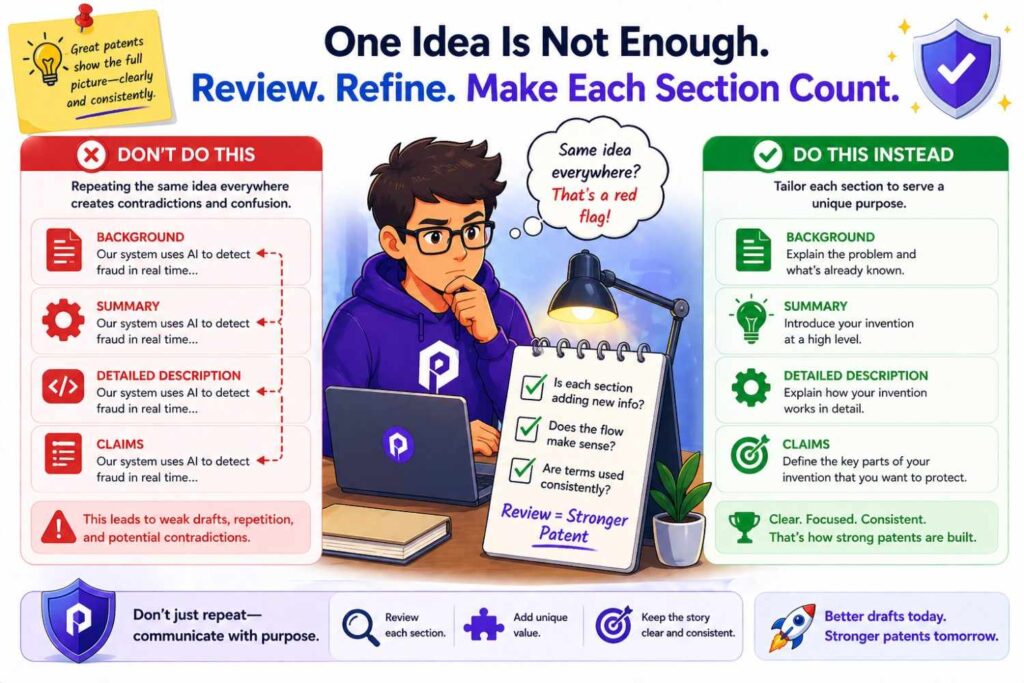
AI often repeats.
It may describe the same module in the summary, the drawing text, the method section, the system section, the examples, and the claims.
Repetition is normal in patent drafts. But repeated text must be checked.
Each time an idea is repeated, AI may change it a little.
That is how contradictions creep in.
The first version may say the model predicts risk. The second says it detects faults. The third says it classifies images. The fourth says it estimates cost. By the end, the invention has drifted.
To prevent this, review repeated concepts as a group.
Search for the key term, such as “risk score.” Read every sentence around it. Make sure the meaning stays the same.
Then search for “model,” “sensor,” “server,” “alert,” and other core terms.
This is one of the best ways to clean an AI draft.
Do not just read from top to bottom. Search by concept.
A contradiction may be 30 pages apart. Search brings the pieces together.
Use “version language” to make differences clear
Not every difference is a contradiction.
A patent draft can describe many versions of an invention.
One version may use a cloud server. Another may use an edge device. One may use image data. Another may use vibration data. One may use a neural network. Another may use a rules-based model.
That is fine.
The problem is when the draft does not clearly mark them as different versions.
Use version language.
Say “in one example,” “in some cases,” “in another version,” or “in certain uses.”
This tells the reader that the draft is showing options, not changing its mind.
For example:
“In one example, the risk model runs on the robot. In another example, the risk model runs on an edge server.”
That is clear.
But this is not:
“The risk model runs on the robot. The risk model runs on the edge server.”
That sounds like a conflict.
Version language is simple, but it is powerful.
It lets your draft be broad without being messy.
Keep the invention broad, but not blurry
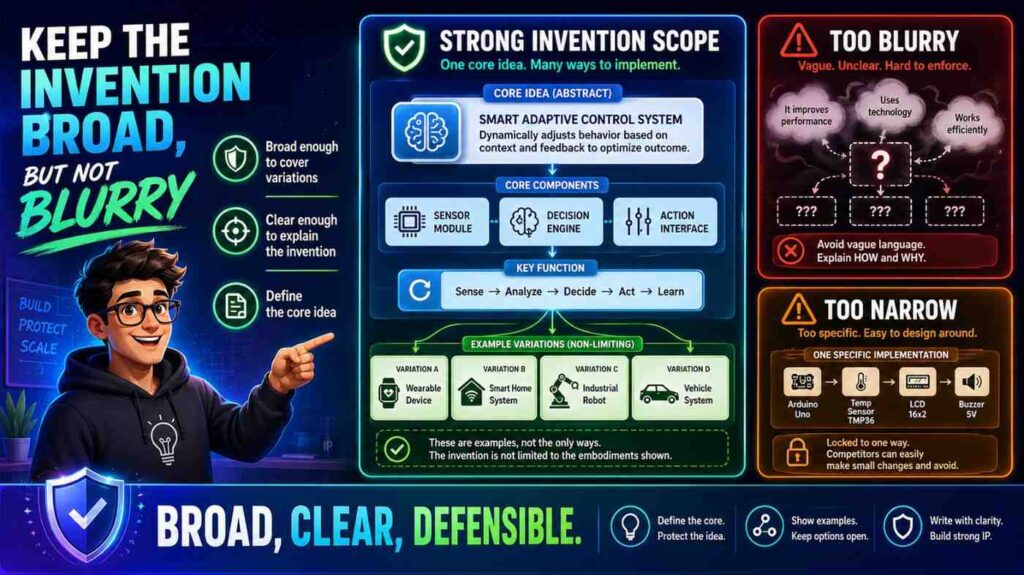
Founders often want broad patents.
That makes sense. You do not want to protect only one tiny version of your idea.
But broad does not mean vague.
A broad draft still needs a clear center.
For example, “using AI to improve factories” is too blurry.
But “using a model to predict a machine state and change a control setting before a fault occurs” is much clearer.
The draft can then describe many factories, many machines, many models, and many control settings. That gives breadth with structure.
AI sometimes makes drafts blurry because it tries to cover everything.
It may add too many fields, too many use cases, and too many features. The result feels wide but weak.
A better approach is to define the core idea clearly, then show several well-chosen versions.
That is how you get useful breadth.
Ask:
What is the one idea we want the reader to remember?
What can change around that idea?
What should not change?
That focus helps prevent contradictions because every section has a clear center.
Check that the examples do not fight the claims
Examples are useful because they show how the invention can work.
But examples can hurt if they do not match the claims.
Suppose a claim says the system creates a score based on sensor data and user input.
But every example uses only sensor data.
That may be a support issue.
Or suppose a claim says the system sends an alert after a threshold is met.
But the example sends an alert before any threshold is checked.
That is a mismatch.
The examples should help the claims feel real.
They do not need to show every possible version. But they should not contradict the claimed flow.
One good review method is to take each claim and find at least one example that walks through it.
If no example fits, add one or adjust the claim.
This is not just about patent rules. It is about clarity.
A reader should be able to see how the claim works in practice.
Do not let old drafts pollute new drafts
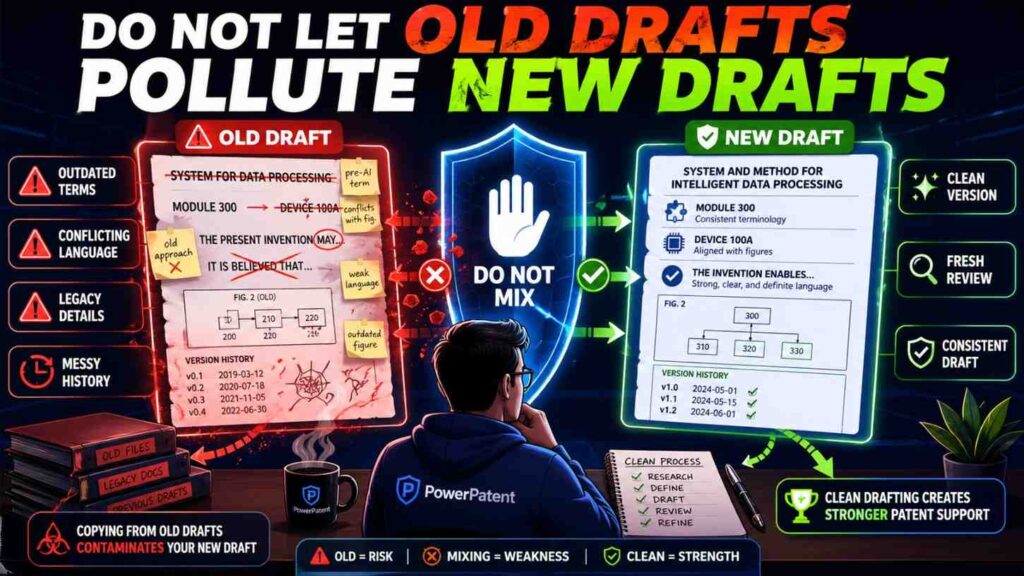
Many teams use AI by pasting in old text.
That can be useful.
It can also create contradictions.
Maybe an old draft described an earlier version of the product. Maybe the old version used a cloud system, but the new version runs locally. Maybe the old version used three sensors, but the new version uses one. Maybe the old version had manual review, but the new version is automatic.
If old text gets mixed into the new draft, the result may be inconsistent.
Before reusing old material, label it.
What is still true?
What is outdated?
What should not be reused?
Then feed only the clean material into the AI.
If you paste old and new notes together without warning, the AI may blend them.
That blend may look smooth, but it may be wrong.
Version control matters.
Keep a clear record of which invention version you are drafting.
For startups, this is especially important because products change fast. What was true three months ago may not be true today.
A patent draft should match the invention you want to protect now and the future versions you want to cover, not a random mix of past notes.
Use engineering review before final attorney review
A patent attorney can help make the draft strong. But your engineering team still needs to check the technical truth.
The best review flow is simple.
First, the inventor or engineer checks whether the draft matches the real system.
Then the patent expert checks whether the draft protects the invention well.
Both reviews matter.
An attorney may not know that your model does not use GPS unless your team says so. An engineer may not know that a small word like “must” could narrow the patent.
Together, they catch more.
For AI-generated drafts, engineering review should focus on truth and consistency.
Does the system really work this way?
Are the parts named correctly?
Are any features fake?
Are any steps in the wrong order?
Are there old product details mixed in?
Are there missing versions that should be included?
Then attorney review can focus on scope, support, claim strength, and filing quality.
PowerPatent is built around this kind of smarter workflow. It gives founders a way to use software for speed while still getting real patent attorney oversight. See how it works here: https://powerpatent.com/how-it-works
Review the draft in passes, not all at once
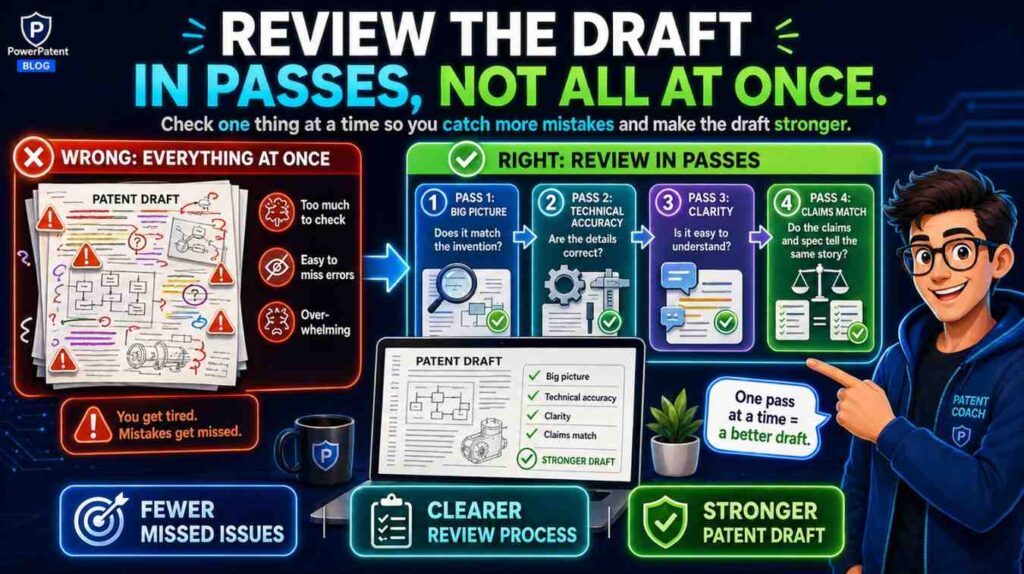
Trying to catch every issue in one read is hard.
Patent drafts are dense. Your brain will miss things.
Use passes.
One pass for names.
One pass for claims.
One pass for drawings.
One pass for data flow.
One pass for optional features.
One pass for numbers.
One pass for broad versus narrow language.
This sounds slower, but it is usually faster than trying to fix a messy draft later.
Each pass gives your brain one job.
During the names pass, you only check whether terms are consistent.
During the drawings pass, you only check whether figures and text match.
During the optional feature pass, you only check whether “may” features stay optional.
This method catches more problems with less stress.
Founders are busy. Engineers are busy. A focused review saves mental energy.
Build a contradiction checklist for each draft
Every startup should have a simple contradiction checklist.
It does not need to be long.
It should cover the issues that matter most for your invention type.
For AI and software inventions, your checklist may include:
Does the draft use the same name for the same part?
Do the claims match the description?
Do the figures match the text?
Are required features truly required?
Are optional features clearly optional?
Are model inputs and outputs consistent?
Are training and use phases separated?
Are data sources consistent?
Are privacy statements true?
Are numbers and thresholds consistent?
This list should become part of your patent process.
You can also add company-specific checks.
For example, if your company avoids sending user data to the cloud, add a check for cloud language. If your system is model-agnostic, add a check to make sure the draft does not limit you to one model type. If your hardware can use many sensor types, add a check to make sure one sensor is not treated as required.
A checklist is not fancy. But it prevents mistakes.
Make the AI show its assumptions
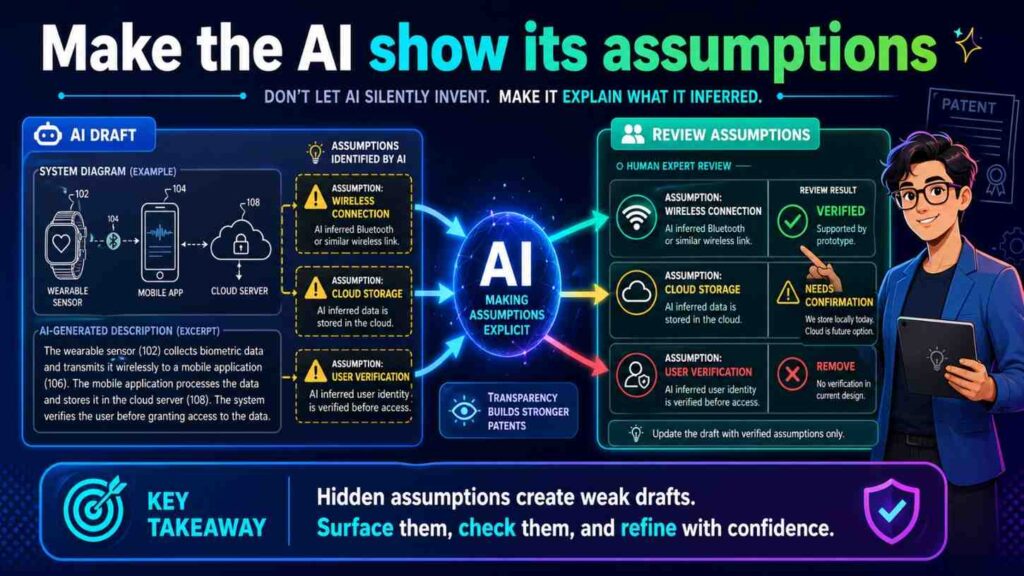
One of the best prompt habits is to ask the AI to list assumptions before drafting.
For example, you can tell it:
“Before drafting, list any assumptions you are making about the invention. Do not add assumed features to the draft unless I approve them.”
This helps you catch fake details early.
The AI may say:
“I assume the system uses a cloud server.”
“I assume the model is trained with historical data.”
“I assume users receive alerts through a mobile app.”
Now you can say yes, no, or maybe.
That is much better than finding those assumptions hidden in a 30-page draft.
You can also ask the AI to mark uncertain details with brackets.
For example:
“Use [confirm] for any detail that is not provided.”
This is helpful because it keeps uncertain points visible.
AI should not silently guess in a patent draft.
A guess can become a contradiction. A contradiction can become a weakness.
Make the guesses show up.
Feed the AI structured invention notes
The quality of the output depends heavily on the quality of the input.
A messy prompt often creates a messy draft.
Before generating a patent draft, give the AI structured notes.
Include the problem, the core idea, the parts, the data flow, the steps, the optional versions, the things to avoid, and the key terms.
Use plain words.
For example:
Problem: Current systems react after a machine has already failed.
Core idea: Predict failure risk before failure and change the machine schedule.
Parts: Sensor, local processor, risk model, schedule controller, alert tool.
Data: Vibration data, temperature data, recent use history.
Output: Risk score and suggested schedule change.
Optional: Cloud dashboard, technician alert, model update.
Avoid: Do not say the system diagnoses human health. Do not say GPS is required. Do not say the cloud is required.
That input is far better than a vague prompt like:
“Write a patent for predictive maintenance using AI.”
The more structure you provide, the fewer contradictions you will get.
This is part of why PowerPatent focuses on helping founders turn real technical details into stronger patent drafts. Better inputs lead to better protection. You can explore the process here: https://powerpatent.com/how-it-works .
Do not let the AI make your invention sound older than it is
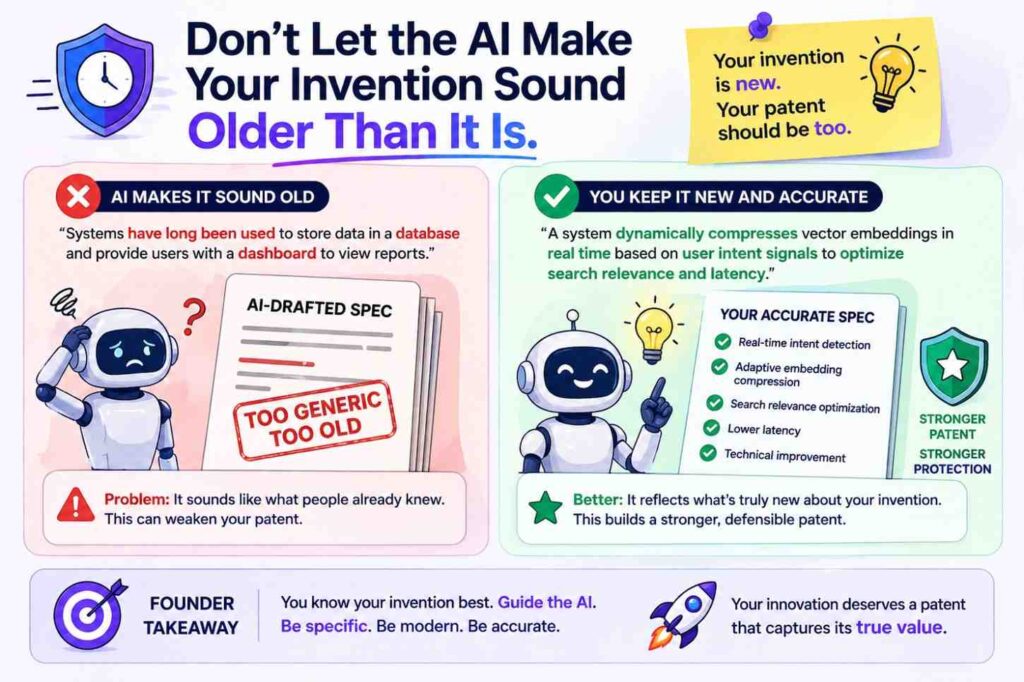
AI sometimes uses old or generic technology language.
For modern AI inventions, it may describe a simple rules engine when your invention uses a learned model. Or it may describe a basic neural network when your key idea is a special training pipeline. Or it may use generic “database and server” language that misses the technical edge.
This can create a different kind of contradiction.
Your invention may be advanced, but the draft may make it sound ordinary.
For example, your notes may say the model adapts to changing sensor drift. The AI draft may simplify that to “the system analyzes sensor data.” That is not exactly a contradiction, but it loses the key point.
Then later, the claims may mention drift correction, while the description barely explains it. That creates mismatch.
Make sure the draft does not flatten the invention.
Simple language is good. Oversimplifying the invention is not.
The draft should be easy to read while still capturing what is new.
That balance is important.
Keep business claims out of the technical story
Founders care about outcomes.
Lower cost. More revenue. Faster onboarding. Better safety. Less downtime.
Those are important.
But the patent draft should focus on how the invention works.
AI may mix business benefits into technical sections in ways that create problems.
For example:
“The model increases revenue by 30%.”
Unless that is a tested and needed detail, it may not belong.
Or:
“The system guarantees safe driving.”
That is too broad and may not be true.
Business benefits can be mentioned carefully, but they should not replace the technical story.
A better version is:
“The system may reduce downtime by allowing maintenance to be scheduled before a predicted failure.”
That ties the benefit to the technical action.
Avoid unsupported claims.
Keep the invention story grounded in steps, parts, data, and results.
Check negative statements carefully
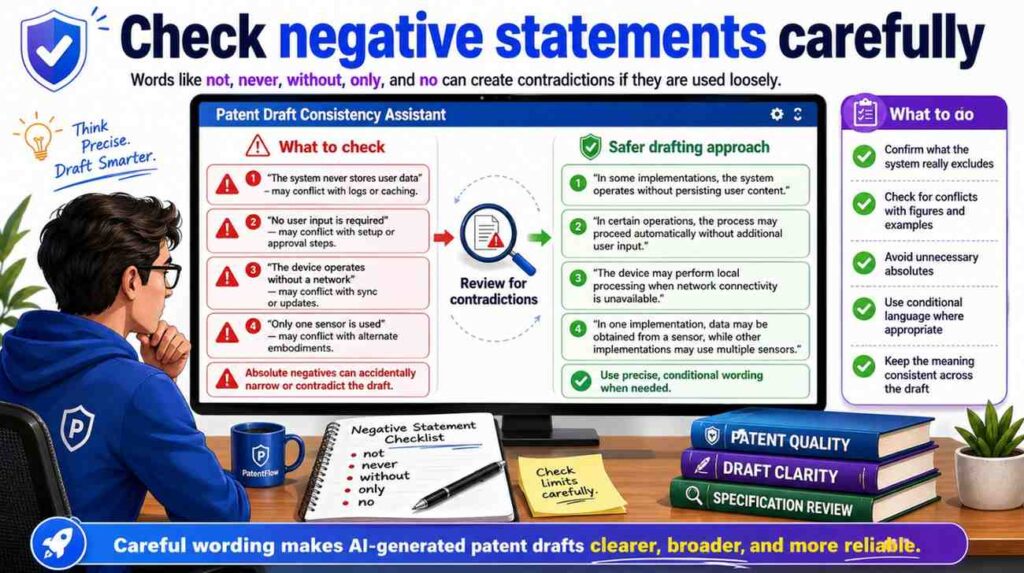
Negative statements say what the invention does not do.
They can be useful. They can also create conflict.
For example:
“The system does not require a cloud server.”
That may be true if the system can run locally.
But later, the draft may describe a cloud server example.
Is that a contradiction?
Not necessarily.
The phrase “does not require” means the cloud is not mandatory. It can still be optional.
But if the draft says:
“The system does not use a cloud server.”
Then a cloud example would conflict.
Small differences matter.
Use negative statements with care.
“Does not require” is often safer than “does not use” when you want to keep optional versions open.
But only use it if true.
If your invention’s main value is that it avoids a certain step, then say that clearly. Just make sure no later section brings that step back by accident.
Make sure improvements match the described mechanism
A draft may say the invention improves accuracy, speed, safety, power use, privacy, or cost.
That is fine if the mechanism supports it.
But AI may claim improvements without showing how they happen.
For example:
“The system improves battery life.”
How?
Does it reduce model runs? Use a smaller model? Turn off sensors? Batch data? Move work to another device?
If the draft never explains the mechanism, the statement feels unsupported.
It can also create contradictions.
One section may say battery life improves because processing is moved to the cloud. Another may say privacy improves because no data leaves the device. These may conflict unless the draft describes different versions.
Tie each benefit to a feature.
If the benefit is speed, show the step that reduces delay.
If the benefit is privacy, show where data stays local or is changed.
If the benefit is accuracy, show the extra signal, training method, or feedback loop.
A benefit without a mechanism is just a claim.
A benefit with a mechanism is much stronger.
Make dependent claims match the base claim
In many patent drafts, some claims build on earlier claims.
A later claim may add a feature to an earlier one.
A later claim may refer to a part that does not exist in the earlier claim. Or it may add a feature that conflicts with the earlier claim. Or it may narrow the invention in an odd way.
For example, a base claim may describe a system where a model runs on a user device.
A later claim may say the model runs on a cloud server.
That may conflict unless the claim is written to allow both options.
Or a base claim may say the system receives image data.
A later claim may say the data includes audio data, but it is not clear whether audio is in addition to image data or instead of image data.
These details matter.
Read the claims as a chain.
Each later claim should make sense with the claim it depends on.
Do not review each claim alone. Review how they connect.
This is an area where attorney oversight is very valuable because claim structure can be subtle. PowerPatent helps founders combine AI speed with real patent review so these details do not fall through the cracks. Learn more here: https://powerpatent.com/how-it-works
Do not let the title narrow the invention too much
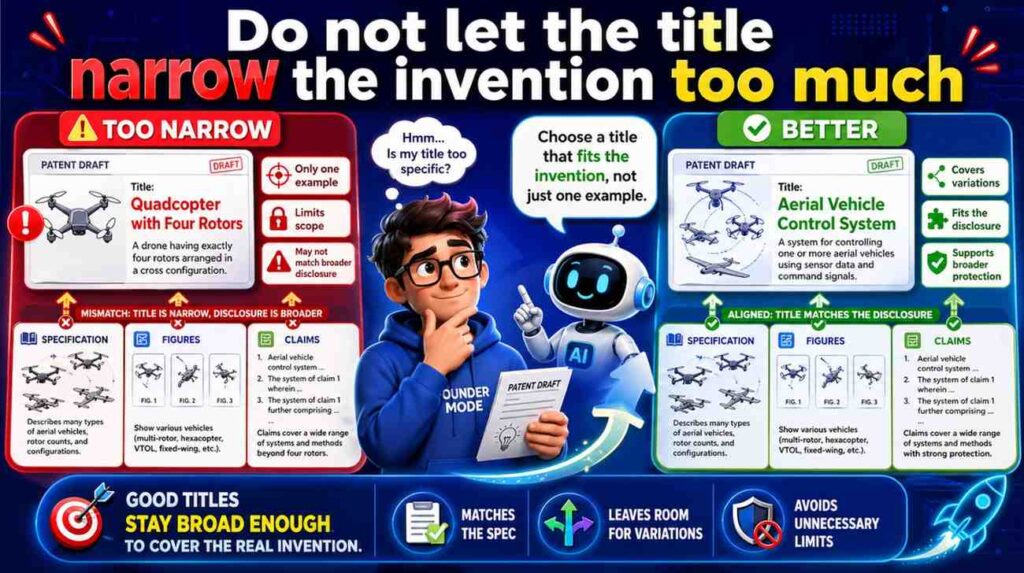
The title of a patent draft is short, but it can still create the wrong signal.
AI may write a title that is too narrow.
For example:
“Cloud-Based Drone Inspection System Using Thermal Cameras”
But maybe the invention is not limited to cloud use, drones, or thermal cameras.
A broader and cleaner title may be:
“Systems and Methods for Risk-Based Inspection Planning”
The title does not need to say everything. It should not trap the invention in one example.
For blog readers, this may seem minor. But it is part of the same habit: keep every part of the draft aligned with the real invention.
If the title says one thing and the claims say another, the draft feels less consistent.
Use plain language first, then formalize
A great way to avoid contradictions is to write the invention in plain language before turning it into patent style.
Plain language exposes confusion.
If you cannot explain the invention simply, the AI will likely create a messy draft.
Write a one-page plain English version.
It should say what the invention does, how it works, and why it is better.
Then use that as the base.
After the draft is generated, compare it to the plain English version.
Does the patent draft still say the same thing?
Did it add details?
Did it remove key points?
Did it change the main idea?
Did it make optional parts sound required?
Plain language is not less professional. It is the foundation of clarity.
A strong patent draft can use formal structure while still being built on a simple, true story.
Be careful with “configured to” language
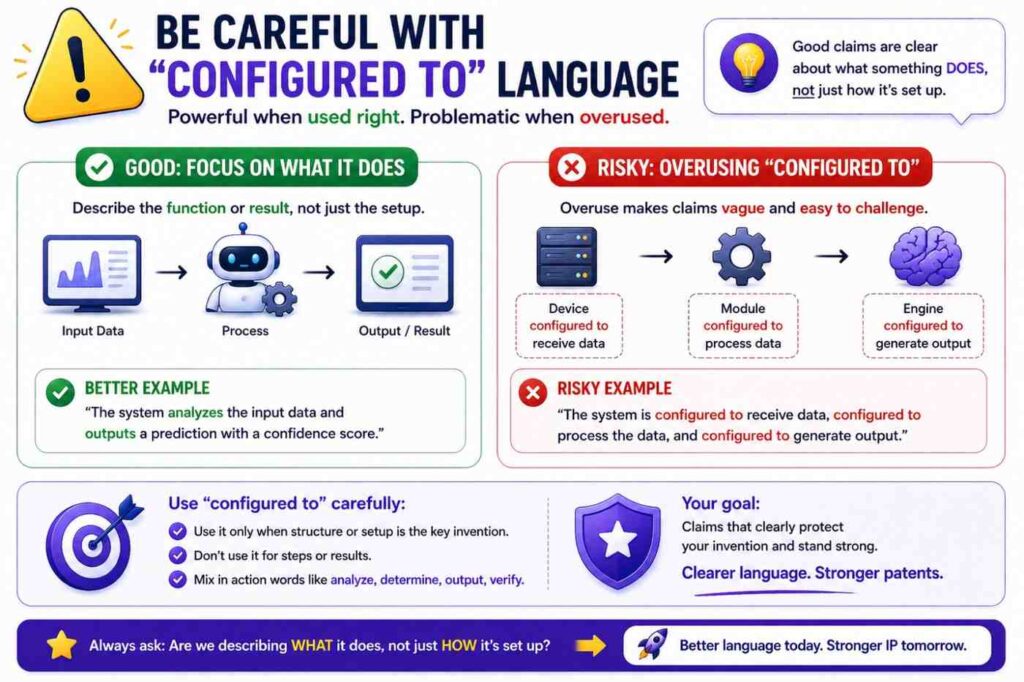
Patent drafts often say a device is “configured to” do something.
AI uses this phrase a lot.
The phrase can be useful, but it can also hide vague or inconsistent roles.
For example:
“A processor is configured to process data.”
That does not say much.
Better:
“A processor is configured to create a risk score based on sensor data and to change a control setting based on the risk score.”
That is clearer.
But you still need consistency.
If one section says the processor is configured to create the score, another section should not say the server creates the same score unless both versions are explained.
Whenever you see “configured to,” ask:
Who is configured to do what?
Is that the same actor used elsewhere?
Is the action clear?
Does the claim match the description?
Do not let formal-sounding language cover up a contradiction.
Keep the same level of detail across sections
Another hidden contradiction happens when one section is very broad and another is oddly narrow.
For example, the summary may say the invention works with any type of sensor. But the detailed section may only describe a camera and later imply the camera is required.
Or the claims may be broad, but the examples may only support a tiny version.
This mismatch can make the draft feel uneven.
A strong draft can be broad in one place and detailed in another, but it should explain the relationship.
For example:
“The sensor may include one or more of a camera, vibration sensor, temperature sensor, pressure sensor, or other sensor.”
Then the example can focus on one sensor:
“In one example, the sensor is a vibration sensor.”
That is clear.
The broad statement opens the door. The example walks through one path.
Without that framing, the reader may not know whether the example is the invention or just one version.
Treat every “the” as a clue
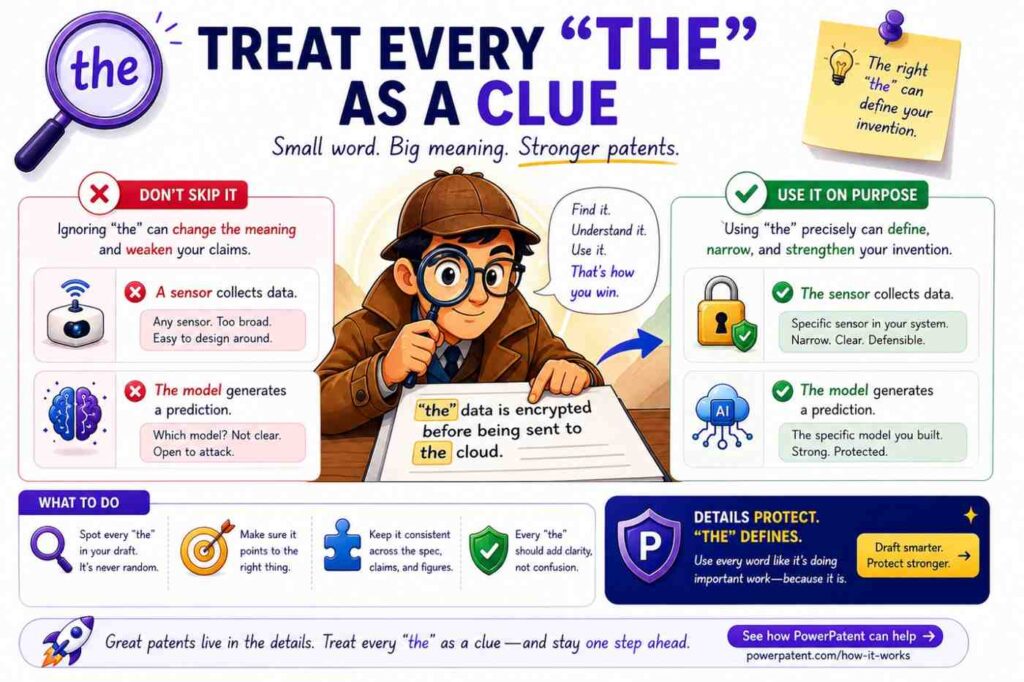
This may sound strange, but it works.
In patent drafts, the word “the” often points back to something already introduced.
For example:
“The model creates the score.”
Which model? Which score?
If the draft never introduced them, there is a problem.
AI can create “the” references to things that do not exist yet.
It may say “the server,” but no server was introduced. It may say “the second model,” but there was no first model. It may say “the feedback signal,” but the draft never explained feedback.
This creates confusion.
A quick review is to search for phrases like “the server,” “the model,” “the score,” “the threshold,” and “the user device.”
Make sure each one has a clear earlier reference.
If not, fix it.
This is a small editing habit that catches many AI mistakes.
Keep claim scope and commercial value aligned
A patent should support your business.
That means the draft should protect what matters.
AI may focus on details that are easy to describe but not commercially important.
For example, it may spend pages describing a login screen while barely explaining the model pipeline that creates the value.
That can create a mismatch between the patent and the company’s moat.
Ask:
What would a competitor copy if they wanted our advantage?
What part of the system makes the product hard to copy?
What technical choice gives us speed, accuracy, cost savings, or safety?
What do we want investors to understand is protected?
Then check whether the draft focuses there.
Contradictions are not only about sentences that disagree. A draft can also contradict your business goal by protecting the wrong thing.
The best patent drafts are clear, consistent, and tied to what the company is really building.
Handle multiple inventions with care
Sometimes a product has more than one invention.
For example, your system may include a new model training method, a new edge deployment method, and a new user feedback loop.
Those may be related, but they may also be separate inventions.
AI may blend them into one giant draft.
That can create contradictions because each invention has its own core idea.
If there are multiple inventions, separate them first.
Write a plain story for each one.
Then decide whether they belong in one draft or more than one draft. That is a strategic call and should involve a patent professional.
At a minimum, do not let the AI mix the core idea of one invention with the required parts of another.
For example, if invention A does not require user feedback, but invention B is all about user feedback, the draft should not make feedback required across both.
Blending can weaken clarity.
Clear separation protects better.
Use comments instead of silent edits
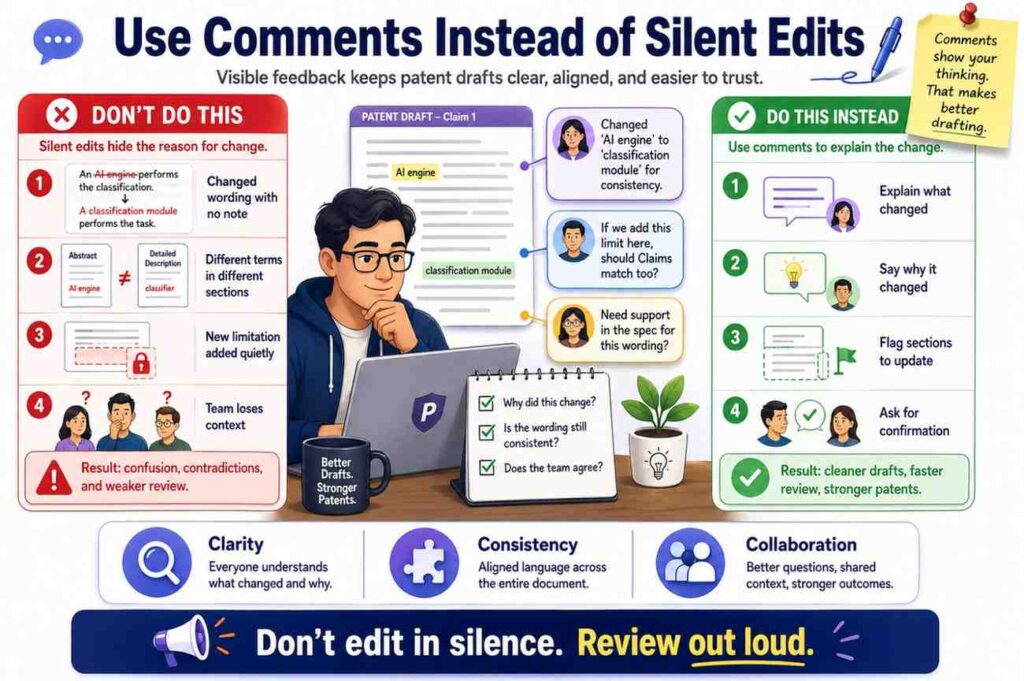
When reviewing an AI draft with your team, do not just edit silently.
Use comments to explain why something is wrong.
For example:
“Cloud server is optional, not required.”
“Model runs on device in our main version.”
“Do not say diagnosis.”
“Risk score and confidence score are different.”
“Figure shows old architecture.”
These comments become a record of the invention truth.
They also help the attorney or drafting team make better fixes.
Silent edits can create new issues because no one knows the reason behind the change.
Clear comments reduce back-and-forth.
They also help if the team reviews another draft later.
Run a “competitor read” on the draft
After you clean the draft, read it like a competitor.
Ask:
Could I use a contradiction to argue the patent is unclear?
Could I design around this because the draft says one feature is required?
Could I claim the invention only covers the example?
Could I point to two sections that say different things?
Could I avoid the claims by moving one step from a server to a device?
This mindset is useful.
You are not trying to be negative. You are trying to make the draft stronger before someone else tests it.
A competitor will not read your patent with kindness. They will look for gaps.
So you should look first.
This is why consistency matters so much. A patent is not just a filing document. It is a business asset that may be tested later.
Use a final “one story” read
At the end, read the draft from start to finish.
Do not edit every small thing on this pass.
Just ask:
Does this tell one story?
Does the problem match the solution?
Do the names stay steady?
Do the claims match the examples?
Do the figures match the text?
Do I understand what is core and what is optional?
Does anything feel out of place?
This final read catches issues that checklists may miss.
A strong draft should feel calm. It should not make the reader stop and wonder which version is right.
If you feel confused, a patent examiner or future reader may feel confused too.
Fix that now.
A practical workflow for founders using AI to draft patents
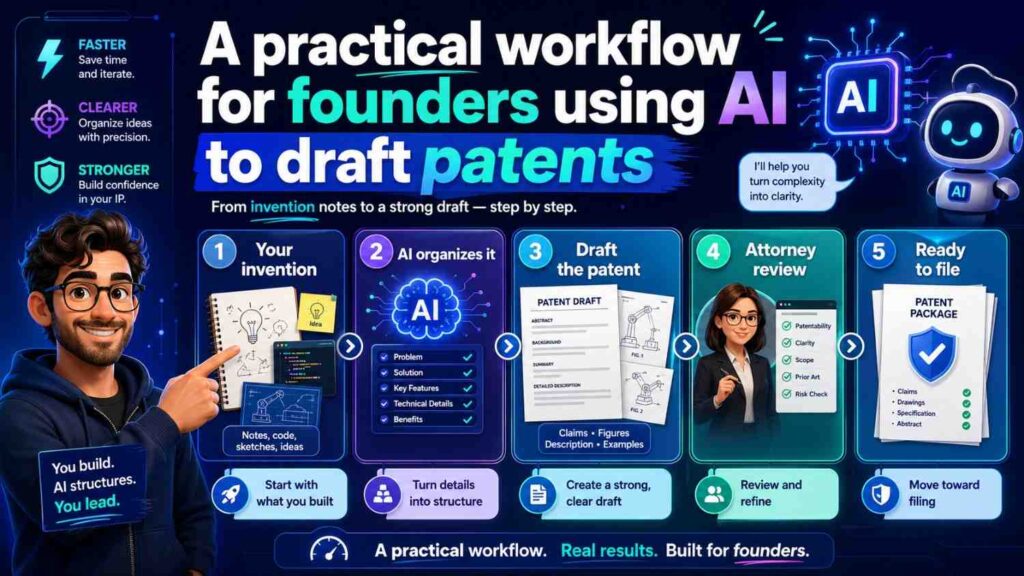
Here is a simple workflow that works well for technical teams.
Start with a plain invention story. Keep it short and true.
Create a term list. Name the key parts once.
Write what is required, what is optional, and what should not be included.
Give the AI structured notes, not loose thoughts.
Ask the AI to list assumptions before drafting.
Generate the draft.
Review names, claims, drawings, data flow, optional features, numbers, and examples in separate passes.
Have an engineer check technical truth.
Have a patent attorney check patent strength.
Use the final read to confirm the draft tells one clear story.
This process is not about slowing you down. It is about avoiding rework.
The worst patent process feels fast at the start and painful later.
The best one feels organized from the beginning.
That is exactly the kind of process PowerPatent is built to support. Founders can move faster, keep control of the invention story, and get real attorney review without the old-school patent headache. Explore it here: https://powerpatent.com/how-it-works
Common contradiction patterns in AI patent drafts
Once you know the patterns, you can spot them faster.
One common pattern is local versus cloud.
The draft says the invention runs on a device, then later says it requires a cloud server.
Another pattern is required versus optional.
The draft says a feature may be used, then later treats it as needed.
Another pattern is one model versus many models.
The draft says there is one trained model, then later describes a first model, second model, and third model without explaining them.
Another pattern is training versus inference.
The draft mixes the phase where the model learns with the phase where the model is used.
Another pattern is data source drift.
The draft starts with sensor data, then adds user data, location data, and purchase data without reason.
Another pattern is figure mismatch.
The text names parts that do not appear in the drawings, or the drawings show parts the text never explains.
Another pattern is overbroad benefit language.
The draft says the invention prevents all errors, when it only reduces the chance of a certain error.
Another pattern is product detail lock-in.
The draft makes your current app screen sound like the invention itself.
These patterns are common because AI fills gaps with common ideas. The more advanced your invention is, the more important it is to stop generic fill-in from changing your story.
How contradictions can hurt later
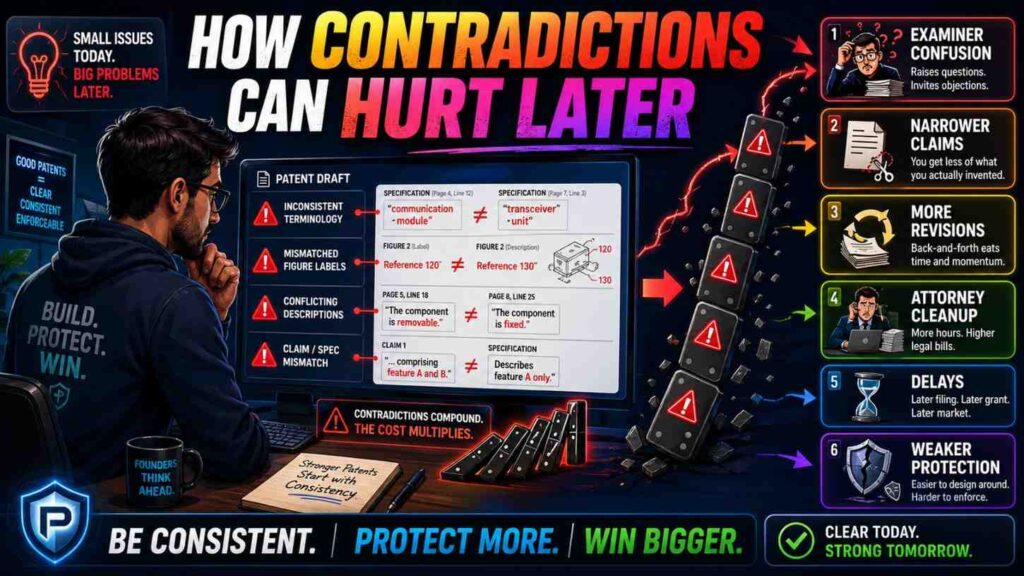
Contradictions are not just editing flaws.
They can create real business pain.
They can slow down filing because your team has to review and fix the draft again.
They can increase cost because unclear drafts take more attorney time to clean up.
They can weaken the patent because unclear support may limit what you can claim.
They can make investors less confident if the invention is hard to understand.
They can give competitors more room to argue or design around.
They can also cause internal confusion. If your own team cannot tell what the patent covers, it is harder to build an IP strategy.
The best time to fix contradictions is before filing.
After filing, your options may be more limited. You may not be able to add new matter freely. You may need more filings. You may lose time.
This is why a clean first draft matters.
AI can help you get there faster, but only if it is used with guardrails.
The best AI patent drafts are guided, not guessed
AI is a tool.
It is not your inventor.
It is not your patent strategy.
It should not decide what your invention is.
You decide that.
Your team knows what was hard to build. Your team knows what competitors do not have. Your team knows which features matter and which are just product choices. Your team knows what should stay broad and what should be specific.
AI can help turn that knowledge into a draft.
But it needs direction.
When AI guesses, contradictions rise.
When AI is guided, the draft gets cleaner.
That is the shift founders need to make.
Do not use AI as a magic patent writer. Use it as a drafting helper inside a smart process.
That means clear inputs, structured review, and expert oversight.
PowerPatent was built with that reality in mind. It helps founders use smart software while still getting real patent attorney support, so they can file stronger patents without getting buried in old-school process. See how it works here: https://powerpatent.com/how-it-works
A simple example of cleaning a contradiction
Let’s walk through a simple example.
Suppose an AI draft says:
“The system includes a cloud server that receives all sensor data from a vehicle and runs a failure prediction model.”
Later, it says:
“The vehicle processes sensor data locally without sending sensor data to a remote server.”
This is a clear conflict.
But the fix depends on the real invention.
If the invention only runs locally, remove the cloud server language.
A cleaned version may say:
“The vehicle may process sensor data locally using a failure prediction model stored on the vehicle.”
If the invention supports both local and cloud versions, explain both.
A cleaned version may say:
“In one example, the vehicle processes sensor data locally using a model stored on the vehicle. In another example, the vehicle sends selected sensor data to a server that runs the model.”
If the invention sends only some data, be precise.
A cleaned version may say:
“In one example, the vehicle processes raw sensor data locally and sends a summary value to a server.”
Each fix tells a different story.
That is the point.
Do not just smooth the wording. Fix the logic.
Another example: optional sensors
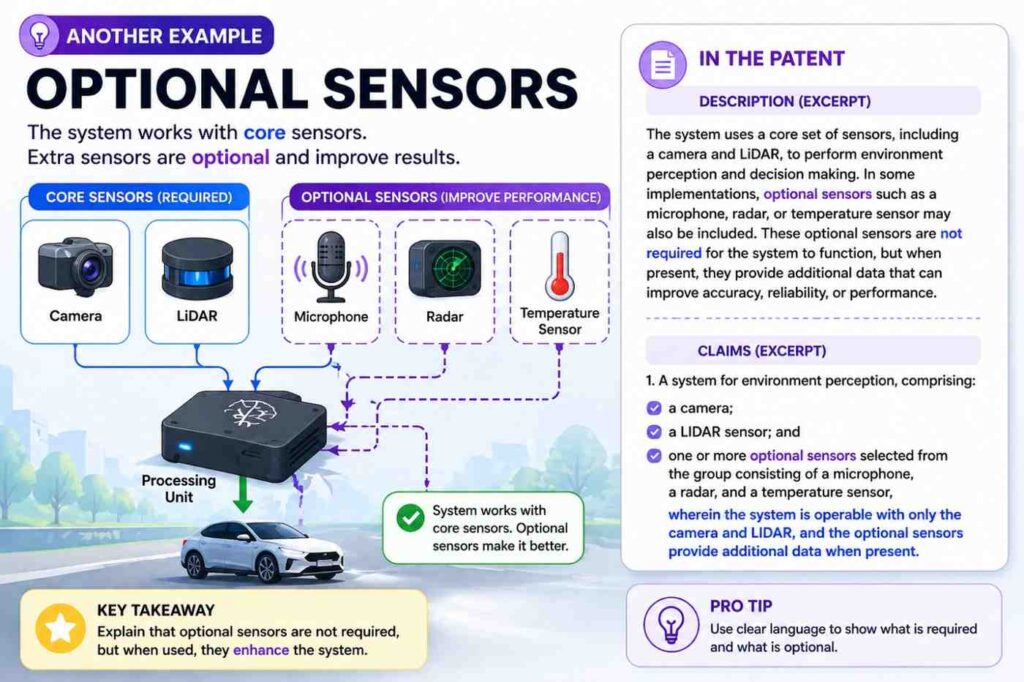
Suppose the draft says:
“The system may include a camera, a vibration sensor, or a temperature sensor.”
Later, it says:
“The camera captures image data used to create the risk score.”
This may accidentally make the camera sound required.
A cleaner version is:
“In examples that include a camera, the camera captures image data that may be used to create the risk score.”
Even better, the draft can explain the broader rule:
“The risk score may be created from one or more sensor data types, such as image data, vibration data, temperature data, or other machine data.”
Now the camera is just one option.
That protects more room.
It also avoids conflict with versions that do not use a camera.
Another example: model type
Suppose the draft says:
“The prediction model is a neural network.”
Later, it says:
“The prediction model may include a decision tree, support vector machine, or rules-based model.”
That is not necessarily wrong, but it needs framing.
A cleaner version is:
“In some examples, the prediction model is a neural network. In other examples, the prediction model may include another type of machine learning model or rules-based model.”
Now the draft shows options.
But if your invention truly requires a neural network, then remove the other model types.
The right fix depends on the invention.
That is why AI cleanup is not only grammar editing. It is invention thinking.
Another example: user approval
Suppose the draft says:
“The system automatically changes a machine setting based on the risk score.”
Later, it says:
“The system waits for a user to approve the machine setting change.”
These can conflict.
But they can also be two modes.
A cleaned version may say:
“In one mode, the system automatically changes the machine setting based on the risk score. In another mode, the system presents the change to a user for approval before applying it.”
That is clear.
If only one mode is real, keep only that mode.
Again, the key is to make differences intentional.
The role of attorney oversight
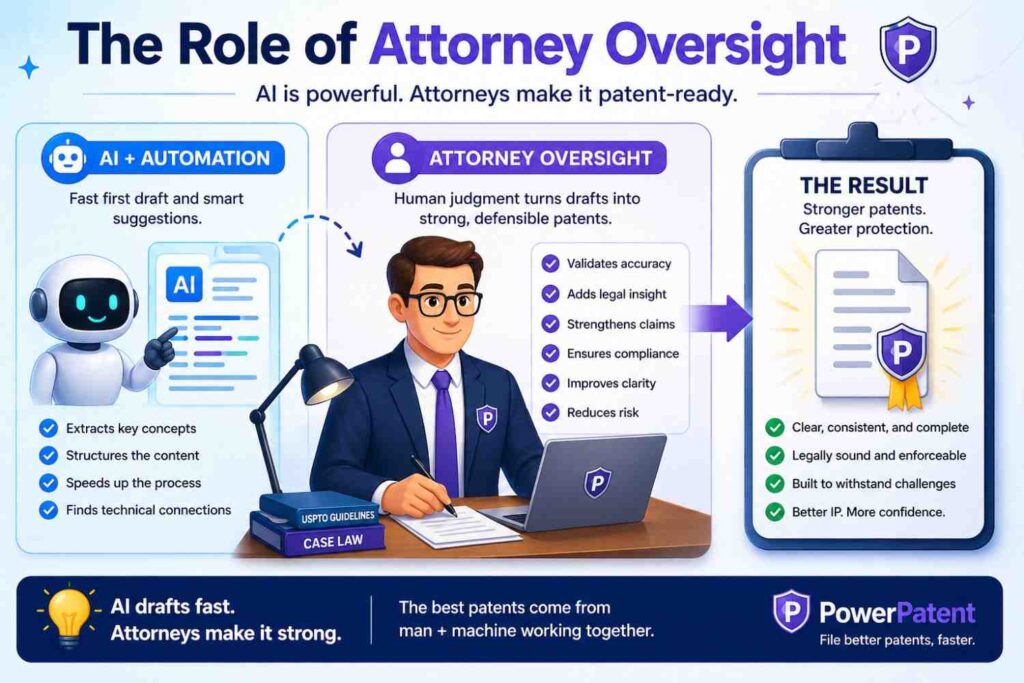
AI can help create a first draft. It can help organize text. It can help find inconsistencies. It can help rewrite sections.
But patents are high-value assets. They need more than clean grammar.
They need judgment.
An attorney can help decide whether the claims are too narrow, whether the description supports the claims, whether terms may cause trouble, whether examples are enough, and whether the filing strategy makes sense.
For founders, this matters because you are not just filing paper. You are protecting the company’s future.
Your patent may matter in fundraising, partnerships, exits, licensing, or defense against copycats.
A cheap draft that misses the real invention is not a bargain.
A fast draft that is full of contradictions is not really fast.
The goal is not just to file. The goal is to file well.
PowerPatent helps founders get the best of both worlds: smart software for speed and control, plus real patent attorney oversight for quality. You can see the process here: https://powerpatent.com/how-it-works
What founders should not do
Do not paste a vague idea into AI and file whatever comes out.
Do not assume polished writing means the draft is correct.
Do not let AI invent technical details.
Do not ignore drawings.
Do not treat optional features as required.
Do not use ten names for the same part.
Do not wait until the end to involve people who know the invention.
Do not skip attorney review because the draft “looks legal.”
That last point is important.
AI can make text look like a patent. But looking like a patent is not the same as protecting your invention.
A strong patent draft is clear, consistent, and tied to the business value of what you built.
What founders should do instead
Start with the real invention.
Write it in plain words.
Give AI strong inputs.
Force assumptions into the open.
Review in focused passes.
Use your engineers for technical truth.
Use patent counsel for patent strength.
Keep the draft aligned from title to claims to drawings to examples.
That is how you get speed without chaos.
That is how you reduce mistakes.
That is how AI becomes a useful tool instead of a risk.
The founder’s mindset: protect the insight, not just the product
Your product will change.
Your UI will change.
Your model may change.
Your data sources may change.
Your deployment may change.
But the key insight behind the invention may stay valuable.
A good patent draft protects that insight.
Contradictions get in the way because they blur the insight.
They make the invention look like a pile of features instead of one clear advance.
When you review an AI-generated draft, keep asking:
What is the insight?
Does this sentence support it?
Does this detail narrow it by accident?
Does this example make it clearer?
Does this claim protect it?
That mindset leads to better patents.
It also leads to better company strategy because it forces you to name what is truly special about your work.
Final thoughts
AI can make patent drafting faster. But faster is only helpful if the draft stays clear.
Contradictions are one of the biggest risks in AI-generated patent drafts. They can hide in names, numbers, drawings, examples, claims, data flows, model steps, and optional features. They can make a strong invention look weak or unclear.
The fix is not complicated.
Start with a clean invention story. Use steady names. Separate core ideas from examples. Make optional features clear. Check the claims against the description. Review drawings closely. Do not let AI guess. Bring in engineering and attorney review before filing.
A patent draft should not feel like five versions of the invention stitched together.
It should feel like one clear, strong story.
That is how you protect what you are building.
And if you want a faster, cleaner way to turn your invention into a real patent draft with smart software and real attorney oversight, see how PowerPatent works here: https://powerpatent.com/how-it-works
Leave a Reply