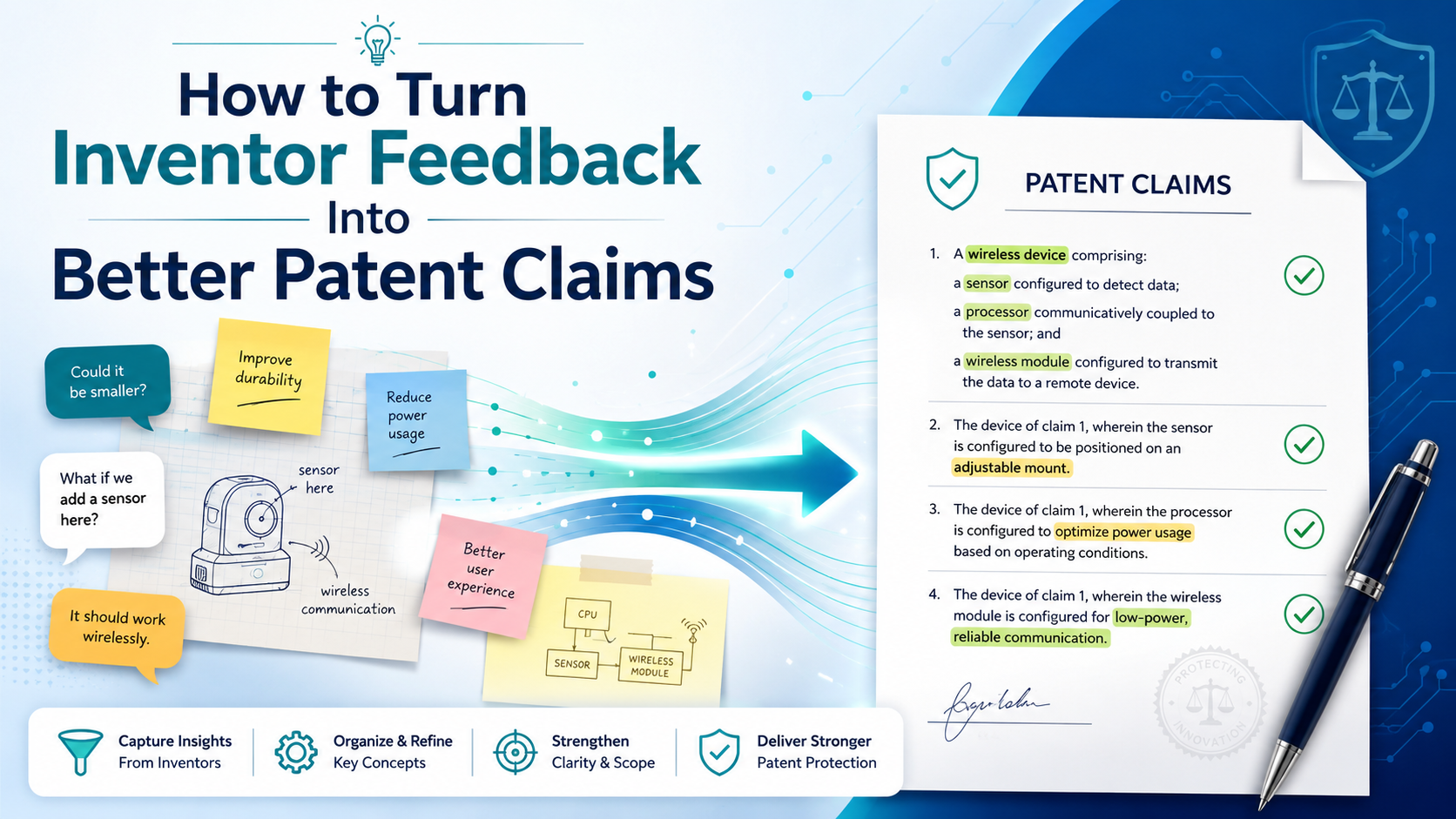
Inventor feedback is one of the most useful parts of building strong patent claims. Yet many teams treat it like a side note. That is a mistake. At PowerPatent, we help teams move from raw invention notes to strong patent filings with smart software and real attorney oversight. You can see how that process works here: https://powerpatent.com/how-it-works
Why Inventor Feedback Can Make or Break Patent Claims
Inventor feedback is not just a review step. It is the raw material that helps turn a basic patent draft into a strong business tool.
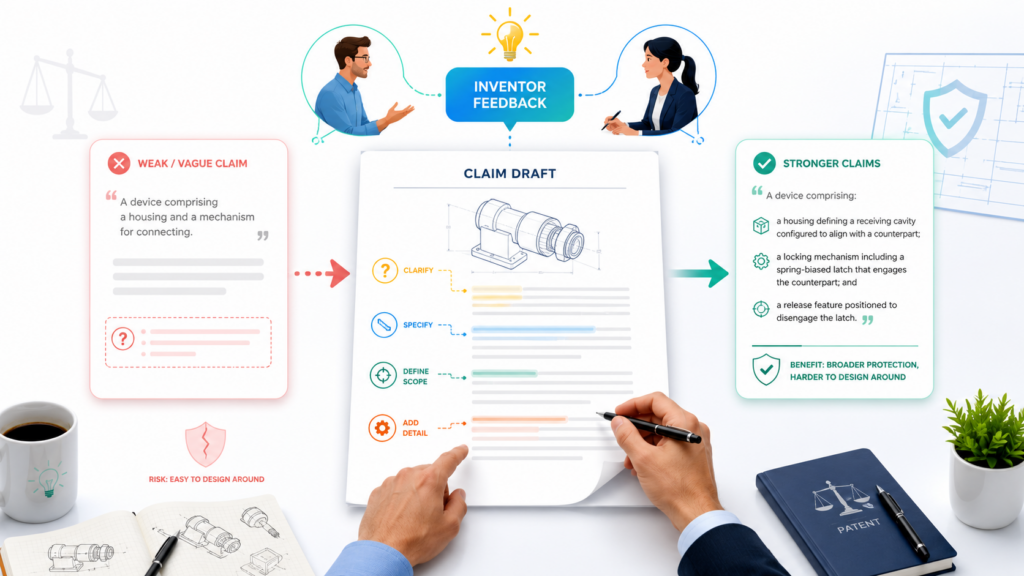
A patent claim is not meant to describe every small part of a product. It is meant to protect the heart of the invention.
The problem is that the heart of the invention is not always clear from a demo, a pitch deck, a code repo, or a product spec. The inventor often holds that missing truth in their head.
That is why feedback from the inventor matters so much. The inventor knows what was hard. They know what took months to solve. They know what looked simple at the end but was not simple at the start.
They know which parts are needed and which parts are only there because of a current design choice. Without that input, patent claims can become too narrow, too vague, or aimed at the wrong thing.
A strong claim should protect the thing that gives the invention its edge. It should cover the idea in a way that is clear, useful, and hard for others to avoid with a tiny change.
That does not happen by accident. It happens when inventor feedback is pulled out in the right way and then shaped with care.
At PowerPatent, this is one of the main reasons we combine smart software with real attorney oversight. Software helps organize invention details and speed up the process.
Attorney review helps turn those details into claims that make sense and protect what matters. You can see how that works here: https://powerpatent.com/how-it-works
Inventors Know the “Why” Behind the Invention
A product spec can tell you what a system does. An inventor can tell you why it had to be done that way. That difference is huge.
When a patent claim is based only on what the product does, it may end up protecting the surface. It may cover the screen, the steps, the current model, the current data flow, or the present hardware layout.
But when the claim is shaped by the reason behind the invention, it can reach deeper. It can protect the real way the problem is solved.
For example, an engineer may say, “We added a second model to improve accuracy.” That sounds helpful, but it is still shallow. The better feedback comes when the engineer explains why the second model matters.
Maybe the first model is good at spotting broad patterns, while the second model catches rare edge cases. Maybe the second model runs only when the system detects low confidence.
Maybe the real invention is not the second model itself, but the timing of when that model is used.
That deeper feedback can change the claim strategy. Instead of claiming only “a second model,” the claim may focus on a system that detects a condition, selects a second analysis path, and changes an output based on the result. That is more useful because it may cover more versions of the same idea.
The Best Feedback Often Starts as a Complaint
Inventors do not always hand over clean claim insights. Sometimes the best feedback sounds like frustration.
They may say, “That claim makes it sound like the database is the main thing, but it is not.” They may say, “A competitor would never do it that way.” They may say, “The hard part was not the sensor.
It was making the signal useful when the data was messy.” These comments are easy to miss if the patent team treats feedback as a simple approval step.
A smart team listens closely to those comments. A complaint often points to a claim that is aimed at the wrong target.
When an inventor pushes back, they may be showing you where the real invention lives. That moment should not be rushed. It should be opened up.
The best follow-up is simple. Ask what the claim should focus on instead. Ask what part created the real gain. Ask what a rival would copy if they wanted the same result.
Those answers can help the patent team rewrite the claim around the true value, not just the current product shape.
Weak Feedback Creates Weak Protection
The most dangerous feedback is the kind that sounds positive but says nothing. “Looks good” can be a trap. “Seems fine” can hide big gaps. “Approved” does not mean the claims are strong.
Inventors are busy. Founders are busy. Engineers are building, testing, fixing bugs, talking to customers, and shipping. If the review process is hard to understand, they may skim it.
They may assume the patent team has everything under control. They may not know what kind of feedback is useful.
That is how weak claims happen.
A claim may include a feature that is not needed. It may leave out the part that makes the invention work. It may focus on one version when the company plans to build five other versions.
It may fail to cover a simple design-around that the inventor could have spotted in ten seconds.
The fix is not to ask inventors to become patent experts. The fix is to guide them with better prompts.
“Does This Look Right?” Is the Wrong Question
When you ask an inventor, “Does this look right?” you place too much burden on them. They may not know how to read the claim.
They may not know which words are broad and which words are limiting. They may not understand how one extra detail can narrow the claim.
A better question is, “What could someone change here and still get the same benefit?” That question is easier to answer because it uses the inventor’s real skill. It asks them to think like a builder, not like a lawyer.
Another strong question is, “Which part of this claim is truly required?” That helps separate the core invention from one example. It also helps remove details that may weaken the broad claim.
PowerPatent helps make this process smoother by giving teams a clearer way to capture invention details, review drafts, and work with attorney-backed support without slowing down the company.
For founders who want better filings without the old back-and-forth mess, the process is explained here: https://powerpatent.com/how-it-works
Start the Feedback Process Before the Claims Are Written
The best time to collect inventor feedback is not after the claim draft is done. It is before the claim strategy is locked. Waiting too long creates a problem.
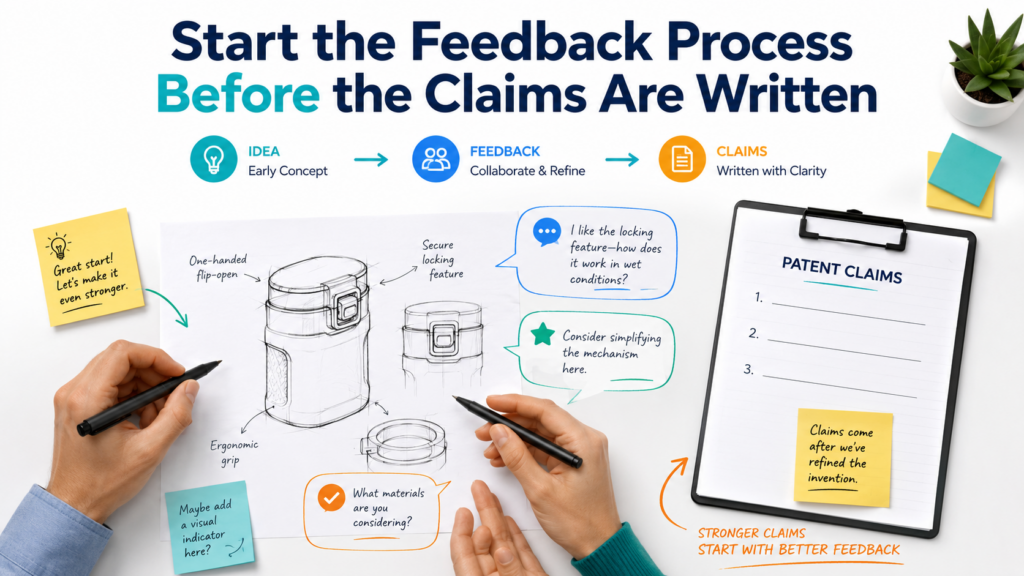
Once a claim set exists, everyone starts reacting to the words on the page. That can make the review narrow. The inventor may focus on small wording issues instead of the bigger question: what should we protect?
Early feedback gives the patent team more room. It helps them understand the invention before they decide how to frame it.
It also helps avoid waste. If the first draft is built on weak inputs, the team may spend hours fixing a claim direction that should never have been chosen in the first place.
This does not mean the inventor has to write the claims. They should not have to.
Their job is to explain the invention in plain words, point out what matters, and help the team understand where the value lives. The claim writer’s job is to turn that input into strong claim language.
When both sides do their part early, the whole process gets better. The claims become clearer.
The review gets faster. The filing is more likely to match the company’s real product and future plans.
Early Feedback Should Focus on the Invention’s Center
Before anyone argues over claim wording, the team should agree on the center of the invention.
This is the part that creates the main benefit. It may be a step, a structure, a data flow, a control rule, a training method, a user action, a hardware layout, or a way different parts work together.
The center is not always the newest feature. It is not always the most complex part. It is the part that makes the invention worth protecting.
A founder may think the center is the customer-facing feature because that is what users see. An engineer may think the center is the hardest technical part because that is what took the most work.
A patent team may see another angle based on what appears new compared with older systems. Good inventor feedback helps bring these views together.
The “What Would We Be Angry to See Copied?” Test
One of the simplest early questions is, “What would we be angry to see copied?”
This question works because it cuts through noise. It moves the team away from a long tour of every feature and toward the part that has business value.
If a competitor copied a minor dashboard layout, the company might not care much. But if they copied the core way the system predicts risk, saves compute power, improves output quality, or controls a device, that would matter.
The answer to this question should shape the first claim discussion. It tells the team where the strongest protection should be aimed.
It also helps avoid a common mistake: claiming the easiest thing to describe instead of the most important thing to own.
Once that core target is clear, the patent team can build outward. The broad claim can focus on the key value. Other claims can cover important versions, product details, and fallback points.
Early Feedback Should Also Capture Future Versions
Inventors often describe what exists today. That is useful, but it is not enough. A patent filing should also support where the product may go next.
Startups move fast. The first version may run in the cloud, while the next version may run on a device. The first version may use one model type, while the next may use another.
The first version may need manual input, while the next may be automatic. If the patent only reflects today’s build, the company may outgrow its own filing.
This is why early feedback should include future versions. Ask the inventor how the system might change in six months, twelve months, or after more customer data.
Ask what parts are likely to be swapped. Ask what features are temporary. Ask what the team already knows it will improve.
Future Plans Can Make Claims More Durable
A durable claim is one that still matters as the product changes. Inventor feedback helps make that possible.
For example, an AI startup may currently use a large model through a third-party API. Later, it may use a smaller private model, a fine-tuned model, or a group of models. If the patent claim is tied too tightly to the current model setup, it may miss the later version.
But if inventor feedback shows that the real invention is how the system prepares data, checks output, and takes a useful action, the claim can be built around that stronger center.
This is also where attorney oversight matters. Future-facing claim work must still be grounded in what the invention supports. The goal is not to claim fantasy. The goal is to describe real variations that the inventor can explain and that the filing can support.
PowerPatent helps teams capture these details while they are still fresh, then work them into a filing process backed by real patent professionals.
For fast-moving teams, that can mean fewer missed details and less delay. See how PowerPatent helps here: https://powerpatent.com/how-it-works
Build a Better Inventor Interview Before You Touch the Claim Draft
A strong inventor interview is not a casual chat. It is a guided search for the real invention. The goal is not to collect every detail.

The goal is to find the parts that deserve protection and understand them well enough to claim them in a smart way.
Many patent drafts become weak because the first interview stays too close to the product. The team talks about what the user sees, what the system does, and what parts are in the current build.
That is useful, but it is only the outer layer. Better claims come from the inner layer. You need to know why the system works, why the choices were made, what problems had to be solved, and what other paths could also work.
The inventor interview should help the inventor think beyond the finished product. It should pull out the hidden work behind the clean demo.
A founder may show a smooth workflow, but the real invention may live in how messy inputs are cleaned before the workflow starts.
An engineer may show a model output, but the real invention may live in how the output is checked before it is trusted.
A hardware inventor may show a device, but the real invention may live in the shape, timing, feedback loop, or control step that makes the device behave in a new way.
When the interview is done well, the first claim draft is stronger before it is even written. That saves time. It also helps the patent team avoid building claims around weak or surface-level ideas.
Ask Questions That Make the Inventor Compare, Not Just Describe
Description is the starting point. Comparison is where the real insight appears. When inventors only describe what they built, they tend to walk through the system as it exists.
When they compare it to older ways, failed attempts, or possible copycat versions, they reveal what is truly different.
A better interview asks the inventor to compare the invention with what people used to do. It asks what was slow, costly, wrong, risky, manual, unstable, or hard before this invention.
It asks what changed once this invention was added. It asks what result could not be reached as well before.
This kind of comparison helps the patent team understand the edge. The edge is the reason the claim matters.
For example, a team may say their software ranks alerts. That sounds common.
But when asked to compare it with older systems, they may explain that old systems ranked alerts by a fixed rule, while their system changes the rank based on live user response and machine state. That difference is much more useful for claim work.
The claim can now focus on the changing rank, the live feedback, and the action taken from that change. Without the comparison, the claim may have stayed too generic.
The First Draft Should Reflect the Problem Solved
A claim does not need to tell a long story, but the patent team still needs to understand the story before writing it. The problem solved helps show what parts belong in the claim and what parts are just context.
If the problem is bad data, the claim may need to focus on how data is filtered, scored, or changed. If the problem is delay, the claim may need to focus on timing, order, or local processing.
If the problem is power use, the claim may need to focus on when parts wake up, sleep, switch modes, or share work. If the problem is user error, the claim may need to focus on guidance, checks, or automatic correction.
This is why the interview should not begin with, “Tell me every feature.” It should begin with, “What problem did this solve that old systems did not solve well?”
That question gives the claim writer a stronger map.
Capture the Failed Attempts Because They Often Point to the Claim
Failed attempts are often more valuable than polished success stories. They show what the invention is not.
They show which simple ideas did not work. They show the hard path the team had to take to reach the final result.
Inventors may skip failed attempts because they seem like old news. They may feel those details are messy or not worth sharing. But for claim work, they can be very important.
A failed attempt can show why a certain step is essential. It can show why the invention needs a feedback loop instead of a one-time rule.
It can show why a model must be trained with a special kind of data. It can show why a device needs a certain shape or spacing. It can show why a control action must happen before a threshold is reached, not after.
These details help the patent team write claims that match the real technical insight.
Failed Paths Help Remove Weak Claim Limits
Failed attempts also help prevent bad limits from entering the broad claim. If the inventor tried a fixed threshold and it failed, but the working version uses a changing threshold, the claim should not carelessly lock itself to a fixed value.
If the inventor tried one sensor and later learned that several sensor types could work, the claim should not be trapped by the first sensor.
If the inventor first used cloud processing but later found edge processing is better for some cases, the claim strategy should consider both.
The point is not to stuff every failed attempt into the claim. The point is to learn from them. They help show the line between the core invention and one build choice.
This is exactly the kind of detail that is easy to lose in a rushed patent process.
PowerPatent helps founders and technical teams capture invention details in a cleaner way, then pair that input with attorney oversight so the filing is not built on guesswork. You can see the process here: https://powerpatent.com/how-it-works
Translate Inventor Comments Into Claim Decisions, Not Just Notes
Inventor feedback becomes useful only when it changes the claim strategy. A comment sitting in a document does not protect anything. A note in a review thread does not matter unless someone turns it into a clear decision.
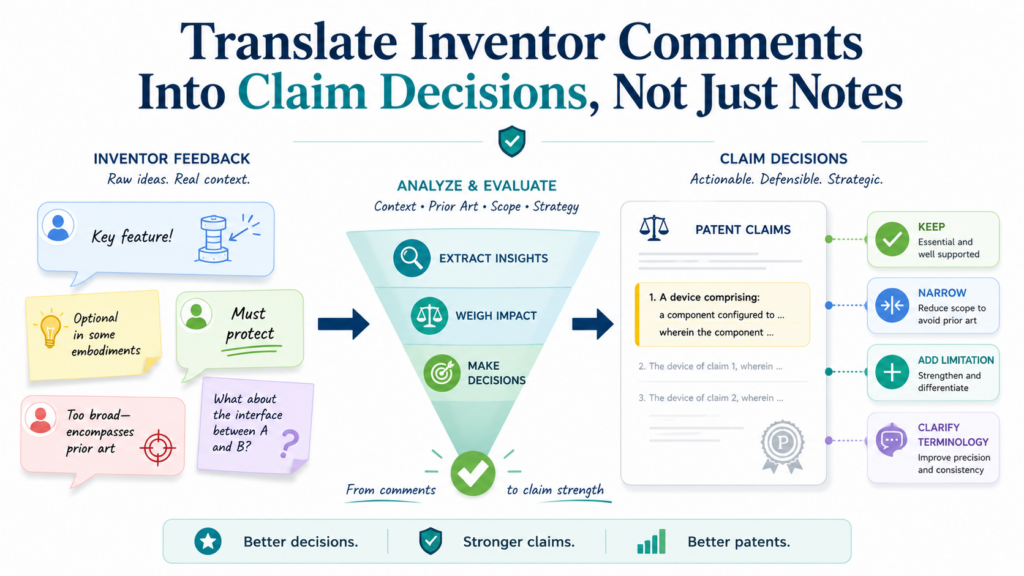
Should the broad claim be changed? Should a detail move into a narrower claim? Should the patent description add more examples? Should a term be made clearer? Should a design-around be covered?
This is where many teams lose value. They collect feedback, but they do not process it. The inventor writes a long comment. The patent team says thank you. Then only a few wording changes happen. The deeper meaning is missed.
A better process treats every inventor comment as a possible signal. Some comments reveal a missing feature. Some reveal that a feature is not essential. Some reveal a competitor workaround.
Some reveal that the current claim is aimed at the wrong part of the invention. Some reveal new versions that should be supported in the filing.
The key is to translate each comment into an action. This does not mean every comment must change the claims.
It means every useful comment should be understood and placed. It should either shape the broad claim, support a narrower claim, strengthen the description, clarify a term, or be set aside for a clear reason.
Separate Wording Feedback From Strategy Feedback
Inventors often give two kinds of feedback at the same time. One kind is wording feedback. The other kind is strategy feedback.
Wording feedback is about accuracy. The inventor may say a step happens before another step. They may say a term is not the word the engineering team uses.
They may say a part should be called a module, a node, a layer, a controller, or a processor. This feedback matters because the patent should be technically correct.
Strategy feedback is deeper. It tells you what should or should not be protected. The inventor may say the model type is not important. They may say a competitor could replace a sensor.
They may say the hard part is the timing rule, not the hardware. They may say the claim should not focus on the user interface because the real value happens in the backend.
This second kind of feedback can change the claim set. It can make the broad claim wider, cleaner, and better aimed.
A Small Comment Can Reveal a Big Claim Problem
Sometimes one small inventor comment should trigger a serious rethink. For example, the inventor may write, “The claim makes it sound like this always happens after the alert, but it can happen before the alert too.”
That is not just a wording issue. It may mean the claim is too narrow. If the action can happen before or after the alert, the broad claim may need to avoid locking itself to one order unless that order is truly required.
A narrower claim can still cover the preferred order, but the broad claim may need more flexible language.
Another example is, “We used a rules engine in the prototype, but the newer version uses a model.”
Again, that is not a tiny edit. It tells the claim writer that the invention may not be tied to rules or models alone. The real claim may need to focus on the input, decision process, and output action in broader terms.
Turn Each Comment Into a Claim Role
A useful way to handle inventor feedback is to ask, “What role should this comment play?”
Some comments belong in the broad claim because they define the core invention. Other comments belong in dependent claims because they cover important details.
Some comments belong in the written description because they support variations. Some comments help remove a limit. Some comments show that more examples are needed.
This step is important because not all feedback should be treated equally. If every inventor detail is added to the broad claim, the claim may become too narrow.
If every detail is ignored, the filing may miss valuable protection. The skill is choosing where each detail belongs.
For example, an inventor may explain that the system uses a confidence score, a fallback model, and a human review step. Which part belongs in the broad claim? The answer depends on what creates the main benefit.
If the key invention is using confidence to choose a fallback path, the confidence score and fallback path may belong in the broad claim.
The human review step may belong in a narrower claim if it is optional. If human review is what makes the system safe enough for use, then it may need stronger claim attention.
The Claim Set Should Feel Like a Set of Doors
Think of a claim set as several doors into the invention. The broad claim is the main door. It should be wide enough to matter. The narrower claims are side doors. They protect important versions and backup positions.
Inventor feedback helps decide where the doors should be. It tells you which version is most valuable, which details are optional, and which paths a competitor may take.
This is why PowerPatent’s software-plus-attorney approach can be so useful for busy teams.
It gives inventors a clearer path to share feedback, while real patent professionals help decide how that feedback should affect the filing. To see how this works for startups and engineering teams, visit https://powerpatent.com/how-it-works
Use Inventor Feedback to Make Claims Broader Without Making Them Weak
Broad claims are valuable, but broad does not mean vague. A broad claim should still be tied to the real invention.
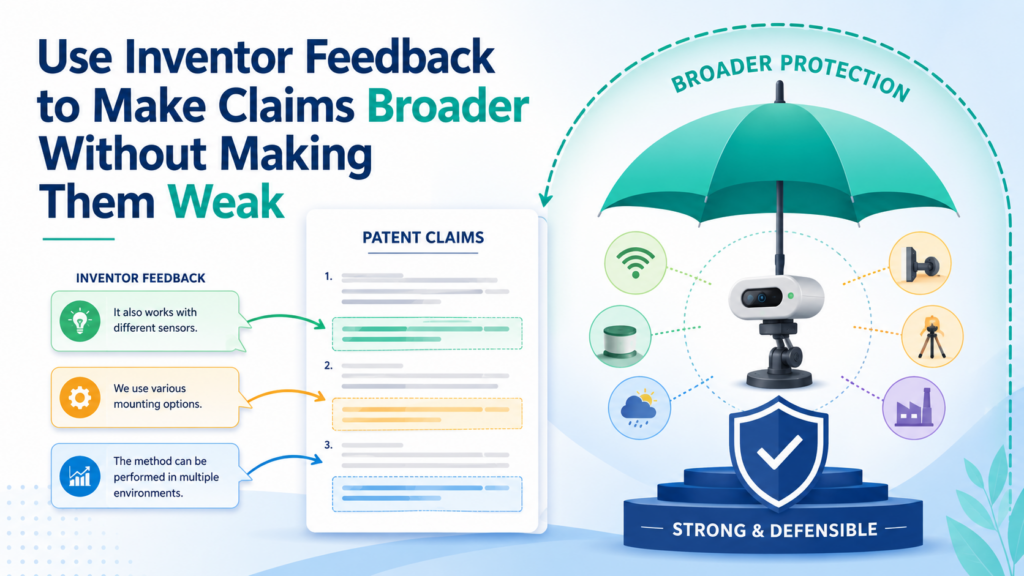
It should protect the main idea without adding extra limits that a competitor can avoid. It should also avoid empty words that sound wide but do not clearly explain what is being protected.
Inventor feedback is one of the best tools for finding this balance. The inventor can tell you what can change and what cannot.
They can explain which parts are required for the invention to work and which parts are only part of one version. That is the information needed to make a claim broader in a smart way.
A weak broad claim often comes from guessing. A strong broad claim comes from understanding.
For example, a draft claim may say the invention uses “a camera.” The inventor may explain that a lidar sensor, radar sensor, thermal sensor, or pressure sensor could also work, depending on the setting.
That feedback may support broader wording like “a sensor” in the broad claim, with narrower claims for the specific sensor types.
But this only works if the filing explains those versions well enough. The feedback must be captured and supported, not just swapped into the claim at the last second.
Remove Details That Do Not Drive the Main Result
One of the fastest ways to improve a claim is to remove details that do not cause the main benefit. These details may be true. They may be in the product. They may even be useful.
But if they are not required for the invention’s core result, they may not belong in the broadest claim.
Inventor feedback is the safest way to find those details.
Ask the inventor what would happen if a feature were removed. Would the invention still work? Would the main benefit still appear?
Would the system still solve the problem, maybe in a different way? If yes, that feature may be optional.
This does not mean the feature is worthless. It may still be claimed later. It may still help show a commercial version. But it should not shrink the main claim unless it is needed.
True But Optional Details Can Hurt the Broad Claim
A claim can be technically correct and still be strategically weak. That happens when it includes too many optional details.
For example, a claim might say that an AI system receives user input through a mobile app, sends the input to a cloud server, processes the input with a trained neural network, creates a score, and displays an alert on a dashboard. That may describe the product today.
But what if the user input can come from an API? What if processing can happen on-device? What if the model can be a rules-based classifier in some cases? What if the output is not always a score? What if the alert is sent to another system instead of shown on a dashboard?
If those things can change, the broad claim should be careful. The inventor’s feedback can help strip the claim down to the true engine of value.
The goal is not to make the claim empty. The goal is to keep the parts that make the invention work and move the optional parts into safer places.
Use Alternatives to Support Smart Breadth
When inventors share alternatives, they give the patent team more room to write better claims. Alternatives show that the invention is not limited to one setup. They also help support a stronger written description.
The best alternatives are not random guesses. They are real options the inventor can explain. They may be versions the team tested, versions they plan to build, or versions that would work based on the same idea.
For software inventions, alternatives may include different data sources, different processing locations, different model types, different output forms, or different user triggers.
For hardware inventions, alternatives may include different materials, shapes, sensor types, layouts, or control methods.
For biotech, materials, robotics, chips, energy, or medical devices, the same idea applies. The patent team needs to know what can change while the invention still works.
Better Alternatives Make Design-Arounds Harder
A design-around is when a competitor changes one part to avoid a claim while still copying the value. Inventor feedback can help predict those moves.
Ask the inventor what they would change if they were trying to avoid the claim. This turns the inventor into a friendly attacker. It reveals weak spots before the filing goes out.
If the inventor says a competitor could replace a fixed threshold with a learned threshold, that alternative should be considered. If they say a competitor could move the processing from the server to the device, that should be considered.
If they say a competitor could use a different signal but reach the same control action, that should be considered.
PowerPatent helps teams think through these issues before filing, not after it is too late.
With structured invention capture and attorney oversight, founders can move faster while still building filings that match the real invention. Learn more here: https://powerpatent.com/how-it-works
Use Inventor Feedback to Make Claims Narrower Where It Helps
It may sound strange, but better patent claims are not always broader. Sometimes inventor feedback shows that a claim should be narrower in a specific way.
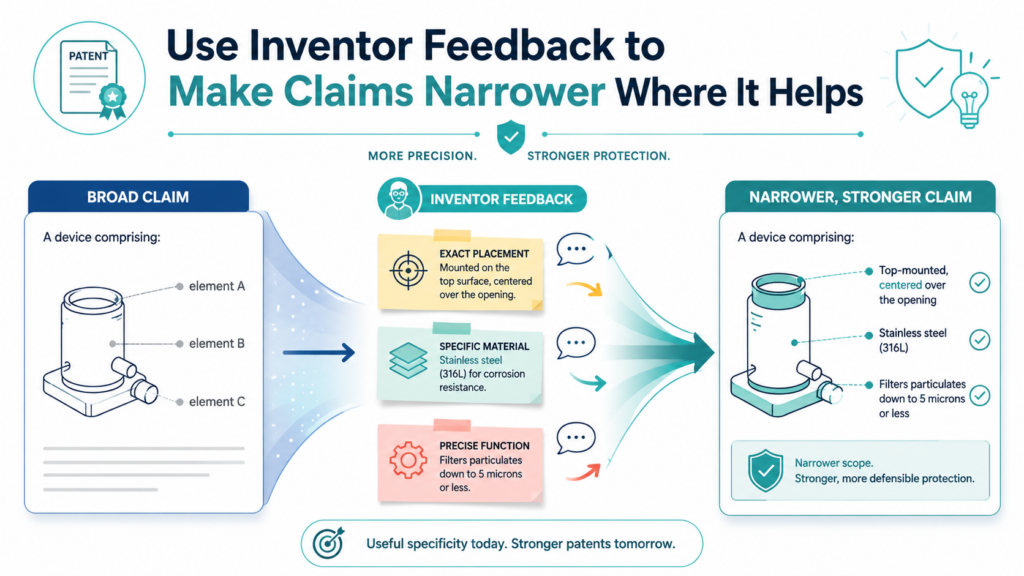
The goal is not to make every claim as wide as possible. The goal is to create a claim set that protects the company from many angles.
A broad claim protects the main idea. Narrower claims protect important details, preferred versions, and backup positions. These narrower claims can be very useful. They may help if the broad claim faces pushback.
They may protect the exact product the company sells. They may cover a feature that competitors are likely to copy. They may also help show the patent office that the invention has real technical depth.
Inventor feedback tells you which details deserve this treatment.
Not every detail should become a claim. But some details are too valuable to leave buried in the description. If a detail improves speed, safety, accuracy, cost, power use, stability, user trust, or product performance, it may deserve its own claim.
If a detail took deep work to solve, it may deserve attention. If a detail is likely to show up in every serious competitor version, it may be strategically important.
Narrow Claims Can Protect the Commercial Product
Founders often want the broadest possible protection. That makes sense. But the product the company actually sells also deserves direct protection.
A broad claim may cover the general method. A narrower claim can cover the exact way the product performs that method. This matters because competitors often copy what works in the market.
They may not copy the abstract idea alone. They may copy the specific flow, setting, timing, or combination that customers love.
Inventor feedback helps identify those commercial details.
Ask the inventor which parts customers notice. Ask which parts drive results in demos. Ask which parts the sales team uses to show the product is different.
Ask which parts are hard for a rival to match without doing real work. These answers can guide narrower claims that protect the market version.
Product Claims Should Not Be an Afterthought
A patent that protects only a broad idea may miss the specific form that makes money. A patent that protects only a specific product may be too easy to avoid. The stronger path is to use both.
Inventor feedback helps link the two. It shows how the product version fits under the broader idea. It also shows which product details should be claimed because they are not just decoration.
For example, a startup may have a broad invention around detecting a risk state and changing a system behavior.
The commercial product may do this using a special confidence check and a two-stage action. If that two-stage action is a major reason the product works well, it should not be left out of the claim set.
This is not about adding more words for the sake of it. It is about protecting the real product in a way that supports the business.
Narrow Claims Can Create Strong Backup Positions
Patent review can be unpredictable. The broadest claim may face pushback. That does not mean the filing is weak. It means the claim set needs smart backup positions.
Inventor feedback is critical here because backup claims should not be random. They should be based on real technical value.
A good backup claim adds a meaningful feature that helps separate the invention from older systems. The feature should matter. It should not be a small extra detail that anyone could add without care.
Ask the inventor what technical feature gives the invention an extra advantage. Ask what detail made the system work better after testing.
Ask what part reduced errors or made the outcome more reliable. These answers can become strong narrower claims.
Fallback Claims Should Be Built Before You Need Them
The best time to build fallback claims is before filing. Waiting until later can limit your choices. If the original filing does not describe enough detail, it may be harder to add claim support later.
That is why inventor feedback should be used early to create layers. The filing should support the broad invention, the main product version, key alternatives, and useful backup positions.
This kind of planning can feel hard when a startup is moving fast. That is why a guided process matters. PowerPatent helps teams capture the right technical detail and work with real attorney oversight so the claims are not built from shallow notes.
See how PowerPatent helps teams file better and faster here: https://powerpatent.com/how-it-works
Teach Inventors How to Review Claims Without Asking Them to Think Like Lawyers
Inventors do not need to become patent lawyers to give great feedback. In fact, asking them to think like lawyers can make the process worse.
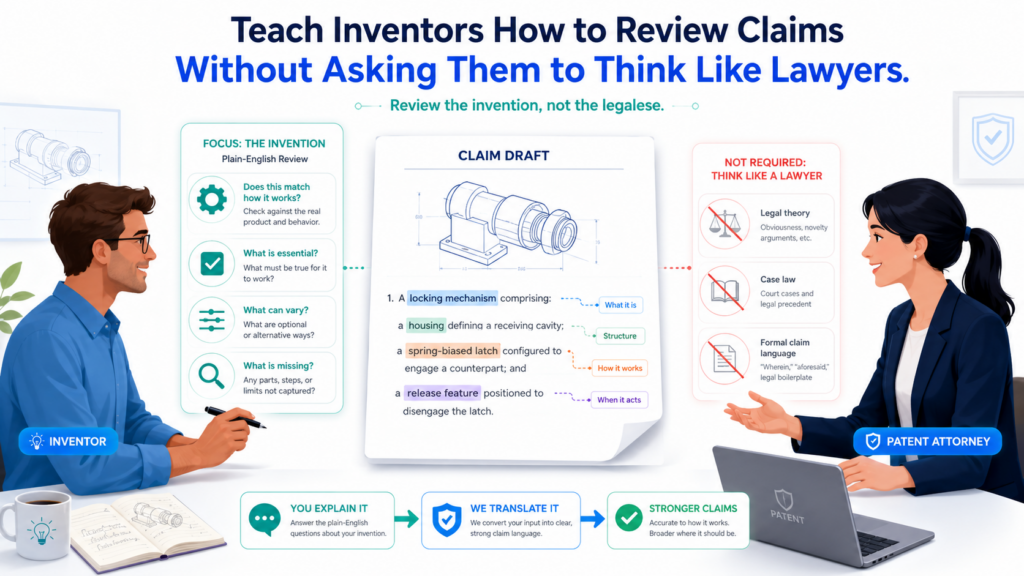
They may get stuck on formal language, worry about the wrong things, or avoid giving feedback because they do not feel qualified.
The better approach is to teach inventors how to review claims like technical experts.
Their job is to check whether the claim captures the real invention, whether the steps make technical sense, whether the claim includes unnecessary limits, and whether competitors could avoid it with simple changes.
This kind of review is practical. It uses the inventor’s real strengths. It also makes the feedback faster and more useful.
When an inventor sees a claim, they should not ask, “Is this written in perfect legal form?” That is not their job. They should ask, “Does this protect the thing we built and the thing others would copy?”
That shift makes the review much better.
Give Inventors a Plain-English Claim Summary First
Patent claims can be hard to read. The structure is dense. The words are formal. The sentence may be long. Even very smart inventors may struggle to see what the claim is doing.
A plain-English summary helps. Before asking for feedback, give the inventor a simple version of what the claim is trying to cover.
The summary should explain the target of the claim, the main parts included, and the reason those parts matter.
This does not replace the actual claim. It helps the inventor review it.
For example, the summary may say, “This claim is trying to protect the way the system uses a confidence level to choose a second processing path before sending the final output.” That is much easier to react to than a long claim sentence.
The inventor can then say whether that target is right. They can explain if confidence is the wrong term, if the second path is optional, or if the real value is the choice of action after the second path.
A Summary Helps Inventors Find Strategic Gaps
A plain summary helps the inventor see the claim as a business tool, not just a document. It helps them ask better questions.
Does this cover the core idea? Does it cover our next version? Does it cover the way a rival would copy us? Does it leave out a key step?
Without the summary, the inventor may only correct small technical words. With the summary, they can review the strategy.
This is especially useful for founders and engineering leaders who do not have time to decode every claim line. They need a fast way to understand what protection is being sought and where their input is needed.
PowerPatent is built to make this kind of collaboration easier. The goal is not to drown inventors in legal process.
The goal is to help them share the right technical truth, then let smart software and real attorneys turn that truth into stronger filings. You can explore the process here: https://powerpatent.com/how-it-works
Ask Inventors to Review for Workarounds
One of the most useful roles for an inventor is to spot workarounds. The inventor knows how the invention could be changed. They know what parts are flexible. They know what a competitor might swap while keeping the same benefit.
This is why every claim review should ask the inventor to look for easy escape routes.
A claim may look fine until the inventor says, “Someone could just do this with a different input source.” Or, “They could run the same logic after the event instead of before it.” Or, “They could replace this module with a shared service.” Those comments can lead to better claims.
The Best Review Question Is Often the Simplest
A powerful review question is, “How would you avoid this claim while still getting the same result?”
This question is direct. It is easy for technical people to answer. It also creates strong claim insight.
If the inventor can avoid the claim in one minute, the claim may need work. Maybe it has an unnecessary limit. Maybe it misses an alternative. Maybe it focuses on the wrong step. Maybe it protects the demo but not the invention.
This does not mean every possible workaround can be stopped. But the obvious ones should be found and considered before filing.
A strong patent process does not treat inventor feedback as a checkbox. It treats it as a way to stress-test the claim before competitors ever see it. That is how feedback becomes protection.
Use Inventor Feedback to Find the Claim’s Strongest “Center of Gravity”
A strong patent claim needs a clear center. That center is the main idea that gives the invention its force. Without it, the claim can feel like a pile of parts.
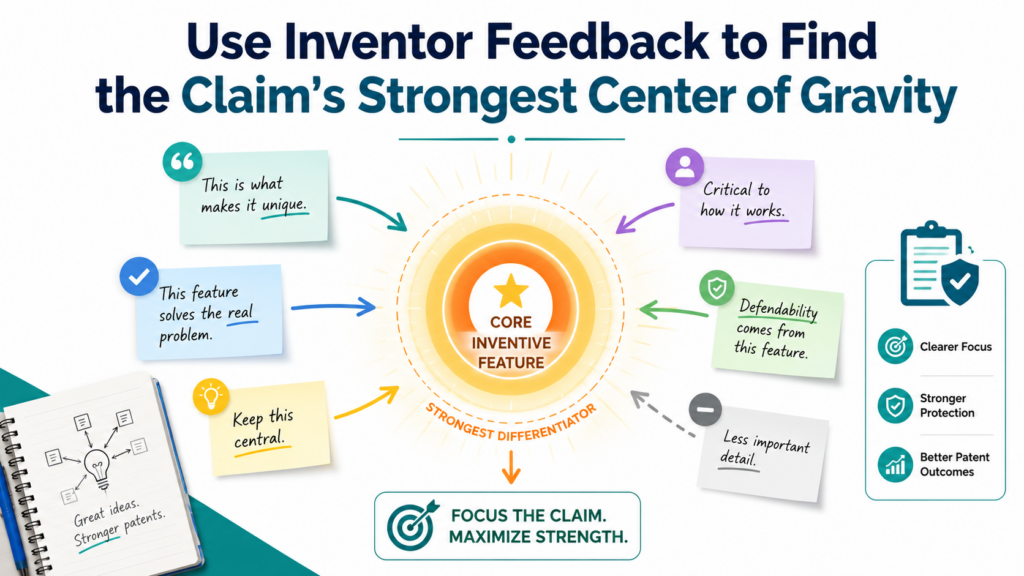
It may mention a processor, a memory, a sensor, a model, a database, and an output, but still fail to protect the real thing that makes the invention valuable.
Inventor feedback helps you find that center. The inventor can explain which part makes the whole system better.
They can point to the moment where the invention stops being a normal product feature and becomes something new, useful, and worth protecting.
This matters because many inventions have several moving parts. Some parts are old. Some are new. Some are only there to support the main idea. Some are included because of product needs, not invention needs.
A claim that treats all parts as equally important may become weak. A claim that finds the true center can protect more with fewer words.
For example, a software invention may include user input, a data store, a model, a score, and an alert.
The center may not be any one of those items. The center may be the way the system changes the score based on real-time feedback before sending the alert. That is the point of value. That is what the claim should protect first.
The Center Is Usually Where the Hard Problem Was Solved
Inventors often know the center because they lived through the hard part. They remember where the system kept breaking.
They remember what customers could not do before. They remember the bug, delay, error, cost, or risk that forced them to build a new solution.
When you ask them where the hard problem was solved, they often give a better answer than when you ask them to describe the invention.
A founder may say the invention is a tool that helps teams review code. But when asked where the hard problem was solved, the answer may become much more precise.
The real invention may be a way to link a code change to a risk score, compare that score with past failure data, and route the change to the right reviewer. That is much more claim-ready.
The goal is to move from the product name to the working heart of the invention.
The Best Claim Center Should Survive Product Changes
A good center should not disappear when the product changes. If the company changes the user interface, swaps a database, changes a vendor, or moves from cloud to edge, the claim should still matter if the core invention is still being used.
This is where inventor feedback becomes strategic. Ask the inventor which part will still be true in the next version.
Ask what would remain even if the product were rebuilt from scratch. Ask which part a competitor would need if they wanted the same result.
The answer can guide the broad claim.
If the center is tied to a temporary product choice, the claim may age badly. If the center is tied to the real method, structure, or system behavior that creates value, the claim can stay useful longer.
PowerPatent helps teams focus on this deeper layer. Instead of only capturing what the product looks like today, the process helps surface what the invention really does and where the strongest protection may live. You can see how that works here: https://powerpatent.com/how-it-works
A Weak Center Creates Easy Workarounds
When the claim’s center is wrong, competitors can avoid it. They may copy the main benefit while changing the feature the claim wrongly treats as central.
This happens often when claims are based too closely on the first build. The first build may use a certain app flow, model type, file format, sensor placement, or server setup.
If that detail is placed at the center of the broad claim, the claim may protect only that version.
Inventor feedback can prevent this.
The inventor may say, “The file format does not matter.” They may say, “The claim should not focus on the dashboard.”
They may say, “The model can be replaced, but the decision rule after the model is the key.” These comments should not be treated as minor edits. They are signals that the claim center may need to move.
The Center Should Match the Competitive Threat
A patent claim is not just a technical statement. It is also a business shield. So the center of the claim should match the thing the company most wants to stop others from copying.
That means the patent team should ask the inventor what the real threat looks like. Would a rival copy the full product? Would they copy one workflow? Would they copy the data method?
Would they copy the device structure? Would they copy the control logic? Would they copy the training process?
Once the likely copy point is clear, the claim can be aimed with more care.
This is one of the most important parts of turning inventor feedback into better claims. The goal is not to protect everything in the same way. The goal is to protect the thing that would matter most if someone else used it.
Use Inventor Feedback to Cut Extra Limits From the Broadest Claim
Extra limits are one of the most common reasons patent claims become weaker than they need to be.
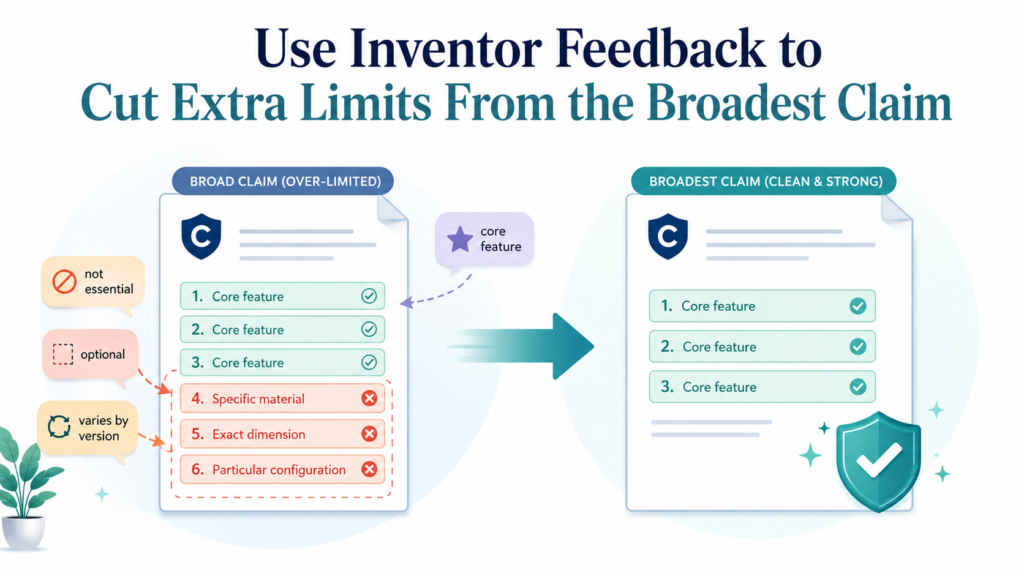
An extra limit is a detail that appears in the claim but is not truly needed for the invention to work. It may be true. It may be part of the current product. It may even be useful. But if it is not essential, it can shrink the claim.
Inventor feedback is the best way to find these extra limits because the inventor knows what can change.
They know which parts are fixed and which parts are flexible. They know which choices were made for speed, cost, design, or customer needs rather than invention needs.
A claim writer who does not have that feedback may assume every product detail matters. That is risky. It can lead to claims that cover the prototype but miss the bigger idea.
For example, a claim may say the system sends a notification to a mobile device. The inventor may explain that the notification could also go to an admin dashboard, an API endpoint, a control system, or another software tool.
If the mobile device is not required, it should usually not limit the broadest claim. It may belong in a narrower claim, but not at the top level.
Ask Whether Each Claim Detail Is Needed for the Main Result
A practical way to cut extra limits is to walk through each claim detail and ask the inventor whether it is needed for the main result.
This should be done in plain words. Do not ask the inventor whether the term is legally limiting. Ask whether the invention still works without it.
If the answer is yes, the detail may need to move.
This process can feel simple, but it often changes the claim in major ways. The claim may start with five or six parts that seem important.
After inventor review, only three may be truly needed for the broad version. The rest may become narrower claims, examples, or support in the written description.
The point is not to make the claim thin. The point is to make it clean. A clean claim includes what matters and avoids locking the company into details that competitors can avoid.
Current Product Details Are Not Always Core Invention Details
Founders and engineers often love the current product because they worked hard to build it. That is natural. But the current product is not always the same as the invention.
The current product may include a certain login flow, cloud provider, model architecture, dashboard layout, file type, hardware enclosure, sensor brand, data format, or workflow order. Some of those details may matter. Many may not.
Inventor feedback helps sort them.
Ask the inventor which parts were chosen because they were the best available option at the time. Ask which parts could be swapped next quarter. Ask which parts customers never see but the invention depends on.
Ask which parts are just there because the product team needed a complete build.
These answers help keep the broadest claim from becoming a product manual.
Move Useful Details Into Safer Claim Layers
Cutting a detail from the broad claim does not mean throwing it away. Often, the best move is to place that detail in a narrower claim.
That way, the broad claim stays focused, while the claim set still protects the commercial version.
This is how good claim layering works. The broad claim covers the core invention.
Narrower claims add important choices, preferred versions, and tested improvements. The written description supports more examples and variations.
Inventor feedback helps decide where each detail belongs.
For example, the inventor may say that a certain timing window gives the best result, but the invention can still work with other timing windows. That detail may not belong in the broadest claim.
But it may deserve a narrower claim because it improves performance. The same is true for a specific model type, sensor type, material, threshold, training method, or output action.
A Detail Can Be Optional and Still Valuable
One mistake is thinking that optional means unimportant. That is not true. Optional details can be very valuable.
They may define the best product version. They may make the invention faster, cheaper, safer, or easier to use. They may be the feature customers notice most.
The issue is not whether the detail matters. The issue is where it belongs.
If the detail is not needed for the broad idea, it should not narrow the broad claim. But if it adds value, it should be preserved somewhere in the claim set or description.
This is why a structured process matters. PowerPatent helps teams capture both the core invention and the valuable details around it, then work with real attorney oversight to shape those inputs into a smarter filing. Learn more here: https://powerpatent.com/how-it-works
Use Inventor Feedback to Add Missing Variations Before Filing
Missing variations can quietly weaken a patent filing. A variation is another way to build or use the invention.
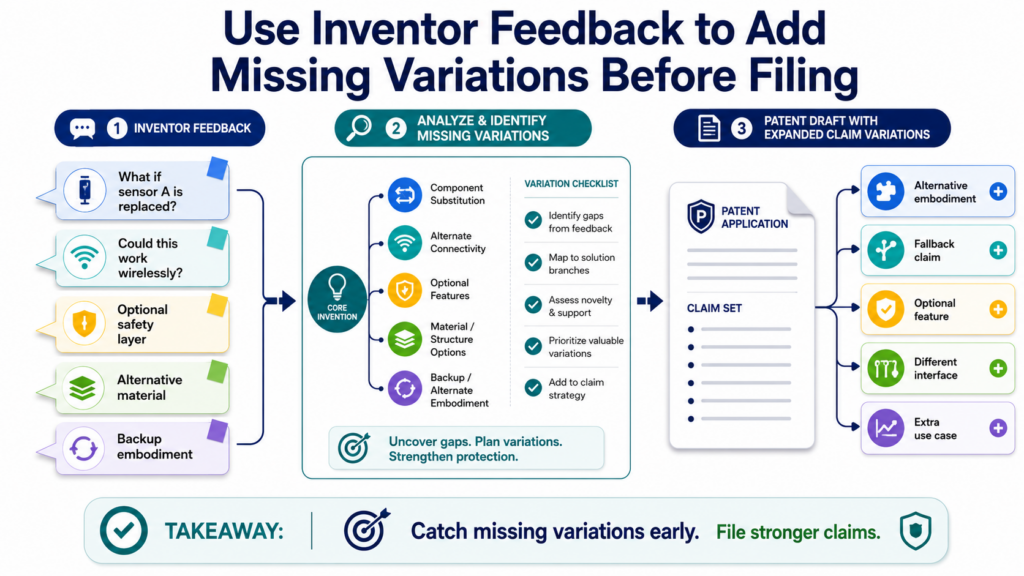
It may use a different input, output, part, step, model, material, device, location, or timing. If the filing does not support these variations, the claims may have less room to grow.
Inventors are the best source of these variations. They know what else could work. They know what they tried.
They know what they plan to try. They know what a competitor might use instead. But they may not share these details unless asked in the right way.
Many invention disclosures focus on the preferred version. That is a useful starting point, but it is not enough.
A patent filing should not only describe the version that exists today. It should also describe reasonable versions that flow from the same inventive idea.
This matters even more for startups because products change fast. A system that uses one data source today may use five later. A device that has one sensor today may add another.
A model that runs in the cloud today may later run on the edge. A process that is manual today may become automatic.
Ask Inventors What Else Could Work
The simplest way to find variations is to ask, “What else could work?”
This question should be asked for every important part of the invention. What other inputs could be used? What other outputs could be produced? What other actions could be triggered?
What other devices could perform the step? What other models, rules, sensors, materials, or control paths could be used?
The answers help the patent team write a richer description and a more flexible claim set.
For example, an inventor may say the system currently sends an alert when a risk score is high. When asked what else could work, they may explain that the system could lock a function, slow a process, request human review, change a route, adjust a machine setting, or start a second analysis. That feedback can lead to much stronger claim support.
The claim may then cover taking an action based on the risk state, while narrower claims cover the specific actions that matter most.
Variations Should Be Real, Not Random
Good variations are not made up just to make the patent look bigger. They should be real enough that the inventor can explain how they would work.
A weak variation sounds like a guess. A strong variation has a reason. It solves the same problem in a related way. It uses the same core idea. It may be planned, tested, or clearly possible based on the inventor’s work.
This is important because better claims need support. The patent filing should describe the invention in a way that matches what the inventor can stand behind.
The goal is not to add empty words. The goal is to capture the true range of the invention.
This is where attorney oversight matters. A skilled patent professional can help decide which variations belong in the filing and how to describe them clearly.
Use Variations to Protect Future Product Paths
Founders should care deeply about variations because future product paths are often where the company’s value grows.
The first product may be only the first use of the invention. The second or third version may be much more important.
Inventor feedback can help the patent team protect those paths early.
Ask the inventor what the team may build after more funding, more data, more users, or more testing. Ask what will change when the product moves from prototype to production.
Ask what will change when the system has to scale. Ask what will change when it moves into a new market.
These answers may reveal variations that should be included before filing.
Patent Filings Should Not Trap the Startup in Version One
A startup should not file a patent that only protects version one if version two is already clear.
That does not mean the filing should claim things the team has not invented. It means the filing should capture the full invention as the team truly understands it.
If the inventor knows the system can work with different models, devices, users, inputs, or actions, those variations should be discussed before filing.
If the inventor knows a production version will replace a temporary prototype part, that should also be discussed.
PowerPatent helps fast-moving teams avoid the trap of filing around a snapshot.
The platform helps organize invention details and supports a smoother path from technical input to attorney-reviewed filings. You can see how it works here: https://powerpatent.com/how-it-works
Use Inventor Feedback to Spot Words That Are Too Narrow, Too Broad, or Just Wrong
Words matter in patent claims. A single word can change the reach of a claim. It can make the claim clearer, narrower, broader, or more confusing. Inventor feedback is vital because inventors know whether the words match the technology.
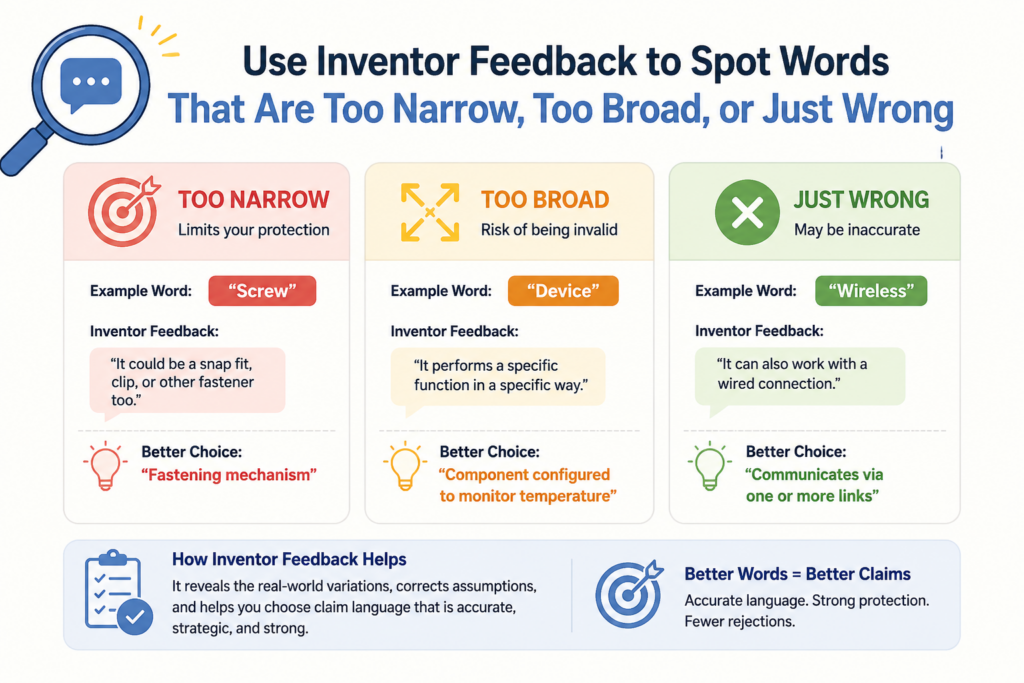
Sometimes a claim uses a word that sounds correct to a general reader but feels wrong to the engineer.
That feeling should be taken seriously. It may mean the word points to the wrong part, the wrong step, or the wrong level of detail.
For example, a claim may say “classifying” when the system is really predicting, ranking, filtering, mapping, matching, or selecting.
A claim may say “training” when the system is actually tuning, updating, prompting, labeling, or validating. A claim may say “sensor” when the invention can use a sensor signal, a log, a user action, or a machine state. These differences can matter.
The goal is not to use fancy words. The goal is to use words that are accurate, flexible, and tied to the real invention.
Inventors Can Catch Terms That Accidentally Limit the Claim
A term may limit the claim more than the team intends. Inventors can help catch this early.
For example, the claim may use “image” because the prototype uses images. The inventor may explain that the same method can work with video frames, point clouds, audio signals, heat maps, or time-series data. In that case, “image” may be too narrow for the broad claim.
Another claim may use “neural network” because the current product uses one. The inventor may explain that a rules engine, graph model, statistical model, or hybrid system could work.
If the invention does not depend on a neural network, that term may not belong in the broadest claim.
This does not mean the patent should avoid technical terms. It means the terms should match the invention’s true scope.
The Right Word Often Lives One Level Higher
A common claim improvement is moving one level higher in wording. Instead of naming the exact tool, the claim may name the function the tool performs. Instead of saying “camera,” the claim may say “sensor” if other sensors can work.
Instead of saying “email alert,” the claim may say “notification” if the output can take several forms. Instead of saying “mobile app,” the claim may say “client device” if different devices can be used.
Inventor feedback tells the patent team when this move is fair and useful.
The danger is moving too high. If the word becomes so broad that it loses the invention’s meaning, the claim may become unclear or weak. That is why the inventor’s technical input and attorney judgment both matter.
Inventors Can Also Catch Words That Are Too Vague
Not all broad words are good. Some words are so vague that they fail to show what the invention actually does. Inventors can help make those words more concrete.
For example, a claim may say the system “optimizes” a result. That word may sound strong, but it can be unclear.
What does the system actually do? Does it select a route, change a weight, reduce a delay, adjust a threshold, rank options, or trigger an action?
The inventor can explain the actual technical step. Then the claim can use clearer language.
The same issue appears with words like “improve,” “enhance,” “manage,” “analyze,” and “process.” These words may be useful in some contexts, but they often need more detail. A claim should not hide the invention behind soft language.
Clear Words Help the Claim Tell the Right Technical Story
A good claim does not need to be long, but it should make the technical story clear. It should show the key steps or parts that create the useful result.
Inventor feedback helps ensure that story is true. The inventor can say whether a step is missing, whether the order is wrong, whether the output is described correctly, or whether a term points to the wrong concept.
This is another reason PowerPatent’s guided process can help. It gives technical teams a better way to share the words, examples, and corrections that matter, while attorney oversight helps turn that feedback into claim language that is clear and useful. Learn more here: https://powerpatent.com/how-it-works
Use Inventor Feedback to Build Claims Around the Customer Value Without Claiming Marketing Copy
Great claims protect technical value. Great startup patents also understand customer value. The two are linked, but they are not the same.
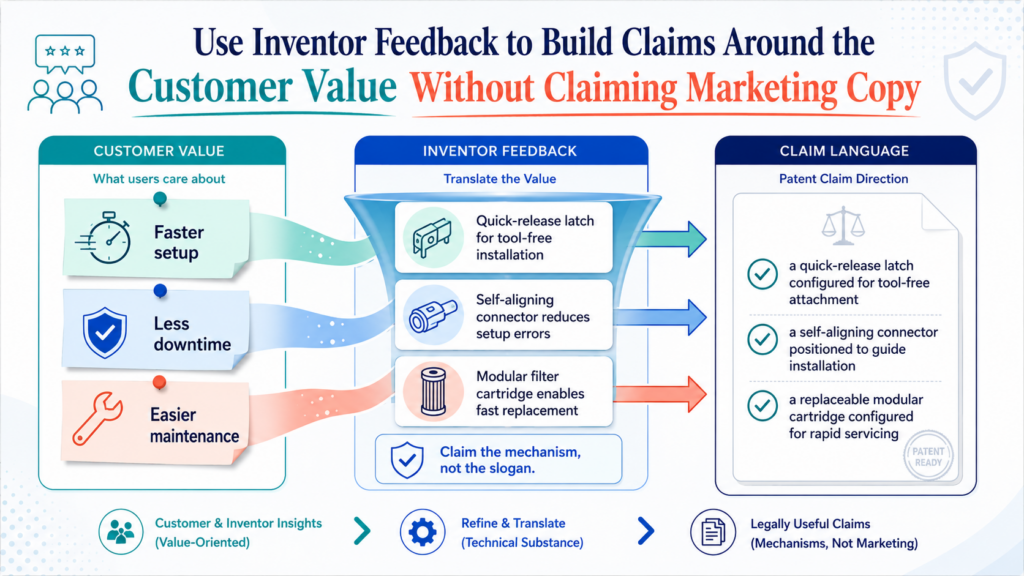
Customer value is why the invention matters in the market. It may be speed, lower cost, better accuracy, fewer errors, less manual work, stronger safety, easier setup, better control, or higher trust. Technical value is how the invention creates that result.
Inventor feedback helps connect the two.
A founder may say the product saves time. That is customer value. The inventor can explain how it saves time. Maybe the system avoids repeat processing by caching a certain result.
Maybe it predicts what the user needs before the user asks. Maybe it routes work to the right machine. Maybe it filters low-value tasks before they reach a person. The claim should focus on the technical “how,” not the marketing phrase “saves time.”
This is important because claims that only sound like benefits may be weak. A claim should not merely say the system is faster or smarter. It should define the parts or steps that make it faster or smarter.
Start With the Benefit, Then Push for the Mechanism
The best way to use customer value in claim work is to treat it as a starting point. Ask what benefit the product gives. Then ask what mechanism creates that benefit.
If the benefit is accuracy, ask what part improves accuracy. Is it better data cleaning? Better training labels? A second check? A new signal? A way of handling rare cases? A feedback loop? A different timing step?
If the benefit is speed, ask what removes delay. Is processing moved closer to the device? Are tasks split? Is only part of the data processed? Is a result reused? Is a model selected based on context?
If the benefit is safety, ask what prevents harm. Is there a risk score? A lockout step? A threshold? A human review path? A sensor check? A control change?
The answers can become claim strategy.
The Claim Should Protect the Engine, Not the Slogan
Marketing language can help explain why an invention matters, but it should not be the core of the claim. A claim should protect the engine that creates the value.
For example, “improving trust in AI output” is a good business message, but it is not enough for a strong claim. The inventor needs to explain how trust is improved. Does the system compare outputs from two sources?
Does it detect low confidence? Does it add a review layer? Does it use user feedback to adjust later outputs? Does it block certain actions unless a check passes?
That mechanism is where the claim strength lives.
PowerPatent is designed for this exact kind of work. It helps founders and technical teams move from product value and invention notes into a patent process that is structured, faster, and backed by real attorneys.
See how PowerPatent helps here: https://powerpatent.com/how-it-works
Align Claims With What the Market Will Reward
Inventor feedback should also be viewed through a market lens. A feature may be technically clever, but not important to the business.
Another feature may seem small, but may be the reason customers buy, stay, or switch.
Claims should not ignore that.
Ask the inventor and founder together which technical feature supports the main market promise. That discussion can reveal the claim targets that matter most.
For example, if customers care about reducing downtime, the claim should look closely at the technical steps that predict, prevent, or respond to downtime.
If customers care about safer automation, the claim should look closely at the checks and controls that make automation safer.
If customers care about lower compute cost, the claim should focus on how compute is reduced while still keeping useful results.
Better Feedback Turns Product Insight Into Patent Strategy
The best inventor feedback does not live in a vacuum. It connects technical truth with business value.
This is where founders should be involved. Engineers know how the invention works. Founders often know why customers care.
Patent professionals know how to shape that into claims. When those three views meet, the patent filing becomes much stronger.
A claim should not read like an ad. But it should protect the technical work that makes the product worth buying. That is how inventor feedback turns into real business protection.
Conclusion
Inventor feedback turns patent claims from basic words into real protection. The best claims come from clear talks about what matters, what can change, what competitors may copy, and what parts truly create value. Founders and engineers should not treat claim review as a quick approval step. They should use it to sharpen the filing before it matters most.
When feedback is guided well, claims become broader where they should be broad, narrower where detail helps, and stronger around the business value. PowerPatent helps teams do this faster with smart software and real attorney oversight. See how it works here: https://powerpatent.com/how-it-works
Leave a Reply