Great ideas die in notebooks every day. You have pages of sketches. Random notes in Notion. Voice memos. Comments in your code. Diagrams on a whiteboard that already got erased. That messy pile is not a patent yet. But inside it, there might be something very valuable. The problem is not that you don’t have enough material. The problem is that it is not shaped the right way.
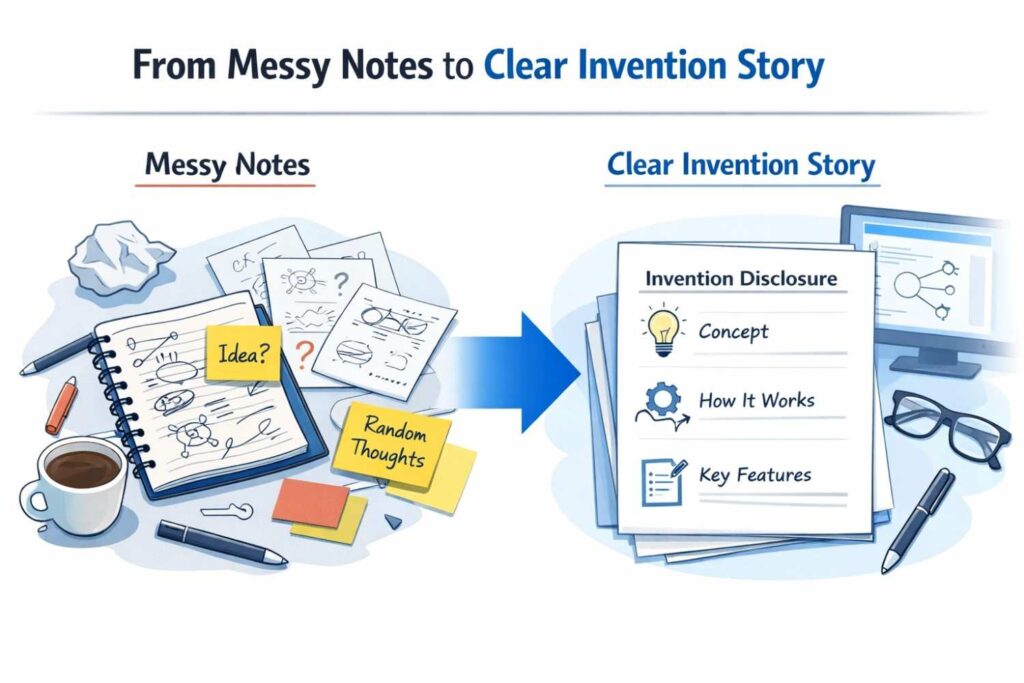
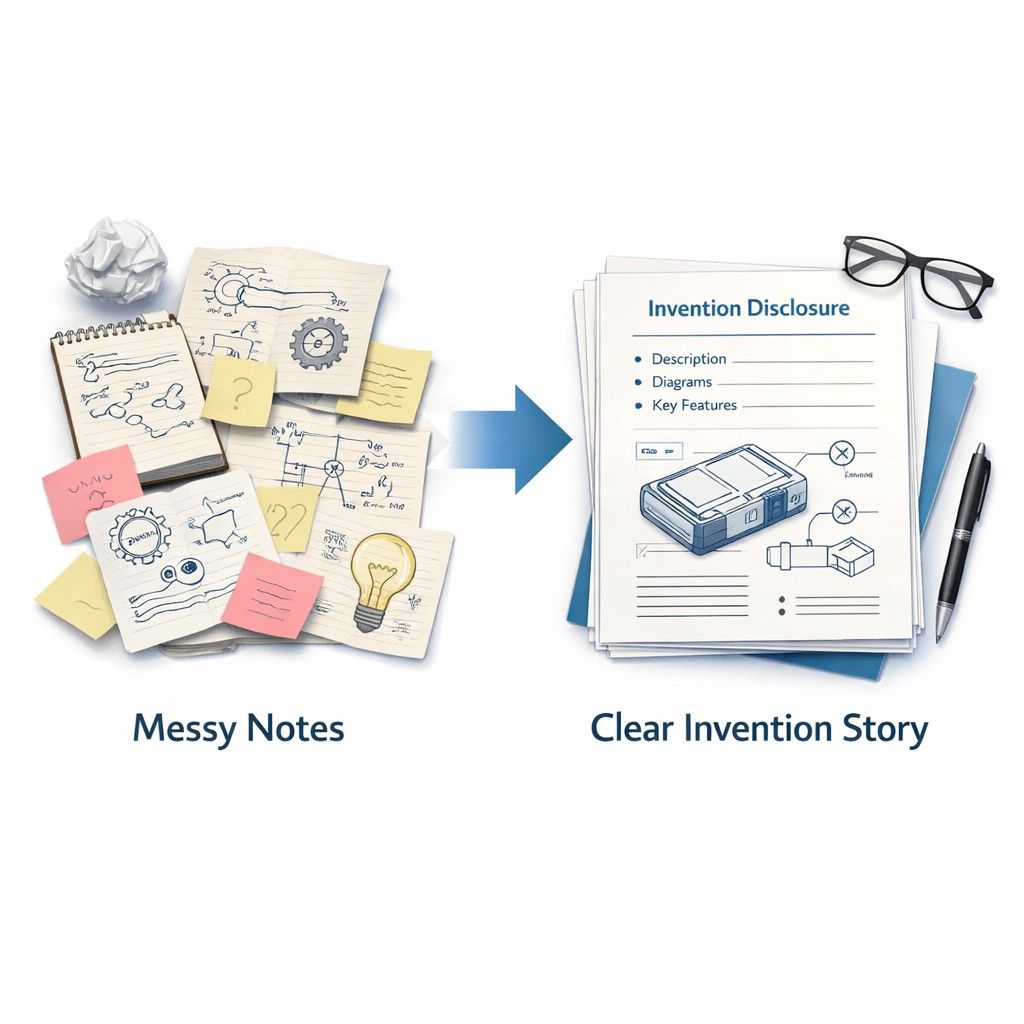
From Messy Notes to Clear Invention Story
Your notes are not the problem. The way they are organized is.
Most founders think they need to “clean up” their idea before they can start a patent. That is not true. You do not need perfect slides. You do not need polished diagrams. You need clarity.
This section is about turning scattered thoughts into a strong invention story. A story that explains what you built, why it matters, and how it works in a way that can actually be protected.
When you do this right, you stop guessing and start building real IP.
Why Your Raw Notes Are More Valuable Than You Think
Your scratchpad might look messy, but it holds timing. It shows how your idea evolved. It captures the small decisions you made along the way. Those details matter.
Investors care about defensibility. Competitors care about copying you. A patent cares about proof and detail. Your raw notes contain both.
Instead of rewriting everything from scratch, start by gathering every piece of material tied to the invention. Pull your Git commits. Export your Slack threads.
Save whiteboard photos. Download design drafts. This is not busy work. It is about building a full record.
The goal here is not organization yet. The goal is completeness.
If you are building something serious, do not rely on memory. Memory shrinks details. Patents reward details.
If you want to see how structured software can help you collect and shape this information into a real filing, take a look at how PowerPatent guides you step by step:
https://powerpatent.com/how-it-works
Separate the Core Idea from the Noise
Not every note belongs in your patent story. Some of it is trial and error. Some of it is business strategy. Some of it is product polish.
You need to find the core technical idea.
Start by asking yourself one simple question: what did we figure out that was not obvious before?
Do not answer with a feature. Do not answer with a benefit. Answer with a technical breakthrough.
Maybe you found a new way to reduce latency in a distributed system. Maybe you trained a model using a data pipeline no one else uses. Maybe you combined two known methods in a way that produces a new result.
Write that down in one plain sentence.
If you cannot explain your invention in one clear sentence, your notes are still too scattered.
This sentence becomes your anchor. Everything else will connect to it.
Turn Features into Technical Mechanisms
Founders often describe inventions like they describe products. That is a mistake.
Products solve user problems. Patents protect technical solutions.
Instead of writing “Our platform automatically detects fraud,” you need to explain how it detects fraud. What signals are collected? What processing steps happen? What models or rules are applied? What thresholds trigger actions?
Take one feature from your notes and break it apart. Ask yourself what happens first. Then what happens next. Then what happens after that.
Write it out like you are explaining the system to a new engineer joining your team.
This exercise forces you to move from marketing language to engineering language. That shift is what makes a disclosure strong.
If you want help structuring this in a way that patent attorneys can use directly, PowerPatent’s guided process makes this transition smooth and fast:
https://powerpatent.com/how-it-works
Rebuild the Timeline of the Invention
A powerful way to clean up messy notes is to rebuild the timeline.
When did the problem first appear? What did you try first? What failed? What finally worked?
This is not about storytelling for fun. It helps you see what is truly new.
Sometimes the real invention is not the final version of your product. It is the solution you created after three failed attempts.
Go back through your commits or design files and mark the moment when the breakthrough happened. What changed? What new structure or method appeared?
Write a short narrative that explains the evolution. This often reveals hidden technical insights that deserve protection.
Clarify the Problem in Technical Terms
A weak disclosure often starts with a vague problem. “Current systems are inefficient.” That is not enough.
Be precise. What systems? Inefficient in what way? Too slow? Too memory-heavy? Too inaccurate?
Quantify the pain if you can. Did previous methods require three database queries instead of one? Did they fail above a certain scale? Did they rely on manual labeling?
When you clearly define the technical problem, you make it easier to show why your solution is different.
This is also useful for business strategy. A sharp technical problem statement makes it easier to explain your value to investors and partners.
Draw It Even If You Are Not a Designer
You do not need beautiful diagrams. You need simple ones.
Take a blank page and draw boxes and arrows. Show where data enters. Show where it is processed. Show where decisions happen. Show where outputs are generated.
Label everything.
When you draw your system, gaps appear. You may notice steps you forgot to describe. You may see dependencies that need to be explained.
Those diagrams can later become figures in your patent application. But first, they serve you. They help you think clearly.
PowerPatent makes it easy to upload diagrams and connect them directly to written explanations, so nothing gets lost in translation between you and the attorney reviewing your work:
https://powerpatent.com/how-it-works
Capture Alternative Versions Before You Forget
Many founders only describe the version they shipped. That is risky.
Ask yourself what other versions could work. Could a different algorithm replace the one you used? Could the system run on a different type of hardware? Could the steps happen in a different order?
Write these down now, even if you have not built them.
A strong disclosure does not just protect what you built. It protects reasonable variations.
Your messy notes may already include hints of these alternatives. Early experiments. Side ideas. Abandoned branches.
Pull them back in.
This does not slow you down. It strengthens your position.
Translate Internal Shortcuts into Full Explanations
Engineers love shorthand. “We cache the result.” “We shard the data.” “We run inference.”
In your head, you know what that means. In a patent disclosure, that is not enough.
Expand every shortcut into a full explanation. What result is cached? Where is it stored? How long does it live? When is it refreshed?
This level of detail may feel obvious to you. But obvious details are often the ones that determine whether protection is strong or weak.
Imagine a competitor reading your disclosure. Could they rebuild your system from it? If the answer is no, you need more detail.
Connect the Invention to Business Impact
While patents are technical, your business strategy should guide what you emphasize.
Ask yourself what part of the system gives you leverage. Is it speed? Is it accuracy? Is it cost reduction? Is it scalability?
Highlight the technical components that drive that leverage.
For example, if your startup wins because your system handles ten times more data at half the cost, your disclosure should deeply explain the architecture that enables that efficiency.
This alignment between technical detail and business value makes your IP portfolio more strategic.
It is not about filing random patents. It is about protecting what truly matters.
Build a Clean Master Document
Once you extract the core idea, clarify the mechanisms, rebuild the timeline, and draw diagrams, bring everything into one structured document.
Start with a clear title. Write a short summary of the invention. Then describe the technical problem. Then describe your solution in detail. Then explain variations. Then describe example use cases.
Keep the language simple. Clear beats fancy every time.
This master document becomes your patent-ready disclosure.
You can build it manually, or you can use a platform designed to guide you through every required section while real patent attorneys review your work before filing.
If you want to avoid missed details and reduce back-and-forth delays, see how PowerPatent helps founders move from raw notes to filed patents faster:
https://powerpatent.com/how-it-works
When you turn messy notes into a clear invention story, you gain more than a document. You gain confidence. You see your system in full. You understand what makes it unique.
And once you see it clearly, protecting it becomes a smart move, not a confusing task
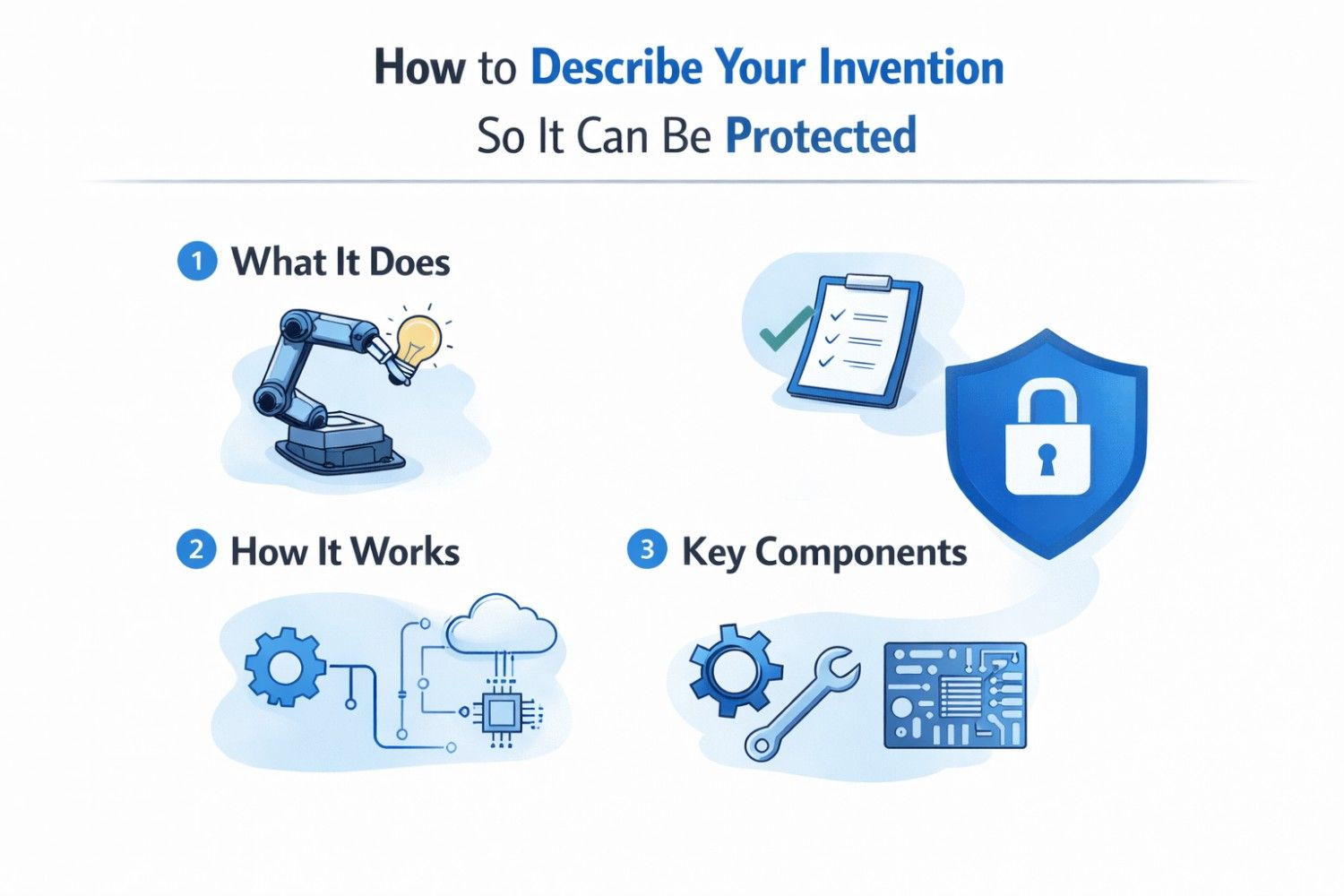
How to Describe Your Invention So It Can Be Protected
A great invention can still fail at the patent stage if it is described the wrong way.
This is where many smart founders slip. They build something powerful. They know it works. They understand every line of code. But when it comes time to explain it, they either oversimplify it or make it too abstract.
A patent is not about hype. It is not about big promises. It is about clarity and depth. You must describe your invention in a way that shows exactly what makes it different and how it actually works under the hood.
This section will show you how to do that in a way that protects your advantage instead of exposing gaps.
Start With What Makes It Different
Before you explain how your system works, you need to make one thing clear: what is new here?
Not what is useful. Not what is exciting. What is different from what already exists?
This requires honesty. Many systems are built using known tools. That is fine. What matters is how you combine them or how you use them in a new way.
Look at your system and identify the step, structure, or flow that others are not using.
Maybe you process data in a different order. Maybe you filter signals before applying a model instead of after. Maybe you use a feedback loop that updates weights in real time instead of on a schedule.
Whatever that core difference is, describe it clearly and early.
Do not hide it inside a long explanation. Bring it to the front.
If you are unsure how to frame that difference, this is where guided tools and real patent attorneys can help shape your thinking.
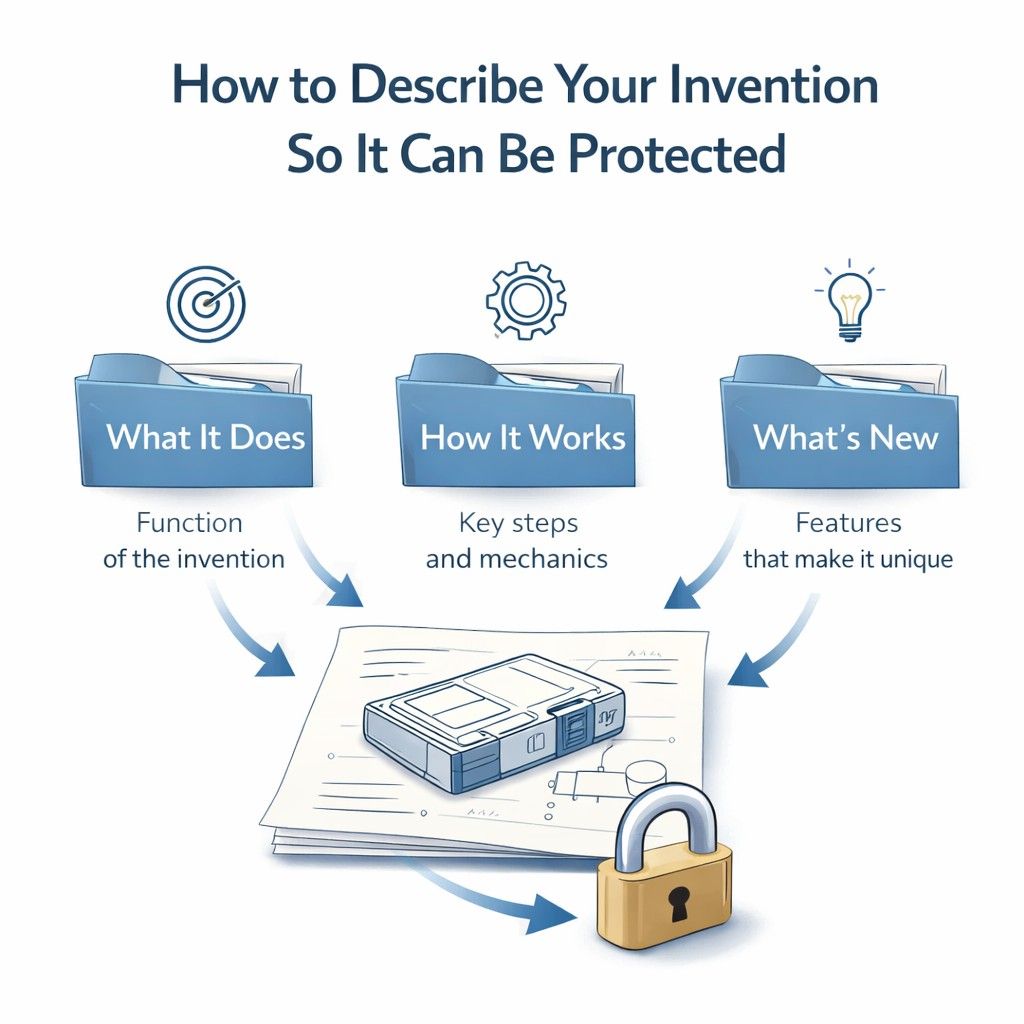
PowerPatent walks you through this process so you do not miss the part that truly matters:
https://powerpatent.com/how-it-works
Describe the System Like You Are Teaching It
Imagine a skilled engineer joins your team tomorrow. They need to rebuild your system from scratch. How would you explain it?
That is how detailed your description needs to be.
Start at the beginning. Where does input come from? What format is it in? How is it received? What happens first?
Then move step by step through the process. Explain each transformation. If there is a model involved, explain how it is trained and how it is used during operation.
If there is a hardware element, explain how it connects to the rest of the system.
Do not assume knowledge.
If your invention involves software, describe the flow of data. If it involves hardware, describe the structure and interaction of parts. If it involves both, make the relationship clear.
This level of clarity does two things. It makes your patent stronger. It also forces you to deeply understand your own system.
Avoid Vague Words That Weaken Protection
Words like optimize, enhance, improve, or intelligent sound impressive. They are weak in a patent disclosure.
Instead of saying your system “improves performance,” explain how it improves performance. Does it reduce computation time by batching requests?
Does it remove redundant steps? Does it compress data before transmission?
Replace general words with specific actions.
When you find a sentence that sounds like marketing, rewrite it as engineering.
This is not about being technical for the sake of it. It is about being precise.
Precision builds defensibility.
Explain the Structure, Not Just the Outcome
Many founders focus too much on results. They describe what the system achieves but not how it is built.
A patent protects structure and method.
If your invention is a method, describe the sequence of steps. If it is a system, describe the components and how they connect. If it is a process running on a server, describe the modules, memory, processors, and how data flows between them.
Even if you are building in the cloud, describe the logical architecture. Are there separate services? Is there a message queue? Is there a controller that triggers tasks?

The more concrete your explanation, the harder it is for someone to copy you without stepping into your protected space.
Show That It Can Work in Different Settings
A common mistake is describing your invention as tied to one product or use case.
For example, if you built a new scheduling algorithm for food delivery, do not only describe it in the context of food delivery. Explain how the same method could apply to ride sharing, logistics, or warehouse management.
This shows that the invention is broader than one app.
You are not changing what you built. You are revealing its full scope.
When you describe different environments where the system could operate, you expand the protective reach of your patent.
This is one of the biggest strategic moves you can make.
PowerPatent helps founders think through these broader applications before filing, so your patent is not boxed into a narrow corner:
https://powerpatent.com/how-it-works
Include Technical Variations on Purpose
Protection becomes stronger when your disclosure shows flexibility.
After describing your main version, explain that certain parts could be replaced with alternatives. If you use a neural network, mention that other models could be used.
If you use a specific database, explain that other storage systems could work as well.
This does not weaken your invention. It strengthens it.
It shows that your idea is not tied to one narrow implementation.
Be thoughtful here. Do not throw in random options. Only include variations that make sense and that you understand.
The goal is to show that the core concept can live in different technical forms.
Use Concrete Examples to Make It Real
Abstract explanations can feel unclear. Add example scenarios.
If your system processes user data, walk through a sample data input. Show what happens to it at each step. Describe how the output is generated.
This makes your disclosure more complete.
It also helps a patent attorney translate your description into formal claims later without guessing what you meant.
Real examples reveal hidden details. Sometimes when you walk through an example, you discover steps you forgot to describe earlier.
Do Not Hold Back Critical Details
Some founders fear that writing too much detail exposes them.
In reality, weak detail exposes you more.
If your patent lacks depth, a competitor can design around it. They can make small changes and avoid infringement.
A strong disclosure gives you room. It gives your attorney material to draft broader protection.
Remember, your patent application will not publish immediately. You are not giving away secrets for free. You are securing a position.
If you are working with a modern system that combines smart drafting tools with real attorney oversight, you can feel confident that what you include strengthens you rather than putting you at risk.
That is the model PowerPatent was built around: software speed with human expertise reviewing and guiding every step:
https://powerpatent.com/how-it-works
Tie Everything Back to the Core Concept
As you describe details, always connect them back to the main idea you identified earlier.
Every module, every step, every variation should support that central concept.
This keeps your disclosure focused.
It also makes it easier for others to understand why your invention matters.
When your explanation is clear, complete, and aligned with your business strategy, you move from “we built something cool” to “we own something defensible.”
That shift changes conversations with investors. It changes negotiations with partners. It changes how competitors see you.
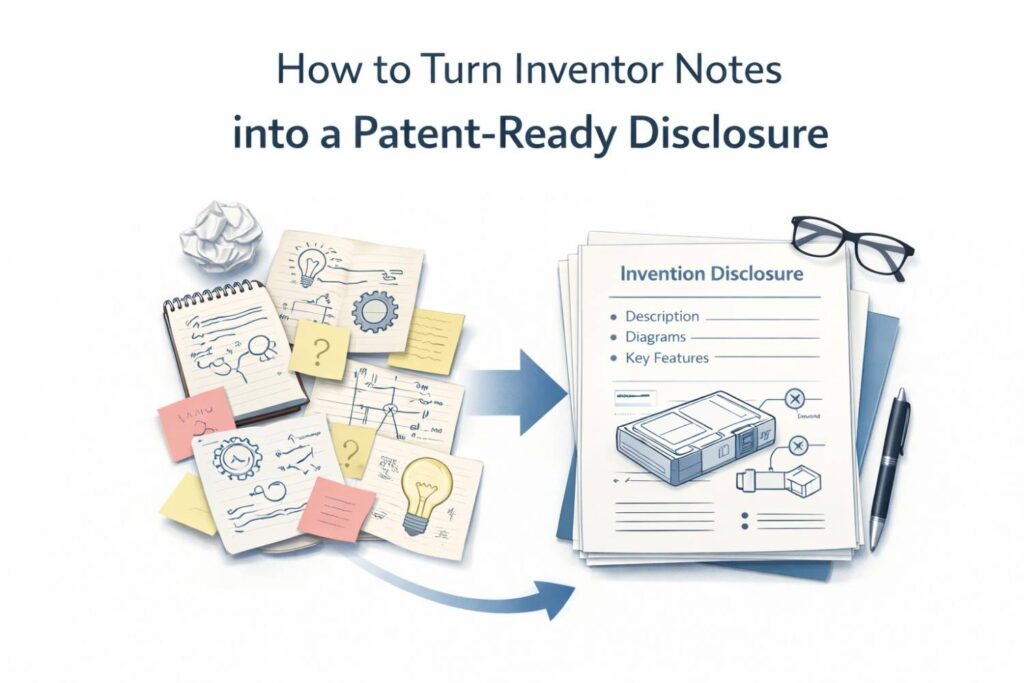
Describing your invention the right way is not paperwork. It is strategy.
Turning Technical Details into a Strong Patent Disclosure
You already know the tech. You built it. You debugged it at 2 a.m. You rewrote parts of it three times until it worked.
But raw technical knowledge is not the same as a strong patent disclosure.
A patent disclosure is not a code dump. It is not a research paper. It is not internal documentation. It is a structured explanation of your invention that gives you leverage.
This is where many startups either overcomplicate things or leave out what matters most. The goal is not to sound impressive. The goal is to build a foundation that allows broad, defensible protection.
Let’s walk through how to turn your deep technical work into something that actually protects your company.
Move From Code to Concept
Your repository shows what you implemented. A patent needs to show the idea behind it.
Code is one way to express an idea. A patent needs to describe the logic at a higher level so that it is not locked into one programming language or one stack.
Instead of pasting functions, explain what those functions are doing.
If you wrote a function that ranks items based on user behavior and contextual signals, describe the ranking process. Explain what inputs are considered. Explain how those inputs are weighted. Explain how the final score is calculated.
Do not get stuck in syntax. Focus on logic.
This shift allows your protection to extend beyond your current version. If you later rewrite the system in a new language, your patent still covers the underlying method.
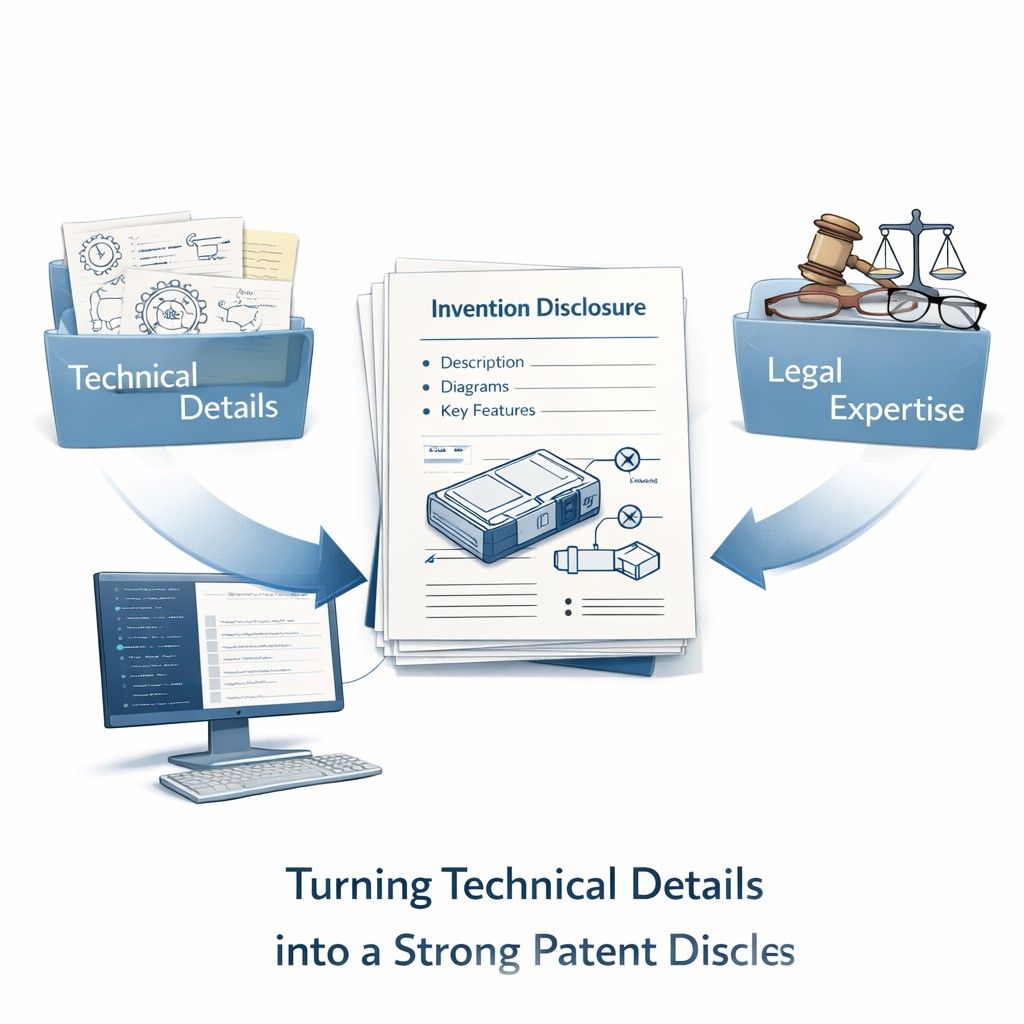
If you want a guided way to extract these core ideas from your technical work without losing strength, you can see how PowerPatent helps engineers turn real systems into structured disclosures reviewed by real patent attorneys:
https://powerpatent.com/how-it-works
Define Each Building Block Clearly
Strong disclosures break systems into clear components.
If your invention includes a data ingestion module, a processing engine, and an output interface, describe each one separately before explaining how they work together.
For each component, answer simple questions.
What is its role?
What inputs does it receive?
What outputs does it produce?
How does it interact with other parts?
When you define building blocks clearly, you create room for strong claims later. You are giving structure to your invention.
Avoid blending everything into one long paragraph. Clarity at the component level makes your entire disclosure more powerful.
Describe Data Flow With Precision
In software and AI inventions, data flow is often the heart of the innovation.
Do not just say data is processed. Describe how it moves.
Does it enter through an API? Is it stored temporarily in memory? Is it normalized before analysis? Is it split into segments? Is it encrypted? Is it cached?
Walk through the journey of a single data unit from entry to final output.
This does two things. It shows technical depth. It makes it harder for competitors to copy your flow without touching your protected method.
Even small ordering differences can matter in patents. The sequence of operations can define novelty.
When founders use PowerPatent, the platform prompts them to explain flows like this in a structured way, which prevents gaps that often weaken filings:
https://powerpatent.com/how-it-works
Explain the Decision Logic
If your invention makes decisions, you must explain how.
Do not say the system determines whether a condition is met. Explain the rule, model, or threshold that drives that decision.
If it is rule-based, describe the rules. If it is model-based, describe the training process and the inference process. If it uses scoring, explain how scores are calculated and compared.
Even if your system uses machine learning, avoid hiding behind that phrase.
Saying “a machine learning model predicts X” is not enough. You need to explain what type of inputs are used, what kind of output is produced, and how that output affects system behavior.
You do not need to reveal proprietary data. But you must show enough structure so that your method is clear and complete.
Capture the Technical Improvements Explicitly
Your invention likely improves something. Speed. Accuracy. Efficiency. Security.
Do not assume that improvement is obvious.
Explain what existed before. Then explain how your structure changes the outcome.
If your system reduces server load, describe the mechanism that reduces it. If it increases accuracy, describe how your training or filtering process leads to that increase.
Quantify where possible. Even approximate ranges help.
This is not about marketing claims. It is about technical cause and effect.

When you show a clear link between structure and improvement, your disclosure becomes much stronger.
Think Beyond the Current Version
Your startup will evolve. Your tech stack will change. New features will be added.
Your patent disclosure should not freeze you in time.
After describing your current implementation, step back and ask yourself how the same concept could be implemented differently.
Could processing occur client-side instead of server-side? Could certain modules be combined? Could they be distributed across multiple machines?
Describe these alternative configurations.
You are not guessing randomly. You are protecting the core concept across reasonable implementations.
This future-focused thinking is often missing in rushed filings. It is one reason working with a system that combines smart drafting tools with experienced attorney review can prevent regret later:
https://powerpatent.com/how-it-works
Turn Edge Cases Into Strength
During development, you likely handled edge cases. Error conditions. Unexpected inputs. Scaling limits.
These details matter.
If your system includes fallback logic, describe it. If it detects invalid data and routes it differently, explain that path. If it scales dynamically under load, describe how scaling decisions are made.
Edge cases show maturity. They show that your invention is not a fragile prototype.
They also expand the depth of your disclosure, giving more material for broader protection.
Align Technical Depth With Business Risk
Not every technical detail deserves equal focus.
Think about where your business is most exposed.
If your competitive edge comes from a specific optimization in your processing engine, that area should receive deep explanation. If another part of your system is standard and replaceable, it may not require the same level of detail.
This does not mean ignoring parts. It means emphasizing what matters most.
Strategic patenting is not about volume. It is about protecting the pieces that truly drive value.
A thoughtful disclosure reflects that strategy.
Write for the Future Reader
Your patent disclosure will be read by a patent examiner. It may later be read by a judge. It may be read by a competitor’s lawyer.
Write with that in mind.
Avoid internal slang. Avoid assumptions. Avoid skipping steps.
Imagine someone intelligent but unfamiliar with your company reading it years from now. Would they understand how your invention works?
Clarity today protects you tomorrow.
When you transform technical details into a structured, complete, and forward-looking disclosure, you turn engineering effort into real assets.
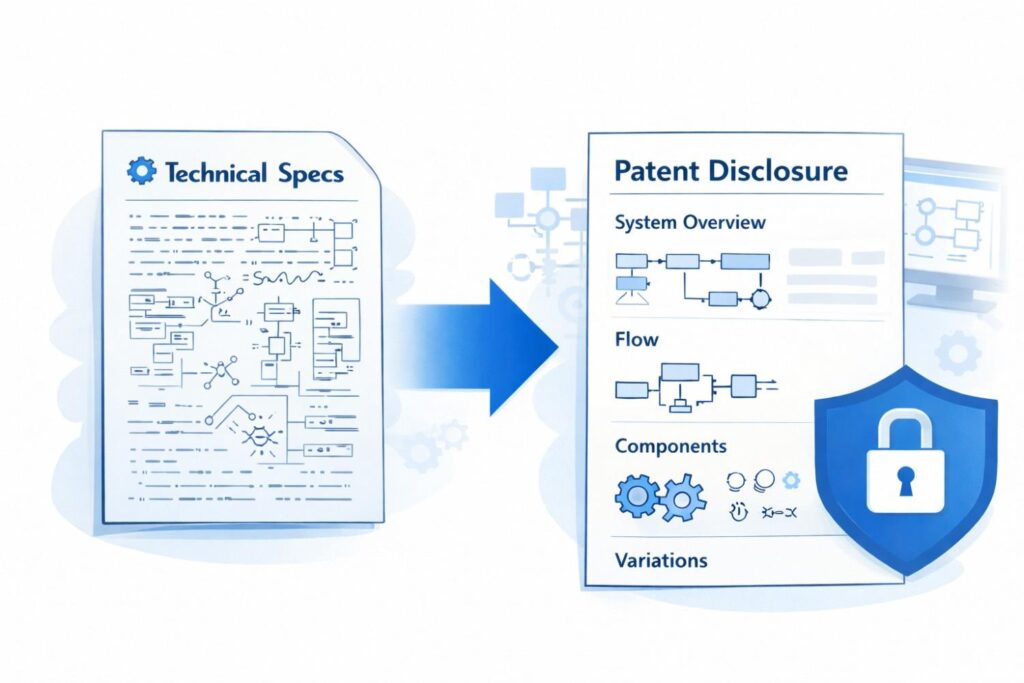
That is how you build durable advantage.
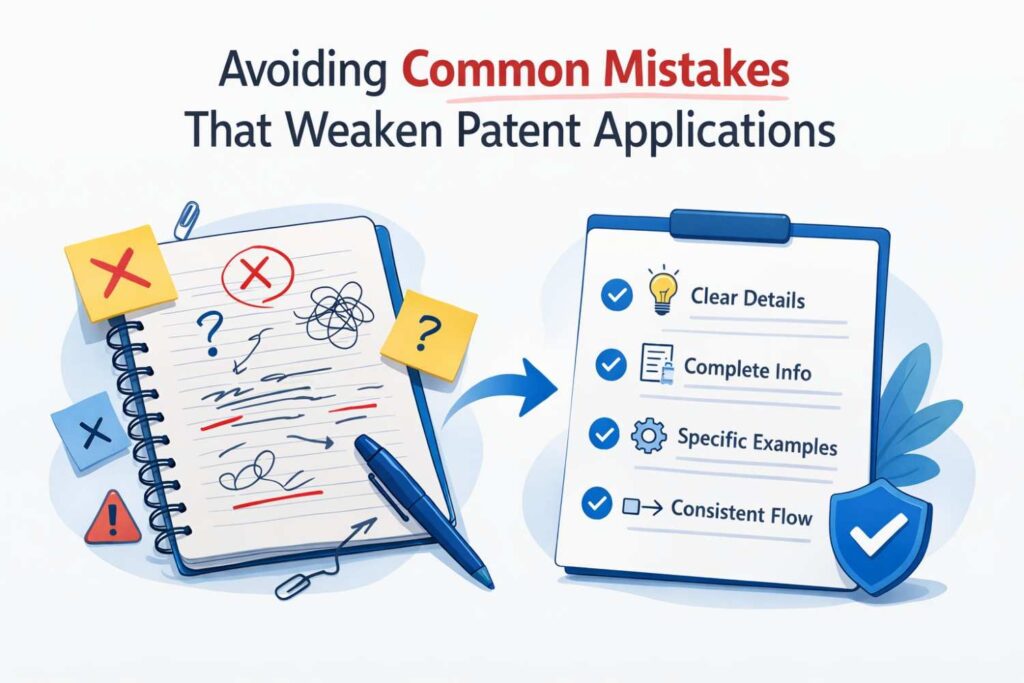
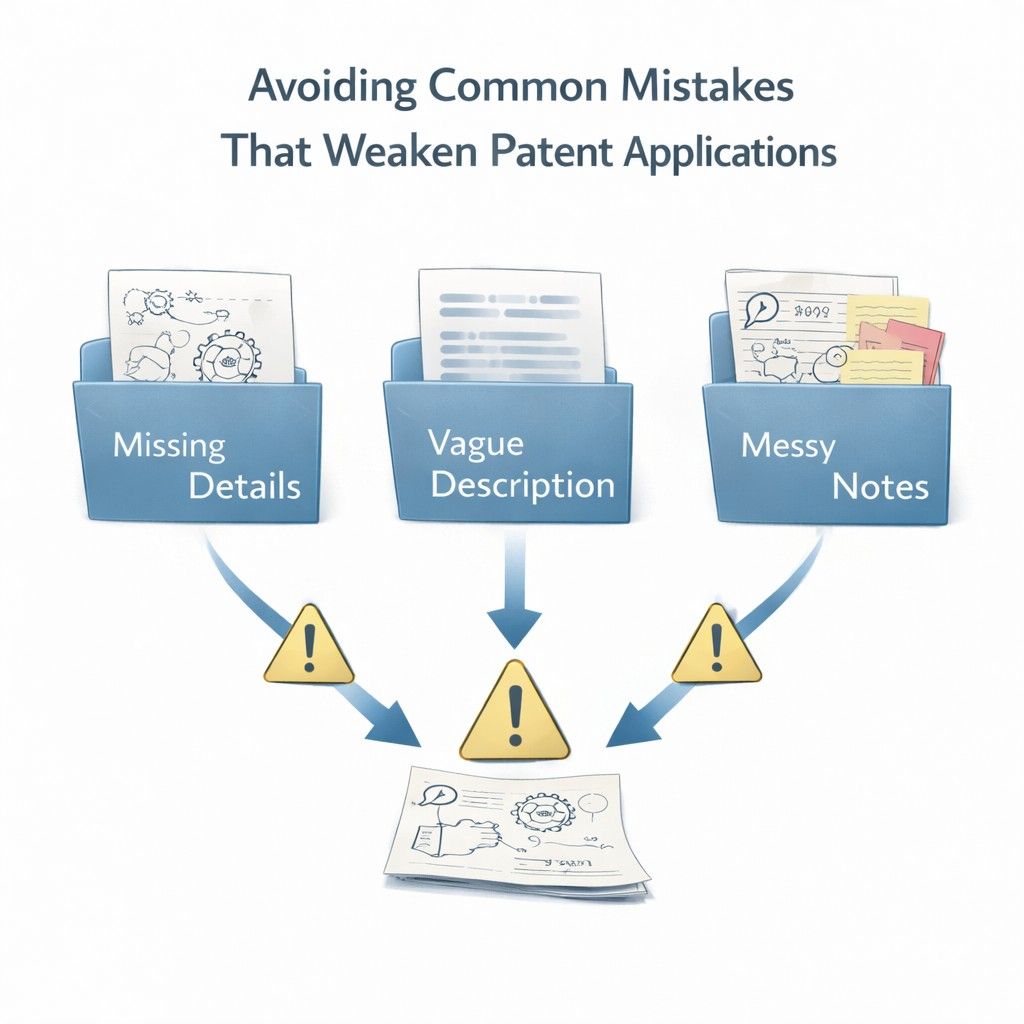
Avoiding Common Mistakes That Weaken Patent Applications
Most weak patents do not fail because the invention was bad.
They fail because the disclosure was thin, rushed, or poorly framed.
This is painful for founders. You spend months or years building something real. Then a small mistake in how it is described limits your protection. Later, when growth picks up or competitors appear, you realize your coverage is narrow.
The good news is this is avoidable.
If you understand the common traps ahead of time, you can sidestep them and turn your patent into a true business asset instead of a paper trophy.
Filing Too Late
One of the biggest mistakes is waiting.
Founders often say they will “file after the next release” or “once revenue is stable.” But in fast-moving markets, waiting can quietly destroy rights.
Public demos, investor pitches, product launches, and even detailed blog posts can count as disclosures. In many places, once something is publicly disclosed, your clock starts ticking. In some countries, your rights can vanish immediately.
The solution is not panic filing. The solution is building a habit of capturing inventions early.
When you finish building a core technical improvement, document it. When you solve a hard system problem in a novel way, capture it. When you create a new architecture that gives you leverage, preserve it.
Using a structured system that lets you draft and refine disclosures quickly makes early protection realistic instead of overwhelming.
That is exactly why PowerPatent was designed to move at startup speed while still involving real patent attorneys before filing:
https://powerpatent.com/how-it-works
Speed matters. Timing matters. Waiting rarely helps.
Describing Only the Final Product
Another common mistake is focusing only on what shipped.
Your live product is just one expression of your invention. The patent should cover the underlying concept, not just the surface version customers see.
If you only describe the current UI flow or one specific deployment setup, you shrink your protection.
Instead, describe the engine beneath the product. Describe the method that drives the result. Describe the system architecture that makes the feature possible.
The product will evolve. The invention is deeper.
Strong patents protect the core mechanism, not the button placement.
Being Too Narrow on Purpose
Some founders believe that being very specific makes their patent stronger. They describe exact thresholds, exact parameter values, exact hardware models.
Specific examples are helpful. But if you lock everything into fixed numbers and narrow details without explaining alternatives, you trap yourself.
A competitor can adjust a number slightly and avoid your claims.
The smarter approach is to describe ranges, options, and variations where appropriate. Show that your invention works across multiple implementations.
You are not trying to write a lab report. You are building strategic coverage.
This balance between detail and flexibility is where experienced review makes a big difference.
Platforms that combine smart drafting tools with real attorney oversight help ensure you do not accidentally shrink your own protection:
https://powerpatent.com/how-it-works
Leaving Out Critical Technical Detail
On the other side, some founders stay too high level.
They say the system analyzes data but do not explain how. They mention a model but do not describe training or inference flow. They reference optimization but never define the mechanism.
This creates risk.
If your disclosure does not fully enable someone skilled in the field to understand how to implement your invention, it can be challenged later.
You do not need to reveal trade secrets like raw datasets. But you must describe structure and logic clearly.
A good rule is this. If an experienced engineer could not reasonably rebuild the invention from your description, you likely need more detail.
Depth protects you.
Treating Patents as a One-Time Task
Many startups treat patent filing like checking a box.
They file once and move on.
But your technology changes. Your architecture improves. You add features that introduce new technical methods.
If you are not reviewing your system regularly for new patentable improvements, you leave value on the table.
Strong IP strategy is ongoing. It evolves with your roadmap.
Build a rhythm. Every major technical milestone should trigger a simple question: did we just create something new and defensible?
If the answer might be yes, document it.
Modern tools make this easier by giving you a repeatable way to capture inventions without starting from scratch each time.

PowerPatent was built with this long-term view in mind, so founders can build a growing portfolio without drowning in process:
https://powerpatent.com/how-it-works
Ignoring Business Alignment
A patent should support your business strategy.
Yet many founders file on side features that are interesting but not core to their advantage.
Before finalizing a disclosure, step back and ask where your future value lies. What part of your system would hurt most if copied? What technical edge helps you win deals or raise funding?
Focus your strongest protection there.
This does not mean ignoring smaller ideas. It means prioritizing.
A focused portfolio sends a strong signal to investors and competitors. It shows you are protecting the engine of your growth, not random fragments.
Failing to Think Like a Competitor
When drafting a disclosure, imagine a competitor reading it.
Ask yourself how they might try to design around your method. Would small changes avoid your protection? Are there obvious alternative implementations you failed to mention?
If so, expand your description to cover those paths.
This mindset strengthens your position.
It turns your patent from a narrow shield into a wider barrier.
Thinking this way early is much easier than trying to fix weak coverage after a competitor appears.
Underestimating the Review Process
Finally, one of the most damaging mistakes is assuming that any filed patent is a strong patent.
The quality of the initial disclosure shapes everything that follows. If it is rushed or incomplete, later amendments may not fully fix it.
That is why review matters.
Not just software that fills in templates. Not just a quick skim. Real attorney oversight combined with structured, founder-friendly tools.
This combination gives you speed without sacrificing strength.
PowerPatent was created to bring that balance to startups who want control and clarity without old-school delays and cost:
https://powerpatent.com/how-it-works
When you avoid these common mistakes, your patent stops being a formality. It becomes leverage.
It becomes something you can point to in investor meetings with confidence. Something that makes competitors think twice. Something that grows in value as your company grows.
Turning inventor notes into a patent-ready disclosure is not about paperwork. It is about building durable advantage.
Wrapping It Up
Your notes are not random scribbles. They are the early form of an asset. Inside your whiteboard sketches, late-night commits, and messy product docs is something that can protect your company for years. But only if you shape it the right way. Turning inventor notes into a patent-ready disclosure is not about legal tricks. It is about clarity. It is about pulling out the true technical breakthrough. It is about explaining how your system works in a complete and structured way. It is about thinking ahead so competitors cannot easily copy what you built.
Leave a Reply